


Just over two weeks ago, a worldwide movement for police reform and racial equality was sparked by the death of a black man in Minneapolis police custody.
Spurred on by 16 days of protests, police departments and municipalities across the US have moved to apply some reforms being called for by protesters, with Minneapolis and New York leading the charge.
George Floyd died after a white officer pressed his knee into the handcuffed man’s neck for nearly nine minutes, even after he stopped moving and pleading for air.
In response to Mr Floyd’s death, the use of choke holds or neck restraints will no longer be included in police training and has been banned from use in at least 12 cities, including New York, Minneapolis and Washington.
New York’s state’s legislation was dubbed the “Eric Garner Anti-Chokehold Act” and lists the police manoeuvre as “aggravated strangulation”, classified as a felony.
The practice came under condemnation in 2014 when a black man, Eric Garner, died after a white New York City police officer used a choke hold on him during an arrest.
France also announced a ban on choke holds after the US demonstrations ignited protests and brought renewed attention to the 2016 death of black man Adama Traore, 24, in police custody.
The choke hold ban is the first in a series of reforms protesters are demanding.
Politicians around the US are proposing bans on tear gas and rubber bullets, with Seattle, New Orleans and Pennsylvania among the cities calling for a halt to the practices commonly used during protests.
Activists have also pointed to racial inequalities and brutality being upheld by a system that refuses to discipline problem officers.
The officer who had his knee on Mr Floyd’s neck, Derek Chauvin, had 17 complaints against him and was disciplined only once.
New York, which has enacted some of the strongest reforms, on Tuesday repealed a decades-old law that has kept police officers’ disciplinary records secret.
-
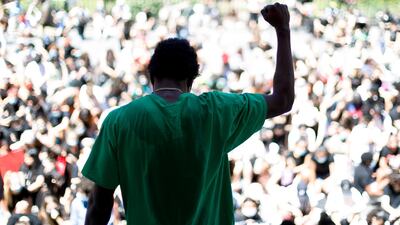
A man holds up his fist on the steps of Brooklyn Borough Hall during a Black Lives Matter protest in Brooklyn, New York. EPA -
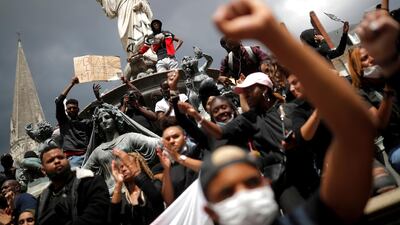
People attend a protest against police brutality and the death in Minneapolis police custody of George Floyd, in Nantes, France. REUTERS -
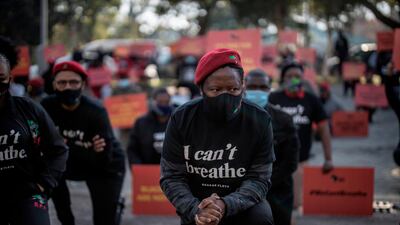
Economic Freedom Fighters (EFF) leader Julius Malema kneels in front of the United States (US) Embassy in Pretoria, South Africa. AFP -
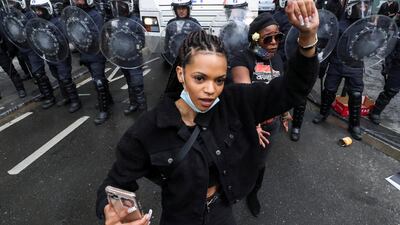
A demonstrator holds up her fist, in front of police officers during a protest, organised by Black Lives Matter Belgium in central Brussels. REUTERS -
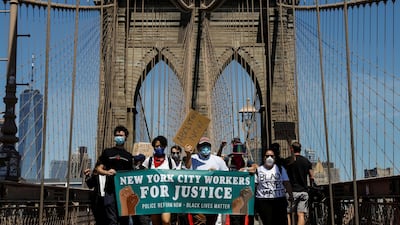
Current and former New York City Mayor's staff march across the Brooklyn Bridge. REUTERS -
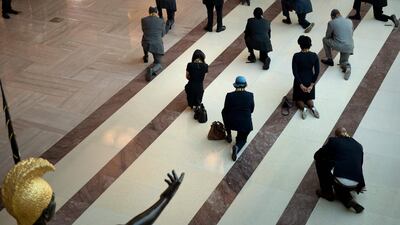
A statue of King Kamehameha I is seen as Democratic lawmakers take a knee to observe a moment of silence on Capitol Hill for George Floyd and other victims of police brutality, in Washington, DC. AFP -
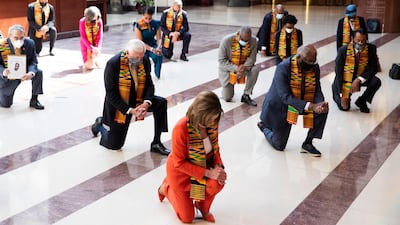
US Speaker of the House Nancy Pelosi and Democratic politicians kneel while observing a moment of silence on Capitol Hill in Washington, DC. EPA -
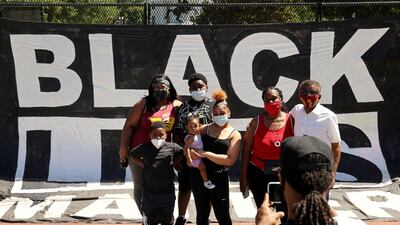
A family stops to take a picture at the fence around Lafayette Square in Washington, DC. REUTERS -
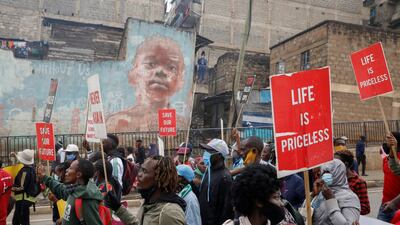
Protesters hold placards during a demonstration against police killings and brutality, in the Mathare slum in Nairobi, Kenya. REUTERS -
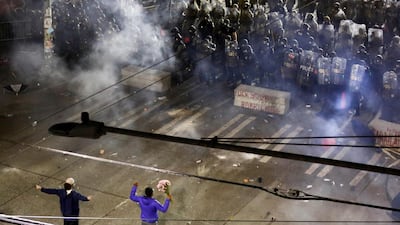
Two protesters hold their ground with their hands up as police deploy chemical agents and blast balls during a protest in Seattle, Washington. REUTERS -
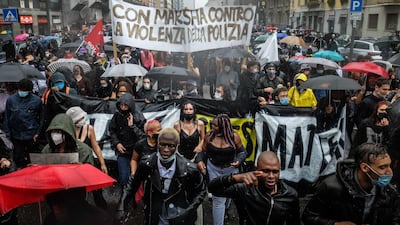
Protesters take part in a demonstration in memory of George Floyd in Piazza Duca d'Aosta, in Milan, Italy. EPA -

Philonise Floyd, brother of George Floyd, whose death in Minneapolis police custody has sparked nationwide protests against racial inequality, is held by Reverend Al Sharpton and attorney Ben Crump in Houston, Texas. REUTERS -
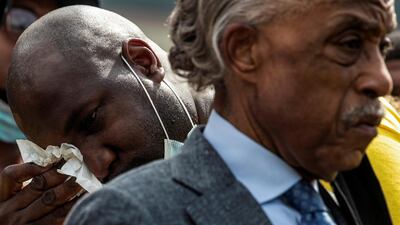
Reverend Al Sharpton is seen in the foreground as Philonise Floyd, brother of George Floyd, wipes tears away after speaking during the public viewing of Floyd at The Fountain of Praise church in Houston. REUTERS -
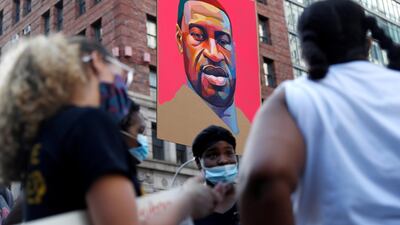
A portrait of George Floyd is seen during a protest against racial inequality in New York City. REUTERS


"The legislation that will be passed over the coming days will help stop bad actors and send a clear message that brutality, racism, and unjustified killings will not be tolerated," New York Senate majority leader Andrea Stewart-Cousins said.
New York police unions have called the legislation an attack on officers.
"The message has been sent very clearly to police officers by our elected officials: 'We don't like you'," said Richard Wells, president of the Police Conference of New York.
"'We don't respect you. We will not support you. We want you to go away'."
In Minneapolis, police chief Medaria Arradondo announced that the department would withdraw from police union contract talks as the first step in what he said would be transformational reforms.
Mr Arradondo’s predecessor, Janee Harteau, and Minneapolis Mayor Jacob Frey are among those who have complained that the union is a block to change.
Mr Frey said this week that the city had difficulty firing and disciplining officers because of the union.
Advisers will now look for ways to restructure the union contract to provide more transparency and flexibility, Mr Arradondo said.
The review will look at critical incident protocols, use of force and disciplinary protocols, including grievances and arbitration, among other things.
Another reform for which activists have called is the introduction of a “duty to intervene” policy, which would require police to intervene when they see a fellow officer using inappropriate force.
The policy has been adopted by law enforcement agencies in Dallas, Tampa Bay and Charlotte, North Carolina, after the protests.
At the core of the reform measures are police budgets, which are often the largest item in a municipality budget.
Some politicians have begun to echo activists’ call to defund police departments and redistribute the money to community services that can affect policing, such as social workers, mental health services and educational programmes.
Most city council members in Minneapolis said they supported disbanding and rebuilding the department.
In New York City, Mayor Bill de Blasio vowed to cut the $6 billion (Dh22.04bn) budget of the police department, promising to divert funds to social services. He did not say how much would be cut.
In Los Angeles, the city council proposed $150 million in cuts to the police department’s $1.8bn budget.
The changes at municipal and state levels are furthered by legislation proposed by the Democrats in Congress to battle racial bias and excessive use of force.
More reforms can be expected as public pressure mounts.
Philonise Floyd, the brother of George Floyd, on Wednesday appeared in person before a House hearing in Washington to demand politicians address the systemic problems in law enforcement.
Mr Floyd buried his brother the day before.

