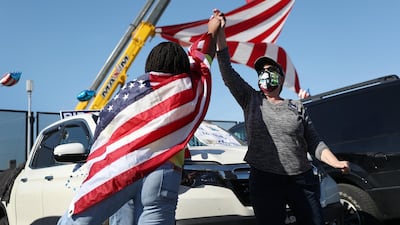
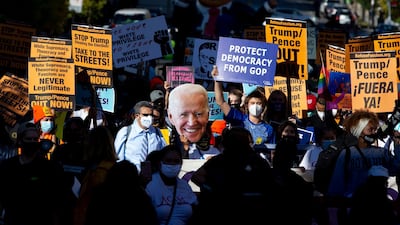
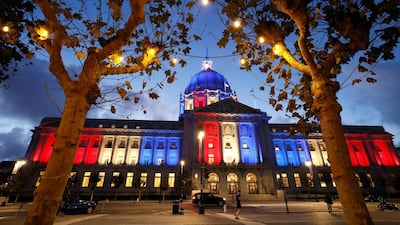
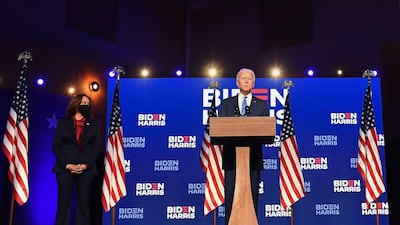
Joe Biden secured enough votes in the US electoral college at 11.25am EST on Saturday to become the 46th president of the United States.
The Democratic nominee crossed the 270-vote threshold by winning the state of Pennsylvania after a long and drawn-out counting process exacerbated by a large number of mail-in ballots.
It was a dramatic turnaround from early on election night, when Republican incumbent Donald Trump looked likely to sweep the race, taking the swing state of Florida. Mr Trump’s campaign is still set on a series of legal challenges over alleged irregularities in the electoral process in several states.
Mr Biden was also leading Mr Trump in Arizona, Georgia and Nevada, where votes are still being counted, but it was Pennsylvania’s 20 electoral votes that pushed him over the 270-vote threshold in the electoral college to win the presidency.
Reacting to his victory, Mr Biden repeated his vow to work for all Americans.
“America, I’m honoured that you have chosen me to lead our great country,” the president-elect wrote on Twitter.
“The work ahead of us will be hard, but I promise you this: I will be a President for all Americans – whether you voted for me or not.”
Mr Trump has refused to accept the election results, continuing to repeat his false claims of voter fraud with mail-in-ballots despite zero evidence of fraudulent ballots.
Shortly before Mr Biden’s win, he again asserted his claim to have won the vote, tweeting: “I won this election, by a lot!”
He first claimed to be headed for victory early on election night, tweeting: “We are up BIG, but they are trying to STEAL the Election,” a missive both Facebook and Twitter hid behind labels telling users it was potentially misleading.
In a later speech, he said he would seek the US Supreme Court to stop the vote count for early ballots in key states where he led the race.
“We want all voting to stop. We don’t want them to find any ballots at four o’clock in the morning and add them to the list,” he said.
Mr Trump had continued to insist that the winner of the election should be announced on November 3 even if all the ballots had not been counted.
On Saturday, his lawyers told a press conference in Philadelphia that “Beginning Monday, our campaign will start prosecuting our case in court to ensure election laws are fully upheld and the rightful winner is seated.”
Mr Trump campaigned by doubling down on the culture war issues that propelled him to the White House in 2016. He touted his hard-line immigration policies and campaigned as the “law and order” candidate, hoping to capitalise on white voters’ resentment and fear of the increased Black Lives Matter protests and sporadic riots that swept the country in late spring following numerous police shootings of black Americans.
By contrast, Mr Biden campaigned by appealing to centrists, independent swing voters and Republicans disaffected with Mr Trump’s presidency. He leaned heavily into his criticism of Mr Trump’s handling of the coronavirus pandemic, which has killed more than 240,000 Americans to date ahead of another expected spike in the cold winter months.
At the same time, the Biden campaign has adopted policy platforms meant to assuage and bolster support among the party’s left flank.
While he made some concessions to his chief primary opponent Bernie Sanders on issues such as climate change and health care, it remains to be seen whether Mr Biden will pursue a more progressive agenda or govern strictly from the centre as he tries to combat the pandemic and jumpstart the flagging economy which has left about 12.6 million Americans unemployed.
But it remains unclear whether Democrats will be able to take control of Congress, threatening more gridlock between a Biden White House and a Republican-held Senate. Democrats maintained control of the House of Representatives but the outcome in the Senate is in limbo until January, and there’s a good possibility that it will remain in Republican hands.
Mr Biden was the vice president under Barack Obama from 2009 to 2017. Prior to that he served as the US senator from Delaware between 1973 and 2009.
His running mate, Kamala Harris, is slated to become the first US female vice president, as well as the first black and South Asian person to hold the office.

500 People from Gaza enter France
115 Special programme for artists
25 Evacuation of injured and sick
WITHIN%20SAND
%3Cp%3EDirector%3A%20Moe%20Alatawi%3C%2Fp%3E%0A%3Cp%3EStarring%3A%20Ra%E2%80%99ed%20Alshammari%2C%20Adwa%20Fahd%2C%20Muhand%20Alsaleh%3C%2Fp%3E%0A%3Cp%3ERating%3A%203%2F5%3C%2Fp%3E%0A
UAE currency: the story behind the money in your pockets
360Vuz PROFILE
Date started: January 2017
Founder: Khaled Zaatarah
Based: Dubai and Los Angeles
Sector: Technology
Size: 21 employees
Funding: $7 million
Investors: Shorooq Partners, KBW Ventures, Vision Ventures, Hala Ventures, 500Startups, Plug and Play, Magnus Olsson, Samih Toukan, Jonathan Labin
Family reunited
Nazanin Zaghari-Ratcliffe was born and raised in Tehran and studied English literature before working as a translator in the relief effort for the Japanese International Co-operation Agency in 2003.
She moved to the International Federation of Red Cross and Red Crescent Societies before moving to the World Health Organisation as a communications officer.
She came to the UK in 2007 after securing a scholarship at London Metropolitan University to study a master's in communication management and met her future husband through mutual friends a month later.
The couple were married in August 2009 in Winchester and their daughter was born in June 2014.
She was held in her native country a year later.
More from Rashmee Roshan Lall
The%20specs
%3Cp%3E%3Cstrong%3EEngine%3A%20%3C%2Fstrong%3E2.3-litre%204cyl%20turbo%0D%3Cbr%3E%3Cstrong%3EPower%3A%20%3C%2Fstrong%3E299hp%20at%205%2C500rpm%0D%3Cbr%3E%3Cstrong%3ETorque%3A%20%3C%2Fstrong%3E420Nm%20at%202%2C750rpm%0D%3Cbr%3E%3Cstrong%3ETransmission%3A%20%3C%2Fstrong%3E10-speed%20auto%0D%3Cbr%3E%3Cstrong%3EFuel%20consumption%3A%20%3C%2Fstrong%3E12.4L%2F100km%0D%3Cbr%3E%3Cstrong%3EOn%20sale%3A%20%3C%2Fstrong%3ENow%0D%3Cbr%3E%3Cstrong%3EPrice%3A%20%3C%2Fstrong%3EFrom%20Dh157%2C395%20(XLS)%3B%20Dh199%2C395%20(Limited)%3C%2Fp%3E%0A
FIGHT CARD
Welterweight Mostafa Radi (PAL) v Tohir Zhuraev (TJK)
Catchweight 75kg Leandro Martins (BRA) v Anas Siraj Mounir (MAR)
Flyweight Corinne Laframboise (CAN) v Manon Fiorot (FRA)
Featherweight Ahmed Al Darmaki (UAE) v Bogdan Kirilenko (UZB)
Lightweight Izzedine Al Derabani (JOR) v Atabek Abdimitalipov (KYG)
Featherweight Yousef Al Housani (UAE) v Mohamed Arsharq Ali (SLA)
Catchweight 69kg Jung Han-gook (KOR) v Elias Boudegzdame (ALG)
Catchweight 71kg Usman Nurmagomedov (RUS) v Jerry Kvarnstrom (FIN)
Featherweight title Lee Do-gyeom (KOR) v Alexandru Chitoran (ROU)
Lightweight title Bruno Machado (BRA) v Mike Santiago (USA)
Ruwais timeline
1971 Abu Dhabi National Oil Company established
1980 Ruwais Housing Complex built, located 10 kilometres away from industrial plants
1982 120,000 bpd capacity Ruwais refinery complex officially inaugurated by the founder of the UAE Sheikh Zayed
1984 Second phase of Ruwais Housing Complex built. Today the 7,000-unit complex houses some 24,000 people.
1985 The refinery is expanded with the commissioning of a 27,000 b/d hydro cracker complex
2009 Plans announced to build $1.2 billion fertilizer plant in Ruwais, producing urea
2010 Adnoc awards $10bn contracts for expansion of Ruwais refinery, to double capacity from 415,000 bpd
2014 Ruwais 261-outlet shopping mall opens
2014 Production starts at newly expanded Ruwais refinery, providing jet fuel and diesel and allowing the UAE to be self-sufficient for petrol supplies
2014 Etihad Rail begins transportation of sulphur from Shah and Habshan to Ruwais for export
2017 Aldar Academies to operate Adnoc’s schools including in Ruwais from September. Eight schools operate in total within the housing complex.
2018 Adnoc announces plans to invest $3.1 billion on upgrading its Ruwais refinery
2018 NMC Healthcare selected to manage operations of Ruwais Hospital
2018 Adnoc announces new downstream strategy at event in Abu Dhabi on May 13
Source: The National
The biog
Hobbies: Writing and running
Favourite sport: beach volleyball
Favourite holiday destinations: Turkey and Puerto Rico
Mercer, the investment consulting arm of US services company Marsh & McLennan, expects its wealth division to at least double its assets under management (AUM) in the Middle East as wealth in the region continues to grow despite economic headwinds, a company official said.
Mercer Wealth, which globally has $160 billion in AUM, plans to boost its AUM in the region to $2-$3bn in the next 2-3 years from the present $1bn, said Yasir AbuShaban, a Dubai-based principal with Mercer Wealth.
“Within the next two to three years, we are looking at reaching $2 to $3 billion as a conservative estimate and we do see an opportunity to do so,” said Mr AbuShaban.
Mercer does not directly make investments, but allocates clients’ money they have discretion to, to professional asset managers. They also provide advice to clients.
“We have buying power. We can negotiate on their (client’s) behalf with asset managers to provide them lower fees than they otherwise would have to get on their own,” he added.
Mercer Wealth’s clients include sovereign wealth funds, family offices, and insurance companies among others.
From its office in Dubai, Mercer also looks after Africa, India and Turkey, where they also see opportunity for growth.
Wealth creation in Middle East and Africa (MEA) grew 8.5 per cent to $8.1 trillion last year from $7.5tn in 2015, higher than last year’s global average of 6 per cent and the second-highest growth in a region after Asia-Pacific which grew 9.9 per cent, according to consultancy Boston Consulting Group (BCG). In the region, where wealth grew just 1.9 per cent in 2015 compared with 2014, a pickup in oil prices has helped in wealth generation.
BCG is forecasting MEA wealth will rise to $12tn by 2021, growing at an annual average of 8 per cent.
Drivers of wealth generation in the region will be split evenly between new wealth creation and growth of performance of existing assets, according to BCG.
Another general trend in the region is clients’ looking for a comprehensive approach to investing, according to Mr AbuShaban.
“Institutional investors or some of the families are seeing a slowdown in the available capital they have to invest and in that sense they are looking at optimizing the way they manage their portfolios and making sure they are not investing haphazardly and different parts of their investment are working together,” said Mr AbuShaban.
Some clients also have a higher appetite for risk, given the low interest-rate environment that does not provide enough yield for some institutional investors. These clients are keen to invest in illiquid assets, such as private equity and infrastructure.
“What we have seen is a desire for higher returns in what has been a low-return environment specifically in various fixed income or bonds,” he said.
“In this environment, we have seen a de facto increase in the risk that clients are taking in things like illiquid investments, private equity investments, infrastructure and private debt, those kind of investments were higher illiquidity results in incrementally higher returns.”
The Abu Dhabi Investment Authority, one of the largest sovereign wealth funds, said in its 2016 report that has gradually increased its exposure in direct private equity and private credit transactions, mainly in Asian markets and especially in China and India. The authority’s private equity department focused on structured equities owing to “their defensive characteristics.”
Benefits of first-time home buyers' scheme
- Priority access to new homes from participating developers
- Discounts on sales price of off-plan units
- Flexible payment plans from developers
- Mortgages with better interest rates, faster approval times and reduced fees
- DLD registration fee can be paid through banks or credit cards at zero interest rates