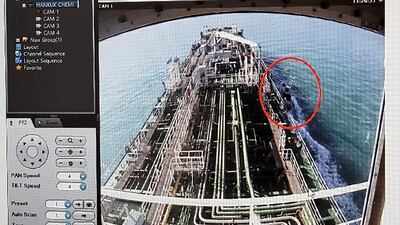
South Korea's foreign ministry is reviewing whether a senior diplomat would be visiting Tehran on Sunday as planned after Iranian forces seized a South Korean-flagged chemical tanker in Gulf waters and detained its crew, an official said.
The incident comes amid tensions between Tehran and Seoul over Iranian funds frozen in South Korean banks because of US sanctions. Iranian state TV quoted a Tehran government official as saying Vice Foreign Minister Choi Jong-kun had been due to discuss Iran's demand that $7 billion in frozen funds be released.
In Seoul, a foreign ministry official told Reuters "the plan is unclear as of now" regarding Choi's visit.
Iranian media said on Monday that the Islamic Revolutionary Guard Corps had seized the tanker Hankuk Chemi over pollution violations. The vessel was carrying 7,200 tonnes of ethanol.
-
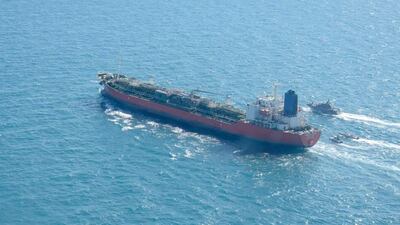
Iranian attack boats guide the Hankuk Chemi toward the Iranian port of Bandar Abbas on January 4, 2021, in aerial images published by Iranian authorities. AFP / Tasnim News -
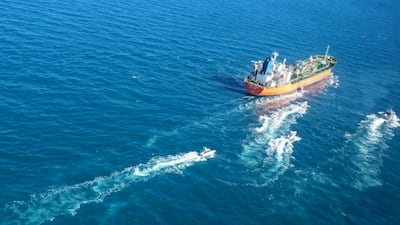
Iranian state television claim the South Korean-flagged vessel was responsible for 'environmental pollution' - but the seizure was widely seen as the latest harassment of a merchant vessel by Tehran's government. AFP / Tasnim News -

A US Marine watches an Iranian fast attack craft from the deck of the USS John P Murtha in the Strait of Hormuz in July, 2019. The US and its allies routinely patrol the narrow 30km strait as Tehran continues to harass maritime oil and gas tankers. US Navy via Reuters -
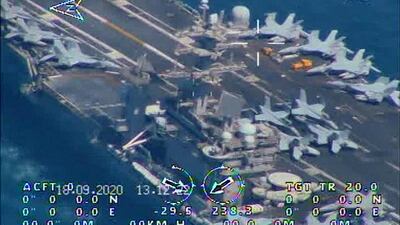
Iran has published a series of mock-up attacks and threats against US forces. This handout photo from Iran's Revolutionary Guard Corps (IRGC) shows it apparently targeting the USS Nimitz in September, 2020. AFP / Iran's Revolutionary Guard -
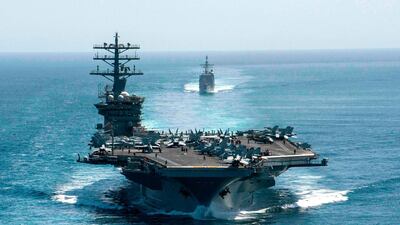
The USS Nimitz and the guided-missile cruiser USS Philippine Sea pass through the Strait of Hormuz on September 18, 2020. The aircraft carrier's deployment was extended on January 3, 2021 in the wake of threats from Iran on the first anniversary of the killing of Iranian military leader Qasem Soleimani. AP -
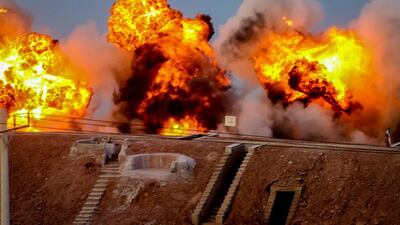
Iranian media shows a series of explosions during Iranian military exercises near the Strait of Hormuz in July, 2020. AFP -
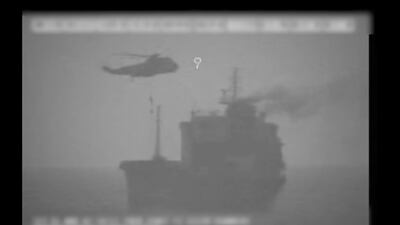
Iranian commandos fast-rope down from a helicopter onto the MV Wila in the Gulf of Oman on August 12, 2020. The Liberian-flagged oil tanker was held for five hours before being released in an operation designed to harass maritime vessels. US Military Central Command via AP -

The Royal Navy's HMS Montrose escorts two vessels through the Strait of Hormuz in July, 2019. AFP -
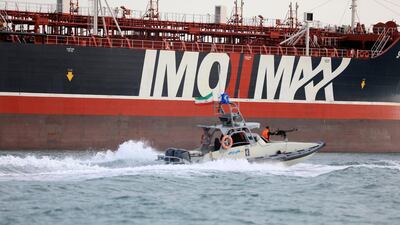
The Stena Impero tanker was seized by Iran in July 2019 and held for two months in the Iranian port of Bandar Abbas, before being released. AP -
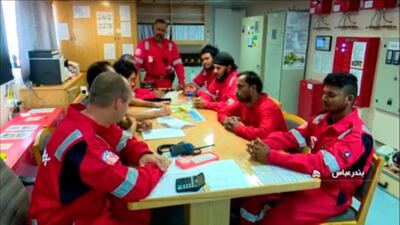
Iranian state media shows the crew of the Stena Impero while held captive in July, 2019. It was released in September, 2019. AFP -
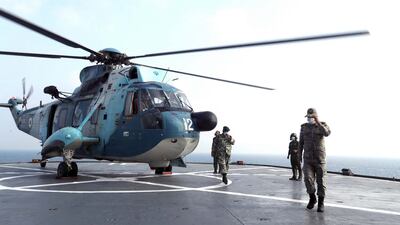
A handout photo made available by Iranian Army website shows an Iranian helicopter lands on a warship during a military exercise in the Arabian Gulf in September, 2020. EPA -
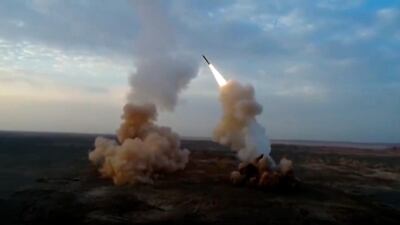
Underground ballistic missiles fired by the Iranian Revolutionary Guard during a military exercise involving a mock-up aircraft carrier in the Strait of Hormuz. AP


South Korea's foreign minister Kang Kyung-wha said on Tuesday diplomatic efforts were being made to secure the release of the tanker, Yonhap news agency reported.
Ms Kang told reporters that she had first responded to her counterparts in Iran on Monday and the ministry is now in talks with diplomats in Tehran and in Seoul to resolve the issue.
"We have been trying to figure out what happened through the Iranian Embassy in South Korea and the South Korean Embassy in Iran and continuing to make efforts to address this situation," Ms Kang told South Korean press agency Yongkip.
Iranian state television quoted Saeed Khatibzadeh, a Foreign Ministry spokesman, as saying the ship had been seized for "polluting the sea".
Last Sunday, the Tehran Times newspaper reported Iran was hoping to negotiate an agreement to use the frozen funds to "barter" for coronavirus vaccine doses and other commodities.
The South Korean foreign ministry did not immediately comment on the report.
Asked about Iran's intentions for the frozen assets, Ms Kang said the safety of the ship's crew was more important, Yonhap said.
Relations hit new low
In the past decade, South Korea has largely complied with US sanctions on Iran, easing them during the so-called "nuclear deal" between 2016 and 2018, when trade restrictions were relaxed in exchange for UN inspections of Iran's nuclear sites. During that period, South Korean imports of Iranian oil rose.
But as President Donald Trump's administration began the "maximum pressure" campaign to reinstate highly restrictive sanctions on Tehran, South Korea cut imports of Iranian oil and condensate, a hydrocarbon liquid used in the South Korean refining industry.
The Woori Bank and Industrial Bank of Korea then froze Iranian funds in September 2019, when a US waiver for South Korea to continue importing Iranian oil expired.
Iranian Foreign Ministry spokesman Seyed Abbas Mousavi had previously said that Iran would take legal action to release the funds, calling South Korea a "servant" of the US.
The US State Department responded to Iran's actions, condemning them as "a clear attempt to extort the international community into relieving the pressure of sanctions”.
The seizure of the boat on Monday by naval forces of the Islamic Revolutionary Guard Corps will therefore be seen by many as an extremely self-defeating move, undermining Mr Mousavi's legal claim.
Koh Kyung-sok, who heads the South Korean Foreign Ministry's division for African and Middle Eastern affairs, said Mr Mousavi's comments were "inappropriate".
In remarks to the Yonhap news agency, South Korean Foreign Ministry spokesperson Kim In-chul said that the ministry had "expressed regret" over Iran's remarks on the crisis.

