More than a million Americans received the first dose of their Covid-19 vaccines, a milestone in the biggest immunisation drive in US history that came even as officials admitted the pace of implementation was slipping behind schedule.
The news comes as cases surge across the country with the death toll going past 320,000, making Covid-19 the third leading cause of deaths this year.
Robert Redfield, director of the Centres for Disease Control and Prevention, said jurisdictions logged the first million shots with his agency since the drive started on December 14.
"While we celebrate this historic milestone, we also acknowledge the challenging path ahead," Mr Redfield said.
"There is currently a limited supply of Covid-19 vaccine in the US, but supply will increase in the weeks and months to come."
About three million doses of the Pfizer-BioNTech vaccine were shipped last week, and the official goal for this week was two million more Pfizer doses, and six million from Moderna.
Moncef Slaoui, chief adviser of the government's Operation Warp Speed, said the objective of injecting 20 million people this month was "unlikely to be met" and a delay was beginning to emerge between doses being distributed to sites and the vaccines reaching arms.
Even so, he was confident of being able to inoculate 100 million people in the first quarter of 2021, and another 100 million by the second quarter.
While the goals are ambitious, the Warp Speed programme has already delivered on its objective of bringing vaccines from the laboratory bench to authorisation within the space of the year.
Many experts doubted this feat was possible.
It required running the various stages of testing in parallel and mass producing doses even before they were proved safe and effective, in case they succeeded. If the Covid-19 vaccinations proceed smoothly, it might be possible to achieve widespread population immunity in the United States by next summer, top infectious disease official Anthony Fauci said.
Dr Fauci suggested people could host weddings as early as June or July.
He said he believed priority populations – such as nursing-home residents, healthcare workers, critical workers, the elderly and people at high risk – should receive inoculations by March or early April.
"We could start in April doing what I call 'open season' on vaccinations – namely anybody in the general population who wants to get vaccinated will get vaccinated," Dr Fauci told WebMD on Wednesday.
"By the time we get into the middle or end of the summer, I believe we will have, if we do it correctly, we could have 70 per cent to 85 per cent of the population vaccinated," he said.
-
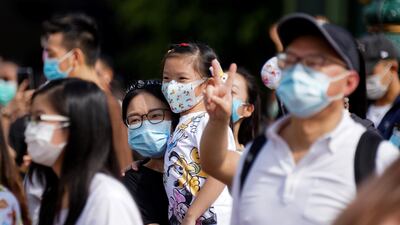
Visitors watch the opening show of the Castle of Magical Dreams at Hong Kong Disneyland Resort, following the coronavirus disease (COVID-19) outbreak in Hong Kong, China. REUTERS -

A health worker takes a sample to test for COVID-19 at a market area in New Delhi, India. India’s total number of coronavirus cases since the pandemic began has crossed 9 million. Nevertheless the country’s new daily cases have seen a steady decline for weeks now and the total number of cases represents 0.6% of India’s 1.3 billion population. AP Photo -
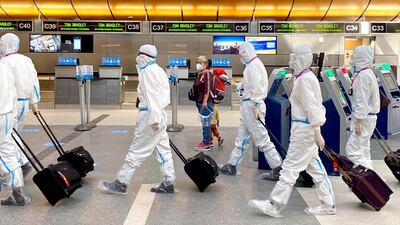
A woman, accompanied by a child, looks over as an airline crew wearing full personal protective equipment against COVID-19 walks through the international terminal at Los Angeles International Airport in Los Angeles. AP Photo -
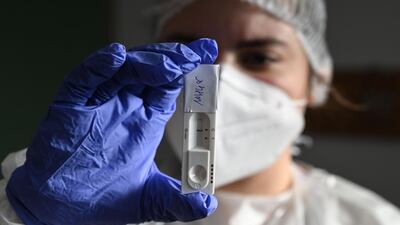
A member of the French Red Cross presents an antigen test at a mobile Covid-19 screening site, in Saint-Gilles, southeastern France. AFP -

U.S. Vice President Mike Pence takes off his protective face mask to speak as he leads a briefing by the White House coronavirus task force about the U.S. spread of coronavirus disease (COVID-19) in the Brady press briefing room at the White House in Washington, U.S. REUTERS -

A nurse’s shoes are seen in the COVID-19 intensive care unit, as the global outbreak of the coronavirus disease (COVID-19) continues, at Providence Saint Joseph Medical Center in Burbank, California, U.S. REUTERS -
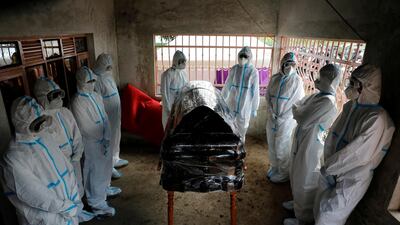
Men dressed in protective suits stand around the coffin of Kenyan doctor Daniel Alushula who died of coronavirus disease (COVID-19), during his funeral in the village of Khumusalaba, in Kakamega county, Kenya. REUTERS -
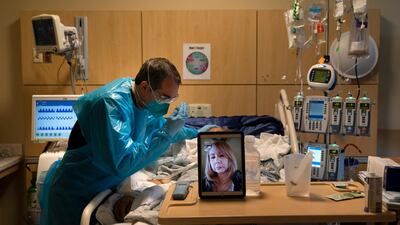
Chaplain Kevin Deegan prays for COVID-19 patient Pedro Basulto while on a video call with the patient's daughter, Grace, at Providence Holy Cross Medical Center in the Mission Hills section of Los Angeles. "These video calls have been a lifeline for families," said Deegan. "It can be emotionally exhausting and very draining, but it also an honor to be a bridge for the family." AP Photo -
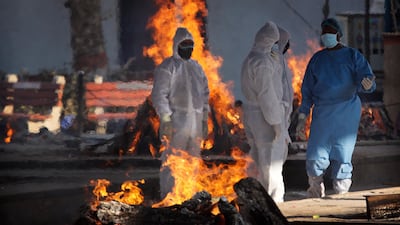
Health workers and relatives stand by the funeral pyre of a COVID-19 victim in New Delhi, India. India’s total number of coronavirus cases since the pandemic began has crossed 9 million. Nevertheless, the country’s new daily cases have seen a steady decline for weeks now and the total number of cases represents 0.6% of India’s 1.3 billion population. AP Photo -
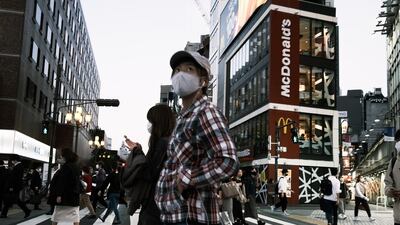
Pedestrians wearing protective masks cross a road in the Shinjuku district of Tokyo, Japan. Tokyo raised its Covid-19 alert to the highest of four levels, as daily infections in the Japanese capital increased by more than 500 for the first time amid a resurgence of the pathogen across the country. Bloomberg -
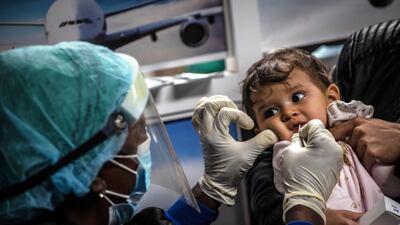
A health worker collects a sample for a COVID-19 test from a baby who arrived on a flight from Mexico at the Jose Marti International Airport in Havana, Cuba. The airport received its first commercial flights in over 8 months since the country locked down to curb the spread of the coronavirus pandemic. AP Photo


"When that occurs, there will be an umbrella of protection over the entire country."
Meanwhile, the Trump administration on Tuesday announced it had bought an additional 100 million doses of the Pfizer-BioNTech vaccine, with inoculations scheduled to be delivered by July.
That brings the current US supply of Covid-19 vaccine to 400 million doses – half from Pfizer and half from Moderna – allowing the country to immunise 200 million people under the two-shot regimens.
The agreement includes options for an additional 400 million doses of the Pfizer vaccine.
The US and other countries are also hoping for more vaccines to be approved, with products from Johnson & Johnson and AstraZeneca potentially next in line.

On Sunday, an expert committee said people 75 and older should be the next vaccinated along with 30 million "frontline essential workers", including teachers, grocery store employees and police.
But the southern state of Florida, home to a high number of pensioners, decided on another way, announcing on Wednesday that people over the age of 65 would be done before essential workers.
"Many of them are very young," Governor Ron DeSantis said of the workers.
"We're going where the risk is greatest and where we think the impact will be most consequential," he said of the over-65s, who make up 20 per cent of the state's population.
They can start getting inoculations on Monday.

