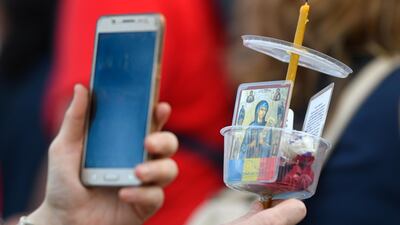
The coronavirus may remain infectious for weeks on banknotes, glass and other common surfaces, research from Australia’s top biosecurity laboratory shows.
Scientists at the Australian Centre for Disease Preparedness said the virus was “extremely robust", surviving for 28 days on smooth surfaces such as mobile phone screens and plastic banknotes, at room temperature, or 20°C.
That compares with 17 days' survival for the influenza virus.
Virus survival declined to less than a day at 40°C on some surfaces, says the study, which will be published on Monday in Virology Journal.
The findings add to mounting evidence that the virus survives for longer in cooler weather, making it harder to control in winter.
The research also helps to more accurately predict and limit the pandemic’s spread, the researchers said.
The results reinforce "the need for good practices such as regular hand washing and cleaning surfaces", said Debbie Eagles, the centre's deputy director.
The coronavirus tended to survive longer on non-porous or smooth surfaces, compared with porous complex surfaces such as cotton.
The research received funding from Australia’s Defence Department.
It involved drying the coronavirus in an artificial mucus on different surfaces, at concentrations similar to those in samples from infected patients, and then re-isolating the virus over a month.
The study was also carried out in the dark to remove the effect of ultraviolet light, which research suggests can quickly inactivate the virus.
-
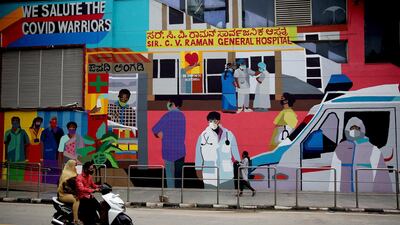
People walk past a mural depicting the coronavirus pandemic in Bangaluru, India, that was created by the Aravani art project to create awareness about the health crisis. EPA -

A vegetable seller wearing a face mask around her neck sits in front of a hoarding informing people about proper use of masks in Bengaluru, India. AP Photo -
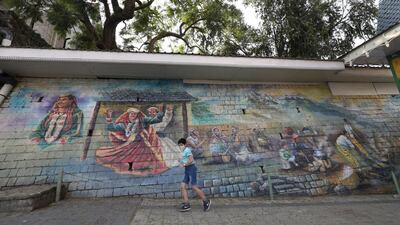
A boy wearing a face mask walks near Kangra museum in Dharamsala, India. EPA -

Palestinian students take part in the morning assembly at Beach refugee camp in Gaza City after schools partially reopened amid the coronavirus disease outbreak. Reuters -

Iraqi children play in Baghdad's Zawraa Park after the government lifted coronavirus restrictions. AFP -

People sit on a ride at the amusement park in Baghdad's Zawraa Park. AFP -

Entertainment workers protest in Milan against the Italian government's economic policies to combat the spread of Covid-19. AP -
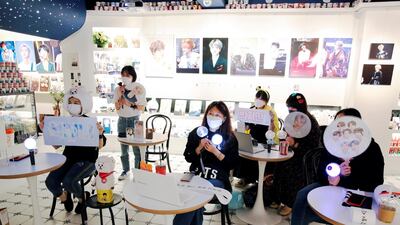
Fans of BTS watch a concert by the K-pop boy band that was only live-streamed online because of the pandemic, at a cafe in Seoul, South Korea. Reuters -
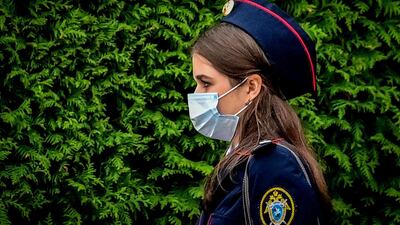
A Russian police cadet wears a face mask while walking through central Moscow. AFP -

A shop in Shanghai, China displays the QR code of the WeChat Pay service as digital payments become more popular because of the pandemic. Reuters -

A security officer awaits the arrival of crowds at Bankwest Stadium in Parramatta, Sydney, Australia. Getty Images -
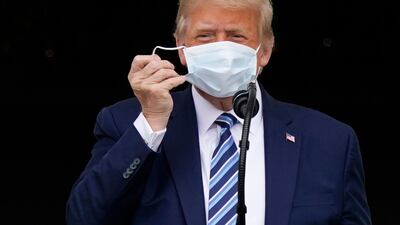
President Donald Trump removes his face mask to speak from the Blue Room Balcony of the White House to a crowd of supporters in Washington. AP Photo -
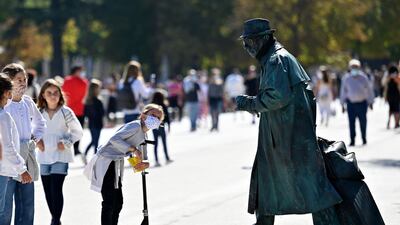
Girls wearing face masks look at a living statue at the Retiro Park in Madrid. AFP -
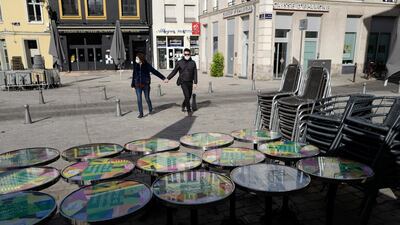
A couple pass a closed cafe in Lille, northern France, where festive gatherings will be banned and all bars required to close after the numbers of coronavirus infections rapidly increased. AP Photo -
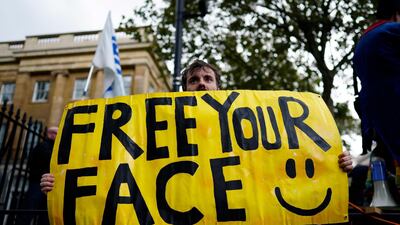
People protest outside the prime minister's residence in Downing Street, London, against coronavirus rules and lockdowns in Britain. EPA -

A health worker at an intensive care unit for people infected with Covid-19 in Mar del Plata, Argentina. AP Photo


“While the precise role of surface transmission, the degree of surface contact and the amount of virus required for infection is yet to be determined, establishing how long this virus remains viable on surfaces is critical for developing risk-mitigation strategies in high contact areas,” Ms Eagles said.
The resilience on glass is an important finding, given that touchscreen devices such as phones, bank ATMs, supermarket self-serve checkouts and airport check-ins are high-touch surfaces that may not be regularly cleaned, the researchers said.
They found the longer survival time on on plastic banknotes “of particular significance, considering the frequency of circulation and the potential for transfer of viable virus between individuals and geographic locations".
Before the pandemic was declared, China had started to decontaminate its paper currency, suggesting concerns over transmission through banknotes existed at the time, the researchers said.
The US and South Korea have also quarantined bank notes because of the pandemic.
The survival of the coronavirus on stainless steel at cooler temperatures may help to explain the many outbreaks linked to meat processing and cold storage facilities, the authors said.
Their data supported the findings of a study showing the survival of the coronavirus on fresh and frozen food.
The pandemic has infected more than 37.6 million people and claimed the lives of nearly 1.08 million, according to the latest data from Worldometer.

