
At first, the attack on the afternoon of December 27, 2019, on a joint Iraqi-US base in Kirkuk known as “K-1” may not have seemed unusual – at least not in the context of violence in Iraq, after the defeat of ISIS.
Dozens of similar attacks had been launched since the winter of 2018, at first on the US embassy and later on American bases.
Many of the rocket attacks were linked to the Iran-backed Iraqi militia group, Kataib Hezbollah.
Until that day, the rocket attacks, although nerve-rattling, had not caused US casualties.
But Kataib Hezbollah had clearly broken its truce with US and international coalition forces, which it previously fought between 2008 and 2011.
US troops, having returned to Iraq at the invitation of the Iraqi government to fight ISIS, were again being singled out by the militia as an occupier, after a shaky agreement to hold off hostilities until ISIS were defeated.
Until that afternoon in December, inaccurate rocket attacks had often come in small salvos.
It was as though the militias intentionally avoided escalation, using the attacks as a message: ISIS has gone, now leave.
After some particularly inaccurate attacks, some Americans believed the rockets were fired to miss on purpose.
But as the dust settled on December 27, it was clear something had profoundly changed.
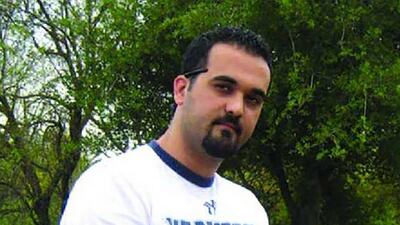
Thirty rockets, an unusually large number, rained down, killing Iraqi-American contractor Nawres Hamid.
Hamid, a civilian contractor, had been working as a linguist with US troops.
He moved to Sacramento, California, from Iraq in 2011, and left behind a wife and two sons, aged 8 and 2.
But unlike the deaths of hundreds of Americans before him in Iraq, Hamid’s killing would nearly spark a regional war.
Building hatred
In the summer of 2019, Kataib Hezbollah’s leader Abu Mahdi Al Muhandis, the head of militia umbrella organisation the Popular Mobilisation Forces, blamed US warplanes for air strikes on his men in Syria.
Those attacks, aimed at pro-Iran militia groups suspected of moving missiles into Syria to threaten Israel, were probably conducted by Israel. The US said it was not involved.
But Al Muhandis warned the Americans on June 28 that his men would not remain silent if more attacks occurred.
Kataib Hezbollah was already accused of murdering Iraqi civilians in sectarian violence, and later, a national protest movement that began in October 2019.
They attacked US troops hundreds of times from 2008 to 2011, the worst of which was in the summer of 2011 as American presence reduced in Iraq.
Rockets fired by Kataib Hezbollah killed 15 American soldiers that summer. For Washington, Al Muhandis had become a marked man.
He was reportedly tracked by US intelligence, even in meetings with Iranian general Qassem Suleimani, in which the two commanders helped to direct resources to an array of pro-Iran militias.
Al Muhandis and media channels linked to Kataib Hezbollah had also been spreading propaganda that the US had created ISIS.

As he and the PMF intensified attacks on the US, an assault on November 8 was a sign of what was to come.
Seventeen rockets were fired at the Iraqi-US base in Qayyara, south of Mosul. By sheer luck, there were no casualties.
By early December attacks were increasing. On December 9, rockets were fired at an Iraqi-US base in Baghdad airport, injuring five Iraqi counter-terrorism soldiers.
“The volume of rockets being shot in a single volley is increasing,” a US official told Reuters at the time.
The official said that Iran-backed groups were approaching a red line and if it were crossed, “no one will like the outcome”.
-

Damaged military vehicles in the aftermath of US air strikes at a militarised zone in the Jurf Al Sakhr area in Iraq's Babylon province controlled by Kataib Hezbollah. AFP -
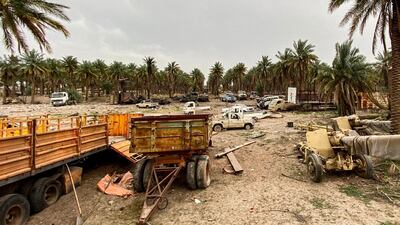
US air strikes targeting pro-Iranian military factions in Iraq killed one civilian and five security personnel early on March 13, the Iraqi military said. AFP -
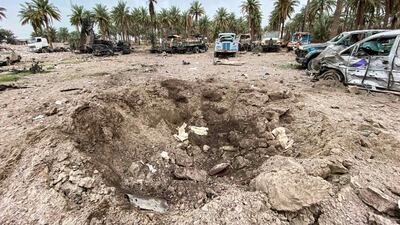
The Pentagon said the strikes were in retaliation for rocket fire against an Iraqi base the night of March 12 that killed one British and two US military personnel in the deadliest such attack in years. AFP -
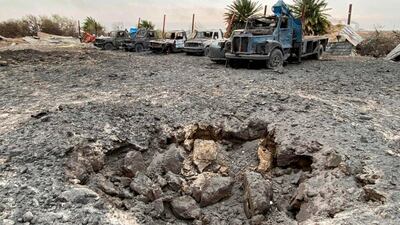
An impact crater in the aftermath of US military air strikes at a militarized zone in the Jurf Al Sakhr area in Iraq's Babylon province. AFP -
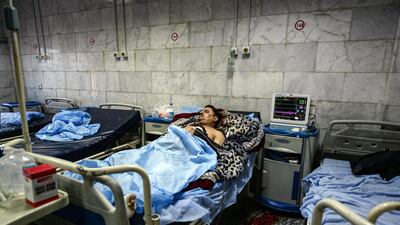
A member of the Hashed Al Shaabi paramilitaries injured in an area targeted by US military air strikes, receives treatment while lying on a bed at Hilla General Teaching Hospital in Iraq's central city of Hilla on March 13, 2020. AFP -
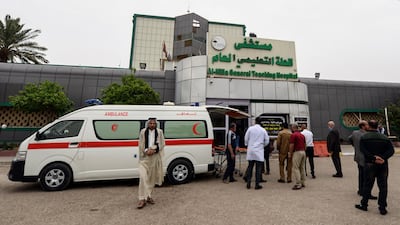
An ambulance that transported members of the Hashed Al Shaabi paramilitaries, injured in an area targeted by US military air strikes, arrives at Hilla General Teaching Hospital. AFP -
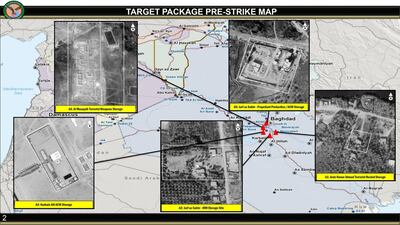
This annotated image provided by the US Department of Defense showing aerial images of sites targeted in airstrikes on Friday, March 13, 2020. US Department of Defense via AP -
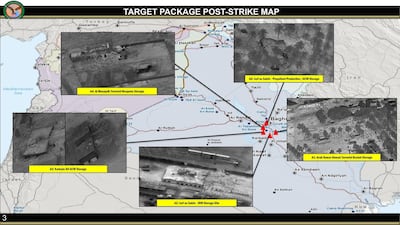
This annotated image provided by the US Department of Defense showing aerial images of sites targeted in airstrikes on Friday, March 13, 2020. US Department of Defense via AP -
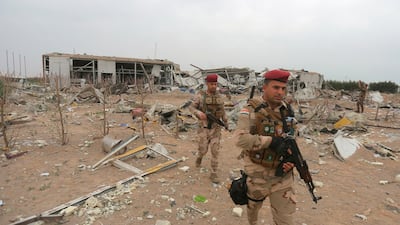
Iraqi army soldiers inspect the destruction at an airport complex under construction in Karbala. AP -

Marine Corps Gen Kenneth F McKenzie, commander of US Central Command, talks to journalists about the military response to rocket attacks that killed two US and one UK service members in Iraq. Getty Images via AFP -
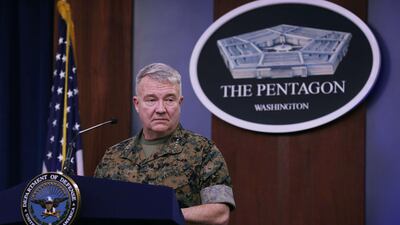
Marine Corps Gen Kenneth F McKenzie, commander of US Central Command, talks to journalists about the military response to rocket attacks that killed two US and one UK service members in Iraq. Getty Images via AFP


Mark Esper, then US secretary of defence, said on December 16 that “Iran should not mistake the United States’ restraint for an unwillingness to respond with decisive military force”.
Less than two weeks later, Hamid was dead and the US was primed to respond.
On December 30, air strikes hit Kataib Hezbollah positions near the Syrian border, killing at least 25 of the militants.
Within days, the PMF had the US embassy surrounded by thousands of people.
What happened next is disputed. The US said it received intelligence that Al Muhandis, who had travelled to Baghdad airport to meet Suleimani, was planning a retaliatory attack on the Americans.
The US killed both men on January 3 in a drone strike near the airport.
Iran’s response was a volley of ballistic missiles fired at two joint US-Iraqi bases on January 7 in a far larger attack than anything seen until that point. It wounded 100 Americans.
US President Donald Trump desisted from further escalation, perhaps satisfied that enough damage had been done.
In Sacramento, Hamid’s widow was devastated.
"He was the only person I knew here," Noor Alkhalili told local paper The Sacramento Bee.
"It has been difficult to accept that he is no longer here.”
The US response to the death of an American citizen last year points to a dangerous path ahead.
Again, Kataib Hezbollah and their PMF allies are warning the US that attacks will continue, while Washington has said, as it did late last year, that its forces will defend themselves.
As the anniversary of the deaths of Al Muhandis and Suleimani approaches on January 3, the danger now is that history will repeat itself.

