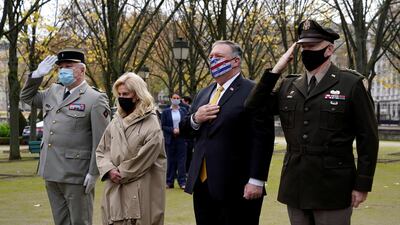
US Secretary of State Mike Pompeo, Deputy Chief of Staff for the Military Governor of Paris Lt Col Jean-Charles Spiteri, US ambassador to France Jamie McCourt and US Army Lt Gen Ricky Waddell participate in a wreath-laying ceremony in homage to victims of terrorism at Les Invalides in Paris. Reuters
US Secretary of State Mike Pompeo, Deputy Chief of Staff for the Military Governor of Paris Lt Col Jean-Charles Spiteri, US ambassador to France Jamie McCourt and US Army Lt Gen Ricky Waddell particip

Mike Pompeo: US and Europe must constrain Turkish aggression


  • English
  • Arabic

The US and Europe need to work together to address action taken by Turkey in the Middle East in the past few months, US Secretary of State Mike Pompeo told French newspaper Le Figaro.

He said he agreed with French President Emmanuel Macron that Turkey had been “very aggressive” and cited its military moves in Libya and the Mediterranean, as well as its support for Azerbaijan in the conflict with Armenia.

Mr Pompeo, who travelled to Istanbul on Monday as part of a seven-country tour of Europe and the Middle East, also told Le Figaro that the Trump administration still had work to do to maintain pressure on Iran.

“Europe and the US must work together to convince Erdogan such actions are not in the interests of his people,” Mr Pompeo said, referring to Turkish President Recep Tayyip Erdogan.

Mr Pompeo said the increase in Turkey’s military operations was a concern, but he did not say whether he thought the country, which hosts US forces at its southern Incirlik Airbase, should quit Nato.

His visit to Istanbul did not include meetings with Turkish officials and Ankara was dismissive of his agenda, which focused on religious freedoms.

Mr Pompeo met Patriarch Bartholomew I of Constantinople, spiritual leader of Orthodox Christians, in the city yesterday to express his “strong position” on religious freedoms.

Mr Pompeo said it was an “incredible privilege” to meet the patriarch but faced cries such as “Yankee go home” from a group of about 20 to 30 Turks when he arrived.

Relations between Washington and Ankara are strained despite the personal friendship between US President Donald Trump and Mr Erdogan.

Mr Pompeo publicly chided Mr Erdogan for his decision to convert the Hagia Sophia from a museum back into a mosque in July.

Before Mr Pompeo arrived in the country the Turkish Foreign Ministry criticised his trip.

It said the US should “first look in the mirror” before making an issue of the “completely irrelevant” subject of religious freedom in Turkey.


The specs

Engine: 2.0-litre 4-cylinder turbo

Power: 240hp at 5,500rpm

Torque: 390Nm at 3,000rpm

Transmission: eight-speed auto

Price: from Dh122,745

On sale: now

PFA Team of the Year: David de Gea, Kyle Walker, Jan Vertonghen, Nicolas Otamendi, Marcos Alonso, David Silva, Kevin De Bruyne, Christian Eriksen, Harry Kane, Mohamed Salah, Sergio Aguero

Terminal High Altitude Area Defense (THAAD)

What is THAAD?

It is considered to be the US' most superior missile defence system.

Production:

It was first created in 2008.

Speed:

THAAD missiles can travel at over Mach 8, so fast that it is hypersonic.

Abilities:

THAAD is designed to take out projectiles, namely ballistic missiles, as they are on their downward trajectory towards their target, otherwise known as the "terminal phase".

Purpose:

To protect high-value strategic sites, such as airfields or population centres.

Range:

THAAD can target projectiles both inside and outside of the Earth's atmosphere, at an altitude of 93 miles above the Earth's surface.

Creators:

Lockheed Martin was originally granted the contract to develop the system in 1992. Defence company Raytheon sub-contracts to develop other major parts of the system, such as ground-based radar.

UAE and THAAD:

In 2011, the UAE became the first country outside of the US to buy two THAAD missile defence systems. It then deployed them in 2016, becoming the first Gulf country to do so.