An attack on Aden airport as Yemen's unity government arrived there last week involved three precision-guided missiles, Prime Minister Maeen Saeed said.
There were explosions as Mr Saeed and Cabinet members disembarked from their plane. All the ministers survived, but 26 people were killed and more were feared dead. A hundred others were wounded.
Mr Saeed said the missiles were targeted on his plane, the arrival hall and the VIP lounge of the airport.
"The guidance accuracy was great. The operation was huge," he told Associated Press on Saturday.
Speaking at his office in the Mashiq Palace in Aden, Mr Saeed said Iran-backed Houthi rebels were responsible for the attack. The techniques used had hallmarks of the Houthis' strategy, he said.
The rebels denied responsibility for the attack.
“It’s a major terrorist attack that was meant to eliminate the government," Mr Saeed said. “It was a message against peace and stability in Yemen.”
-
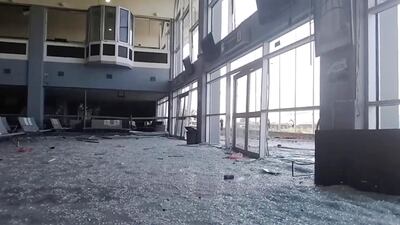
Glass and debris covers the damaged portion of the airport in Yemen’s southern city of Aden after an explosion. The blast struck the airport building shortly after a plane carrying the newly formed Cabinet landed on Wednesday. No one on the government plane was hurt. AP -
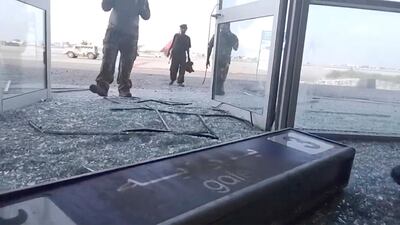
Glass and debris covers the damaged portion of the airport in Yemen’s southern city of Aden after an explosion. The blast struck the airport building shortly after a plane carrying the newly formed Cabinet landed on Wednesday. No one on the government plane was hurt. AP -

Bystanders and a soldier stand near a damaged portion of the airport of Yemen’s southern city of Aden’s after an explosion, Wednesday, Dec. 30, 2020. The blast struck the airport building shortly after a plane carrying the newly formed Cabinet landed on Wednesday. No one on the government plane was hurt. (AP Photo/Majid Saleh) -
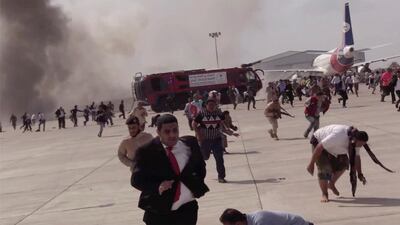
People run after an explosion at the airport in Aden, Yemen, shortly after a plane carrying the newly formed Cabinet landed. No one on board the government plane was hurt but initial reports said several people at the airport were killed. AP -
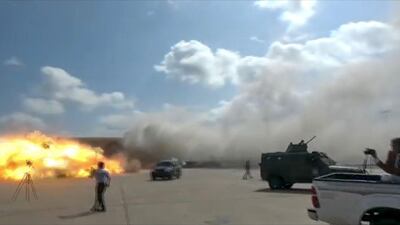
A video grab shows the moment an ordnance hit the Aden Airport, shortly after the arrival of a plane carrying members of a new unity government. Explosions rocked Yemen's Aden airport on Wednesday shortly after the arrival of a plane carrying members of a new unity government, an AFP correspondent at the scene said. "At least two explosions were heard as the cabinet members were leaving the aircraft," the correspondent said. Yemen's internationally recognised government and southern separatists formed a new power-sharing cabinet on December 18, and arrived in the southern city of Aden on Wednesday, days after being sworn in Saudi Arabia. AFP -
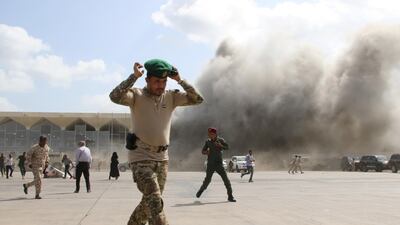
A security personnel member reacts as dust rises after explosions hit Aden airport, upon the arrival of the newly-formed Yemeni government in Aden, Yemen. REUTERS -

A video grab shows the moment an ordnance hit the Aden Airport, shortly after the arrival of a plane carrying members of a new unity government. Explosions rocked Yemen's Aden airport on Wednesday shortly after the arrival of a plane carrying members of a new unity government, an AFP correspondent at the scene said. "At least two explosions were heard as the cabinet members were leaving the aircraft," the correspondent said. Yemen's internationally recognised government and southern separatists formed a new power-sharing cabinet on December 18, and arrived in the southern city of Aden on Wednesday, days after being sworn in Saudi Arabia. AFP -
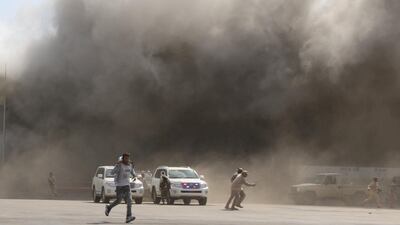
People react as dust rises after explosions hit Aden airport, upon the arrival of the newly-formed Yemeni government in Aden, Yemen. REUTERS -
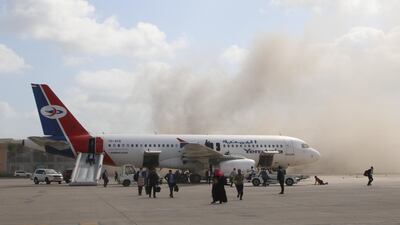
People walk on the tarmac as dust and smoke rise after explosions hit Aden airport, upon the arrival of the newly-formed Yemeni government in Aden, Yemen. REUTERS -
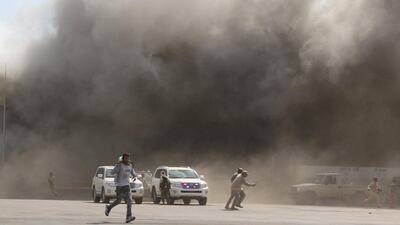
People react as dust rises after explosions hit Aden airport, upon the arrival of the newly-formed Yemeni government in Aden, Yemen. REUTERS -
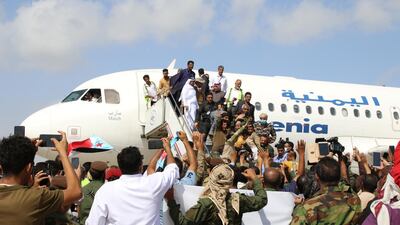
People wait to greet members a newly formed cabinet for government-held parts of Yemen upon their arrival at Aden airport, before an attack on the airport, in Aden, Yemen. REUTERS -
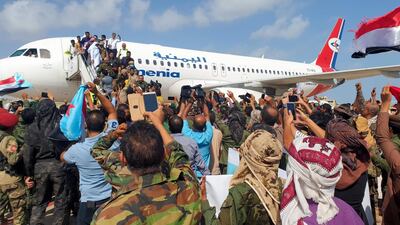
Yemenis welcome members of the new unity government at the Aden Airport, before explosions rocked the Yemeni airport. Explosions rocked Yemen's Aden airport on Wednesday shortly after the arrival of a plane carrying members of a new unity government, an AFP correspondent at the scene said. "At least two explosions were heard as the cabinet members were leaving the aircraft," the correspondent said. Yemen's internationally recognised government and southern separatists formed a new power-sharing cabinet on December 18, and arrived in the southern city of Aden on Wednesday, days after being sworn in Saudi Arabia. AFP -
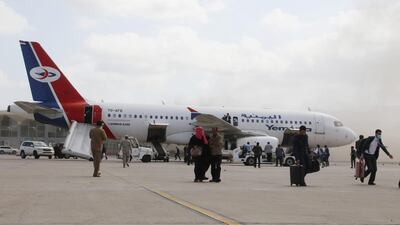
People walk away from a plane that carried a newly formed cabinet for government-held parts of Yemen, after an attack at Aden airport shortly after the plane's arrival, in Aden, Yemen. REUTERS -

People wait to greet members a newly formed cabinet for government-held parts of Yemen upon their arrival at Aden airport, before an attack on the airport, in Aden, Yemen. REUTERS


The prime minister said Yemeni investigators had collected the remains of the missiles and that experts from the Saudi-led coalition supporting his government and from the United States would help to determine the type and origin of the missiles.
President Abdrabu Mansur Hadi inaugurated the Cabinet a week earlier as part of a Saudi-brokered agreement to end a political rift between the government and the Southern Transitional Council, which advocates secession for southern Yemen. The two sides are allies against the Houthis, who have controlled much of northern Yemen since 2015.
In 2015, former Yemeni prime minister Khaled Bahah and members of his Cabinet survived a missile attack, blamed on the Houthis, at an Aden hotel.
In 2019, the Houthis fired a missile at the base of a pro-government militia in Aden during a military parade, killing dozens of people.
Mr Saeed said his government would prioritise security and stability in government-held areas after months of infighting between government and the STC.
“Whatever the challenges in Aden, the government remains,” he said.

