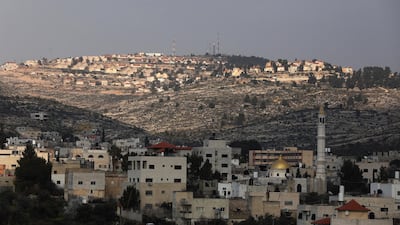
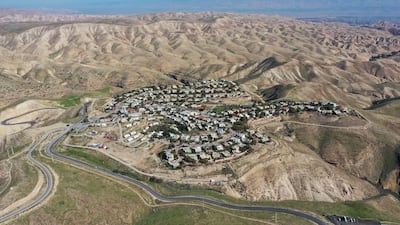
Cars with Palestinian licence plates drive through the Tapuach junction, near Nablus, towards the Jordan Valley in the occupied West Bank, on July 1, 2020. AFP

West Bank annexation: female world leaders denounce 'mostly male' plan


Mina Aldroubi
  • English
  • Arabic

Female political leaders on Wednesday called for the international community to exert efforts to stop Israel from annexing parts of the occupied West Bank, a move they described as an “existential threat” to world order if implemented.

Israeli Prime Minister Benjamin Netanyahu made annexation a major pledge during campaigning, before the latest round of national elections held in March.

The plan, which is endorsed by Washington, sets out the creation of a Palestinian state, but on reduced territory, and without Palestinians’ core demand of a capital in East Jerusalem.

“Such a move would unravel half a century of efforts for peace in the region and the vision of two sovereign states, Israel and Palestine, living side by side in peace and security, based on the pre-1967 borders, with far-reaching consequences,” said a joint statement by more than 40 global female leaders.

It also said the plan was created mostly “by men”, without any reference to the diverse perspectives of women.

The statement is signed by former heads of state, parliamentarians, Nobel Peace Laureates and senior UN and human rights officials, including: Micheline Calmy-Rey, the former President of Switzerland; Tarja Halonen, former President of Finland; Roza Otunbayeva, former President of Kyrgyzstan; Mary Robinson, former UN Commissioner for Human Rights and former President of Ireland, and Helen Clark, former Prime Minister of New Zealand.

  • Palestinian protesters wave flags as Israeli troops take position during a protest against Jewish settlements in the West Bank village of Nabi Saleh, near Ramallah. Reuters
    Palestinian protesters wave flags as Israeli troops take position during a protest against Jewish settlements in the West Bank village of Nabi Saleh, near Ramallah. Reuters
  • Now that Prime Minister Benjamin Netanyahu has secured a new term in office, there’s little to prevent him from annexing large parts of the West Bank as early as this summer. AP
    Now that Prime Minister Benjamin Netanyahu has secured a new term in office, there’s little to prevent him from annexing large parts of the West Bank as early as this summer. AP
  • An Israeli soldier stands guard during a tour made by Israeli parliament members in the Jordan Valley near the Jewish settlement of Maale Efrayim. Reuters
    An Israeli soldier stands guard during a tour made by Israeli parliament members in the Jordan Valley near the Jewish settlement of Maale Efrayim. Reuters
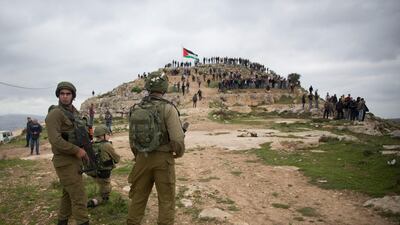
  • Israeli soldiers take position as Palestinian demonstrators gather during a protest against expansion of Israeli settlements in the West Bank. AP
    Israeli soldiers take position as Palestinian demonstrators gather during a protest against expansion of Israeli settlements in the West Bank. AP
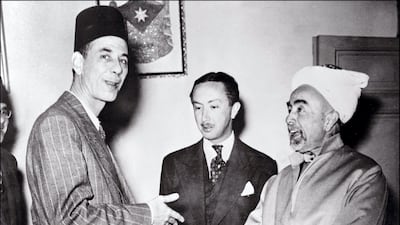
  • King Abdullah (r) of Transjordan on May 13, 1948 in Amman with Abed Al Rahman Azzam, the secretary general of the Arab League and Abd Al Elah Ibn Ali, the Prince Regent of Iraq, the day before the beginning of the first Arab-Israeli War. AFP
    King Abdullah (r) of Transjordan on May 13, 1948 in Amman with Abed Al Rahman Azzam, the secretary general of the Arab League and Abd Al Elah Ibn Ali, the Prince Regent of Iraq, the day before the beginning of the first Arab-Israeli War. AFP
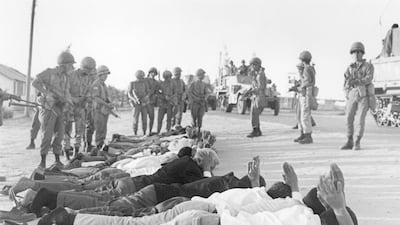
  • Palestinians surrender to Israeli soldiers in June 1967 in the occupied territory of the West Bank after Israel launched a pre-emptive attack on Egypt and Syria and seized the Gaza Strip, Sinai Peninsula and the Golan Heights in Syria as well as the West Bank and Arab East Jerusalem. AFP
    Palestinians surrender to Israeli soldiers in June 1967 in the occupied territory of the West Bank after Israel launched a pre-emptive attack on Egypt and Syria and seized the Gaza Strip, Sinai Peninsula and the Golan Heights in Syria as well as the West Bank and Arab East Jerusalem. AFP
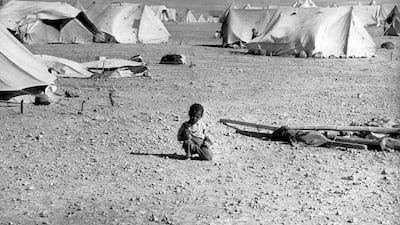
  • A Palestinian child plays in a refugee camp in Jordan on June 23, 1967. AFP
    A Palestinian child plays in a refugee camp in Jordan on June 23, 1967. AFP
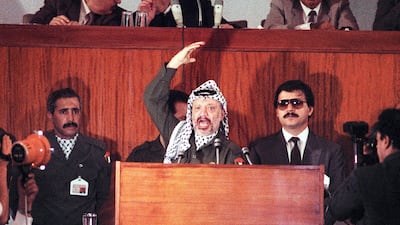
  • PLO chairman Yasser Arafat delivers a speech to the Palestine National Council meeting to make the historic proclamation of a Palestinian state in the Israeli-occupied territories and to recognize Israel in the Palace of Nations conference hall on November 12, 1988, in Algiers. AFP
    PLO chairman Yasser Arafat delivers a speech to the Palestine National Council meeting to make the historic proclamation of a Palestinian state in the Israeli-occupied territories and to recognize Israel in the Palace of Nations conference hall on November 12, 1988, in Algiers. AFP
  • US President Bill Clinton stands between PLO leader Yasser Arafat and Israeli Prime Minister Yitzahk Rabin as they shake hands for the first time on September 13, 1993 at the White House. AFP
    US President Bill Clinton stands between PLO leader Yasser Arafat and Israeli Prime Minister Yitzahk Rabin as they shake hands for the first time on September 13, 1993 at the White House. AFP
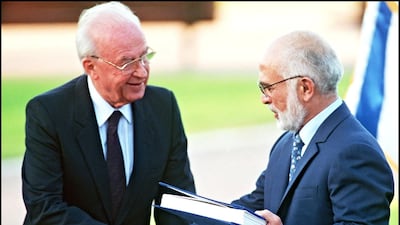
  • Hussein Ibn Talal, King of Jordan and Israeli Premier Yitzhak Rabin shake hands after they exchanged the documents of the Peace Treaty at Beit Gabriel conference centre on November 10, 1994 on the southern shore of the Sea of Galilee. AFP
    Hussein Ibn Talal, King of Jordan and Israeli Premier Yitzhak Rabin shake hands after they exchanged the documents of the Peace Treaty at Beit Gabriel conference centre on November 10, 1994 on the southern shore of the Sea of Galilee. AFP
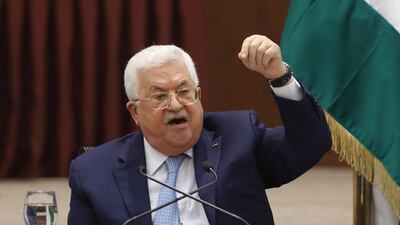
  • Palestinian President Mahmoud Abbas speaks during the Palestinian leadership meeting and threatened to end security coordination with Israel and the United States, saying Israeli annexation would ruin chances for peace. AFP
    Palestinian President Mahmoud Abbas speaks during the Palestinian leadership meeting and threatened to end security coordination with Israel and the United States, saying Israeli annexation would ruin chances for peace. AFP
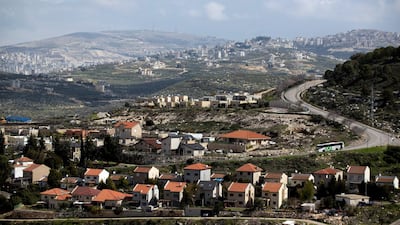
  • Houses in the Israeli settlement of settlement of Kedumim are seen in the foreground as part of the Palestinian city of Nablus is seen in the background (far left) in the Israeli-occupied West Bank. Reuters
    Houses in the Israeli settlement of settlement of Kedumim are seen in the foreground as part of the Palestinian city of Nablus is seen in the background (far left) in the Israeli-occupied West Bank. Reuters
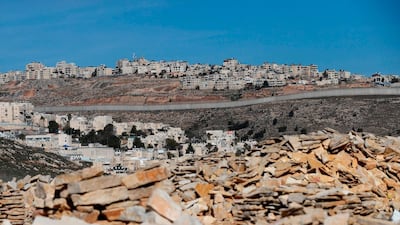
  • Israel's controversial concrete barrier (C) separating the Jewish settlement of Neve Yaakov (foreground) in the northern part of east Jerusalem and the Palestinian area of al-Ram (background) in the occupied West Bank. AFP
    Israel's controversial concrete barrier (C) separating the Jewish settlement of Neve Yaakov (foreground) in the northern part of east Jerusalem and the Palestinian area of al-Ram (background) in the occupied West Bank. AFP
  • An Israeli activist holds a banner during a protest against the US peace plan for the Middle East, in front of the US ambassador's residence in Jerusalem, on May 15, 2020, as Palestinians commemorate the 72nd anniversary of the 1948 Nakba or "catastrophe". AFP
    An Israeli activist holds a banner during a protest against the US peace plan for the Middle East, in front of the US ambassador's residence in Jerusalem, on May 15, 2020, as Palestinians commemorate the 72nd anniversary of the 1948 Nakba or "catastrophe". AFP
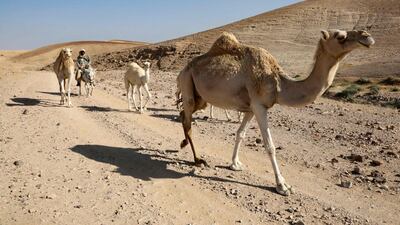
  • A Palestinian shepherd tends to his camels on arid land considered to be in "Area C" (under Israeli security and administrative control), southeast of Yatta town in the southern West Bank district of Hebron. AFP
    A Palestinian shepherd tends to his camels on arid land considered to be in "Area C" (under Israeli security and administrative control), southeast of Yatta town in the southern West Bank district of Hebron. AFP
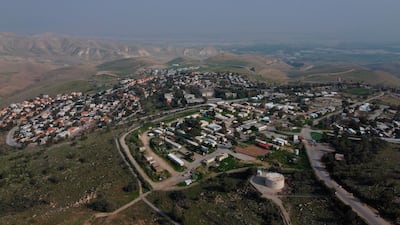
  • A general view of the Israeli settlement of Elon Moreh, as seen from the Palestinian village of Azmout near the West Bank City of Nablus. EPA
    A general view of the Israeli settlement of Elon Moreh, as seen from the Palestinian village of Azmout near the West Bank City of Nablus. EPA
  • The West Bank Jewish settlement of Maale Michmash. AP
    The West Bank Jewish settlement of Maale Michmash. AP

“We have received urgent appeals against annexation sent by both Palestinian and Israeli women,” their statement said, adding that the calls resonated as annexation “is an existential threat ... to an already fragile global order”.

“Their strong appeals, while separate and distinct, have in common a sense of shared humanity, and a common rejection of subjugation and discrimination, oppression and violence,” it said.

The annexation plan would extend sovereignty to roughly 30 per cent of the West Bank, covering most of the Jordan Valley and hundreds of illegal Israeli settlements.

US President Donald Trump’s proposal calls for Israeli sovereignty over about 30 per cent of the West Bank – land on which Israel has built settlements for decades – as well as the creation of a Palestinian state under strict conditions.

The Palestinians want to establish an independent state in the West Bank, the Gaza Strip and East Jerusalem, territories Israel captured in the 1967 Middle East war, and have rejected Mr Trump’s plan, saying it would deny them a viable state.

Much of the international community sees Israel’s settlements as illegal. Israel disputes this, citing historical and biblical ties to the West Bank, as well as security needs.

“Annexation is a breach of international law and the UN Charter, and of UN Security Council and General Assembly resolutions,” the statement from female leaders said.

They said they support the Palestinian and Israeli women’s call against unilateral annexation and “back their efforts to prevent its disastrous consequences”.


Who's who in Yemen conflict

Houthis: Iran-backed rebels who occupy Sanaa and run unrecognised government

Yemeni government: Exiled government in Aden led by eight-member Presidential Leadership Council

Southern Transitional Council: Faction in Yemeni government that seeks autonomy for the south

Habrish 'rebels': Tribal-backed forces feuding with STC over control of oil in government territory

Related
Ten tax points to be aware of in 2026

1. Domestic VAT refund amendments: request your refund within five years

If a business does not apply for the refund on time, they lose their credit.

2. E-invoicing in the UAE

Businesses should continue preparing for the implementation of e-invoicing in the UAE, with 2026 a preparation and transition period ahead of phased mandatory adoption. 

3. More tax audits

Tax authorities are increasingly using data already available across multiple filings to identify audit risks. 

4. More beneficial VAT and excise tax penalty regime

Tax disputes are expected to become more frequent and more structured, with clearer administrative objection and appeal processes. The UAE has adopted a new penalty regime for VAT and excise disputes, which now mirrors the penalty regime for corporate tax.

5. Greater emphasis on statutory audit

There is a greater need for the accuracy of financial statements. The International Financial Reporting Standards standards need to be strictly adhered to and, as a result, the quality of the audits will need to increase.

6. Further transfer pricing enforcement

Transfer pricing enforcement, which refers to the practice of establishing prices for internal transactions between related entities, is expected to broaden in scope. The UAE will shortly open the possibility to negotiate advance pricing agreements, or essentially rulings for transfer pricing purposes. 

7. Limited time periods for audits

Recent amendments also introduce a default five-year limitation period for tax audits and assessments, subject to specific statutory exceptions. While the standard audit and assessment period is five years, this may be extended to up to 15 years in cases involving fraud or tax evasion. 

8. Pillar 2 implementation 

Many multinational groups will begin to feel the practical effect of the Domestic Minimum Top-Up Tax (DMTT), the UAE's implementation of the OECD’s global minimum tax under Pillar 2. While the rules apply for financial years starting on or after January 1, 2025, it is 2026 that marks the transition to an operational phase.

9. Reduced compliance obligations for imported goods and services

Businesses that apply the reverse-charge mechanism for VAT purposes in the UAE may benefit from reduced compliance obligations. 

10. Substance and CbC reporting focus

Tax authorities are expected to continue strengthening the enforcement of economic substance and Country-by-Country (CbC) reporting frameworks. In the UAE, these regimes are increasingly being used as risk-assessment tools, providing tax authorities with a comprehensive view of multinational groups’ global footprints and enabling them to assess whether profits are aligned with real economic activity. 

Contributed by Thomas Vanhee and Hend Rashwan, Aurifer

The years Ramadan fell in May

1987

1954

1921

1888