Major General John Lorimer of the Parachute Regiment at their barracks in Colchester after the Prince of Wales presented Afghanistan campaign medals. PA Images via Reuters Connect

'We are all still good friends and partners despite the challenges of Covid'


Thomas Harding
  • English
  • Arabic

When John Gordon Lorimer died unexpectedly in 1914 the British Political Resident’s standing was such that flags in Gulf states were lowered.

To this day, both his encyclopaedic works on Arabia and his reputation remain in high esteem, such was his influence in informing the wider world from his postings, including a stint in Bahrain.

That goodwill extends to his great-grandson, named after the academic and diplomat, and who, a few generations on, remains on good terms with Gulf leaders.

Lt Gen Sir John Lorimer’s deep and personal history of the region inevitably took him on a military career that swirled around the Middle East, its conflicts, culture and people.

John Lorimer was an academic and diplomat and the great grandfather of the current general.

Nearly three years into the job as Britain’s Defence Senior Adviser to the Middle East, he has cemented strong relationships with Crown Prince Mohammed bin Zayed as well as UAE defence ministers and military chiefs. In his role as Britain’s chief military and commercial ambassador to the Middle East, he also calls on the Emir of Kuwait, the King of Bahrain and Sultan of Oman.

It is a relationship that works well for both sides. Britain strengthens its military and business ties with the Gulf while providing reassurance that it remains a dependable ally.

'Virtual outreach'

Those ties have proven crucial during the pandemic that threatens the global economy.

Within hours of the lockdown being introduced Sir John was going through his contacts list and engaging with the leaders via WhatsApp, Skype and Zoom.

"I call this virtual outreach, to reassure all the countries across the region that the UK has not forgotten about them," he told The National, speaking via Zoom from his home in England. "We are still good friends and good partners despite the challenges of Covid. From our perspective, we've had a difficult time and they've been very sympathetic."

Indeed Britain’s ‘difficult time’ has seen it lose at least 43,000 people to the disease and 300,000 contracting it. When the UK was struggling at the height of the coronavirus crisis, with its hospitals almost overwhelmed, the UAE sent almost 100 tonnes of protective equipment and testing kits as well as allowing London’s Emirates Excel Arena to be used as a back-up hospital, where - by chance - Sir John’s wife worked as a volunteer.

“We have to say thank you for the support, specifically from UAE. They have been incredibly supportive, which is emblematic of the Emiratis.”

'Working together is so important'

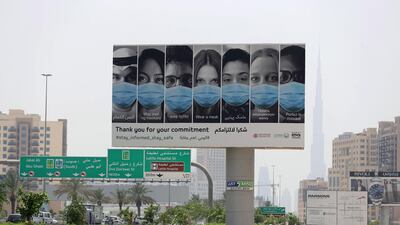
  • A billboard on Al Khalil Road in Dubai advises people to wear masks to prevent the spread of the coronavirus pandemic. Chris Whiteoak / The National
    A billboard on Al Khalil Road in Dubai advises people to wear masks to prevent the spread of the coronavirus pandemic. Chris Whiteoak / The National
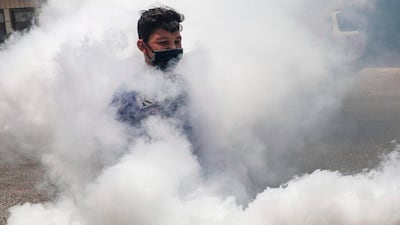
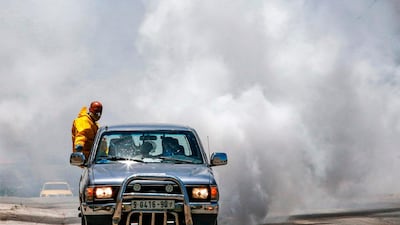
  • A mask-clad Palestinian boy is seen through the fumes from a Hebron municipality vehicle fumigating a street in the city of Hebron in the occupied West Bank, after a recent surge of coronavirus cases. AFP
    A mask-clad Palestinian boy is seen through the fumes from a Hebron municipality vehicle fumigating a street in the city of Hebron in the occupied West Bank, after a recent surge of coronavirus cases. AFP
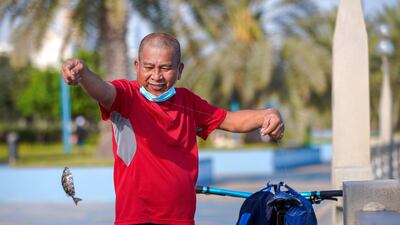
  • An Abu Dhabi resident shows his catch after fishing along the Corniche. Victor Besa / The National
    An Abu Dhabi resident shows his catch after fishing along the Corniche. Victor Besa / The National
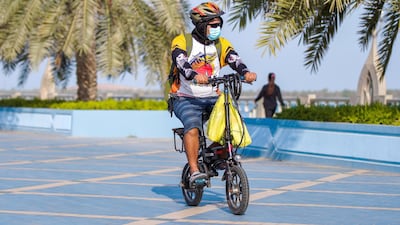
  • A man on his bike along the Corniche in Abu Dhabi amid the Covid-19 pandemic. Victor Besa / The National
    A man on his bike along the Corniche in Abu Dhabi amid the Covid-19 pandemic. Victor Besa / The National
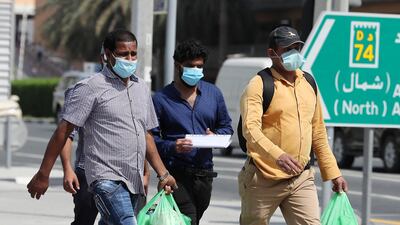
  • People wear protective face masks as a preventive measure against the spread of coronavirus in Deira, Dubai. Pawan Singh / The National
    People wear protective face masks as a preventive measure against the spread of coronavirus in Deira, Dubai. Pawan Singh / The National
  • A health worker of the Palestinian Hebron municipality, dressed in PPE, rides in a fumigation vehicle sterilising streets and buildings in the city of Hebron in the occupied West Bank. AFP
    A health worker of the Palestinian Hebron municipality, dressed in PPE, rides in a fumigation vehicle sterilising streets and buildings in the city of Hebron in the occupied West Bank. AFP
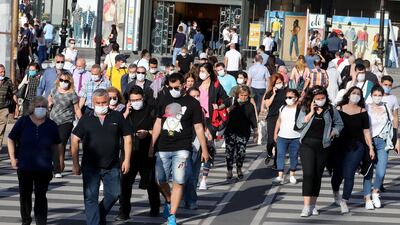
  • People wear protective face masks against curb the spread of the coronavirus in Kizilay Square, in Ankara, Turkey. AFP
    People wear protective face masks against curb the spread of the coronavirus in Kizilay Square, in Ankara, Turkey. AFP
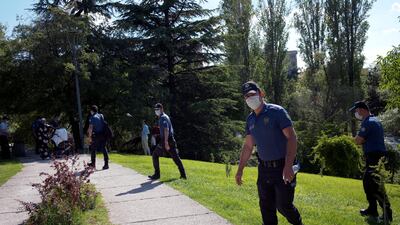
  • Police officers wearing face masks to protect against the spread of coronavirus, patrol in a public garden, warning people to respect social distancing, in Ankara. AP Photo
    Police officers wearing face masks to protect against the spread of coronavirus, patrol in a public garden, warning people to respect social distancing, in Ankara. AP Photo
  • A man who has recovered from the coronavirus wears a protective face mask as he donates his blood plasma to help critically ill patients at Basra Teaching Hospital in Basra, Iraq. Reuters
    A man who has recovered from the coronavirus wears a protective face mask as he donates his blood plasma to help critically ill patients at Basra Teaching Hospital in Basra, Iraq. Reuters
  • A couple who have recovered from the coronavirus wear protective face masks as they wait to donate blood plasma to help critically ill patients at Basra Teaching Hospital in Basra, Iraq. Reuters
    A couple who have recovered from the coronavirus wear protective face masks as they wait to donate blood plasma to help critically ill patients at Basra Teaching Hospital in Basra, Iraq. Reuters
  • An assistant of Dr Hiba Jabbar Ashoor wears a protective face mask while taking a break at Basra Teaching Hospital, following the outbreak of the coronavirus disease, in Basra, Iraq. Reuters
    An assistant of Dr Hiba Jabbar Ashoor wears a protective face mask while taking a break at Basra Teaching Hospital, following the outbreak of the coronavirus disease, in Basra, Iraq. Reuters
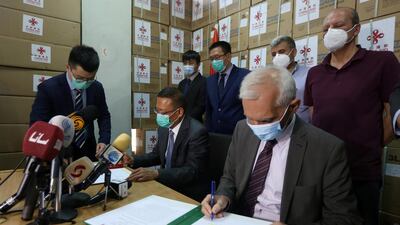
  • Deputy Syrian health minister, right, and Chinese ambassador to Syria Feng Biao, left, sign a document for receiving boxes of Chinese medical supplies at a store in Damascus, Syria. EPA
    Deputy Syrian health minister, right, and Chinese ambassador to Syria Feng Biao, left, sign a document for receiving boxes of Chinese medical supplies at a store in Damascus, Syria. EPA
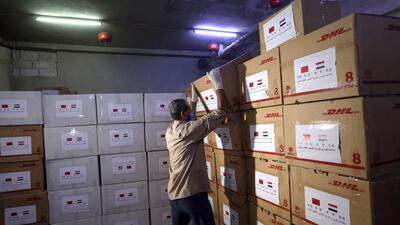
  • Workers unload boxes of Chinese medical supplies in Damascus, Syria. EPA
    Workers unload boxes of Chinese medical supplies in Damascus, Syria. EPA
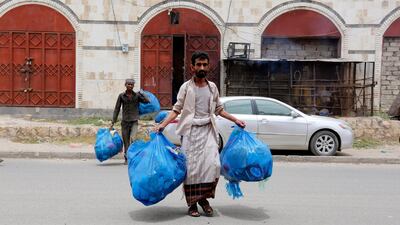
  • Sanitary workers remove rubbish from a street amid the spread of epidemics, in Sanaa, Yemen. EPA
    Sanitary workers remove rubbish from a street amid the spread of epidemics, in Sanaa, Yemen. EPA
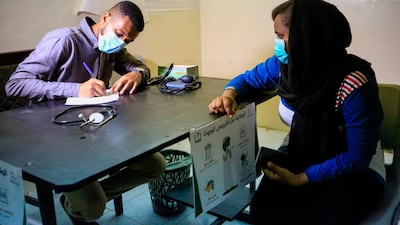
  • A woman consults a doctor at a small treatment centre set up by local volunteers in the Shambat district of northern Khartoum, amid shortage of medicine as Sudan fights to control the spread of coronavirus. AFP
    A woman consults a doctor at a small treatment centre set up by local volunteers in the Shambat district of northern Khartoum, amid shortage of medicine as Sudan fights to control the spread of coronavirus. AFP

The discussions on Covid-19 have allowed both sides to share information, lessons learnt and best practices in the “new world order” that the disease has hastily ushered in.

“It’s not just defence and security,” said Sir John. “It’s politics, the economy, humanitarian, health and education. And it’s psychological because a lot of people have gone through a really hard time. That’s why working together is so important.

“We have long-term partnerships and Covid is just another way we have to cooperate in the future and not ignore each other.”

Opportunities on the horizon

Britain’s relationship with the rest of the world is going to face a severe test when it leaves the European Union in 2021, with or without a trade deal. Downing Street is looking at new trading relationships and agreements and the Gulf is high on the agenda.

“Post-Brexit and post-Covid link together,” said Sir John, 57. “The UK is confident outward-looking, trusted and trusting partner with our friends in the region. Clearly we would wish to build on our shared history and interest with Gulf states.”

He added that Boris Johnson has a taken “a real interest in the Gulf” and has strong personal relationships with its leaders including Crown Prince Mohammed bin Zayed. The Prime Minister is also working with the trade and defence secretaries “to push forward with a trade mission into the region”.

“The GCC is seventh-largest export market for the UK and clearly there are opportunities to expand on this post-Brexit.”

Britain’s connections run deeper than that. There are 120,000 British citizens living in the UAE and more than a million visit the Gulf each year. The Royal Family are also regular guests with the Prince of Wales and Duke of Cambridge visiting just before lockdown. They too have kept in contact with the region during the pandemic.

UAE Prime Minister and Ruler of Dubai, Sheikh Mohammed bin Rashid Al Maktoum shakes hands with Prince Charles during a three-day visit to the UAE. AFP Photo / HO / Government of Dubai Media Office

Britain’s military involvement in the Gulf has seen it join the coalition that forced Saddam Hussein out of Kuwait in 1991 and the 2003 invasion that toppled the dictator. Sir John once again followed in his forebear’s path when he commanded a Parachute Regiment battalion in 2003 and British brigade in Basra in 2005.

With Iran increasing its military strength there is greater importance attached to the British defence industry, in particular the defence firm BAE Systems.

Sir John indicated that while business in lockdown was difficult, deals were still going ahead and contracts signed. Once travel restrictions are lifted the Ministry of Defence and Department for International Trade will work with industry to get into trade shows.

“UK firms are carrying on trying to do as much as they can. They are missing the face-to-face, sitting down and talking, although a lot of it can be done virtually. Because we have invested so much time in relationships we have a good foundation so we can progress it through virtual conversation and Skype. That highlights the strength of the relationship.”

Long summers and learning Arabic

For a man much endeared to the region, the job is an ideal fit. Travel takes him through the Maghreb, North Africa, then up into the Levant and the Gulf.  Even before lockdown in March, this year he managed to visit Egypt, Iraq, Saudi Arabia, Oman, Kuwait and Lebanon.

Perhaps guided by a strong Middle East tradition, Sir John opted to study Arabic and Islamic Studies at Cambridge University. Over the long summers, he travelled to the Middle East learning his Arabic in Egypt, which occasionally leads to unexpected reactions. “People sometimes raise their eyebrows because the Egyptian slang comes out although I do my best to raise my game.”

His travels gave rise to a fascination with the Arabic people, their traditions, history and culture. “All of that gives me a desire to make a difference in terms of between Britain and the region.”

He also enjoys its people, their manners and hospitality. “The personal relationships you are able to develop there are very special. It takes a bit of time, but once you get that relationship the people I deal with are incredibly generous, exceptionally good in terms of time and sharing their views.

“One of the most interesting things about the region is it’s so complex. For a non-Arab and non-Muslim, it’s difficult but I enjoy that challenge to try and understand what’s going on.”

After lockdown, Sir John will continue to visit the area where his great grandfather spent his career. His affinity is strong. As he says, “It’s in my blood.”


Director: Laxman Utekar

Cast: Vicky Kaushal, Akshaye Khanna, Diana Penty, Vineet Kumar Singh, Rashmika Mandanna

Rating: 1/5

Dust and sand storms compared

Sand storm

  • Particle size: Larger, heavier sand grains
  • Visibility: Often dramatic with thick "walls" of sand
  • Duration: Short-lived, typically localised
  • Travel distance: Limited 
  • Source: Open desert areas with strong winds

Dust storm

  • Particle size: Much finer, lightweight particles
  • Visibility: Hazy skies but less intense
  • Duration: Can linger for days
  • Travel distance: Long-range, up to thousands of kilometres
  • Source: Can be carried from distant regions
Who has been sanctioned?

Daniella Weiss and Nachala
Described as 'the grandmother of the settler movement', she has encouraged the expansion of settlements for decades. The 79 year old leads radical settler movement Nachala, whose aim is for Israel to annex Gaza and the occupied West Bank, where it helps settlers built outposts.

Harel Libi & Libi Construction and Infrastructure
Libi has been involved in threatening and perpetuating acts of aggression and violence against Palestinians. His firm has provided logistical and financial support for the establishment of illegal outposts.

Zohar Sabah
Runs a settler outpost named Zohar’s Farm and has previously faced charges of violence against Palestinians. He was indicted by Israel’s State Attorney’s Office in September for allegedly participating in a violent attack against Palestinians and activists in the West Bank village of Muarrajat.

Coco’s Farm and Neria’s Farm
These are illegal outposts in the West Bank, which are at the vanguard of the settler movement. According to the UK, they are associated with people who have been involved in enabling, inciting, promoting or providing support for activities that amount to “serious abuse”.

Mercer, the investment consulting arm of US services company Marsh & McLennan, expects its wealth division to at least double its assets under management (AUM) in the Middle East as wealth in the region continues to grow despite economic headwinds, a company official said.

Mercer Wealth, which globally has $160 billion in AUM, plans to boost its AUM in the region to $2-$3bn in the next 2-3 years from the present $1bn, said Yasir AbuShaban, a Dubai-based principal with Mercer Wealth.

Within the next two to three years, we are looking at reaching $2 to $3 billion as a conservative estimate and we do see an opportunity to do so,” said Mr AbuShaban.

Mercer does not directly make investments, but allocates clients’ money they have discretion to, to professional asset managers. They also provide advice to clients.

“We have buying power. We can negotiate on their (client’s) behalf with asset managers to provide them lower fees than they otherwise would have to get on their own,” he added.

Mercer Wealth’s clients include sovereign wealth funds, family offices, and insurance companies among others.

From its office in Dubai, Mercer also looks after Africa, India and Turkey, where they also see opportunity for growth.

Wealth creation in Middle East and Africa (MEA) grew 8.5 per cent to $8.1 trillion last year from $7.5tn in 2015, higher than last year’s global average of 6 per cent and the second-highest growth in a region after Asia-Pacific which grew 9.9 per cent, according to consultancy Boston Consulting Group (BCG). In the region, where wealth grew just 1.9 per cent in 2015 compared with 2014, a pickup in oil prices has helped in wealth generation.

BCG is forecasting MEA wealth will rise to $12tn by 2021, growing at an annual average of 8 per cent.

Drivers of wealth generation in the region will be split evenly between new wealth creation and growth of performance of existing assets, according to BCG.

Another general trend in the region is clients’ looking for a comprehensive approach to investing, according to Mr AbuShaban.

“Institutional investors or some of the families are seeing a slowdown in the available capital they have to invest and in that sense they are looking at optimizing the way they manage their portfolios and making sure they are not investing haphazardly and different parts of their investment are working together,” said Mr AbuShaban.

Some clients also have a higher appetite for risk, given the low interest-rate environment that does not provide enough yield for some institutional investors. These clients are keen to invest in illiquid assets, such as private equity and infrastructure.

“What we have seen is a desire for higher returns in what has been a low-return environment specifically in various fixed income or bonds,” he said.

“In this environment, we have seen a de facto increase in the risk that clients are taking in things like illiquid investments, private equity investments, infrastructure and private debt, those kind of investments were higher illiquidity results in incrementally higher returns.”

The Abu Dhabi Investment Authority, one of the largest sovereign wealth funds, said in its 2016 report that has gradually increased its exposure in direct private equity and private credit transactions, mainly in Asian markets and especially in China and India. The authority’s private equity department focused on structured equities owing to “their defensive characteristics.”

The specs

Engine: Dual 180kW and 300kW front and rear motors

Power: 480kW

Torque: 850Nm

Transmission: Single-speed automatic

Price: From Dh359,900 ($98,000)

On sale: Now

Formula%204%20Italian%20Championship%202023%20calendar
%3Cp%3EApril%2021-23%3A%20Imola%3Cbr%3EMay%205-7%3A%20Misano%3Cbr%3EMay%2026-28%3A%20SPA-Francorchamps%3Cbr%3EJune%2023-25%3A%20Monza%3Cbr%3EJuly%2021-23%3A%20Paul%20Ricard%3Cbr%3ESept%2029-Oct%201%3A%20Mugello%3Cbr%3EOct%2013-15%3A%20Vallelunga%3C%2Fp%3E%0A
Spec%20sheet
%3Cp%3E%3Cstrong%3EDisplay%3A%3C%2Fstrong%3E%204.7%22%20Retina%20HD%2C%201334%20x%20750%2C%20625%20nits%2C%201400%3A1%2C%20True%20Tone%2C%20P3%3Cbr%3E%3Cstrong%3EChip%3A%3C%2Fstrong%3E%20Apple%20A15%20Bionic%2C%206-core%20CPU%2C%204-core%20GPU%2C%2016-core%20Neural%20Engine%3Cbr%3E%3Cstrong%3ECamera%3A%3C%2Fstrong%3E%2012MP%2C%20f%2F1.8%2C%205x%20digital%20zoom%2C%20Smart%20HDR%2C%20Deep%20Fusion%3Cbr%3E%3Cstrong%3EVideo%3A%3C%2Fstrong%3E%204K%2B%40%2024%2F30%2F60fps%2C%20full%20HD%2B%40%2030%2F60fps%2C%20HD%2B%40%2030%20fps%3Cstrong%3E%3Cbr%3EFront%20camera%3A%20%3C%2Fstrong%3E7MP%2C%20f%2F2.2%2C%20Smart%20HDR%2C%20Deep%20Fusion%3B%20HD%20video%2B%40%2030fps%3Cbr%3E%3Cstrong%3EBattery%3A%3C%2Fstrong%3E%20Up%20to%2015%20hours%20video%2C%2050%20hours%20audio%3B%2050%25%20fast%20charge%20in%2030%20minutes%20with%2020W%20charger%3B%20wireless%20charging%3Cbr%3E%3Cstrong%3EBiometrics%3A%3C%2Fstrong%3E%20Touch%20ID%3Cbr%3E%3Cstrong%3EDurability%3A%3C%2Fstrong%3E%20IP67%2C%20dust%2C%20water%20resistant%20up%20to%201m%20for%2030%20minutes%3Cbr%3E%3Cstrong%3EPrice%3A%3C%2Fstrong%3E%20From%20Dh1%2C849%3C%2Fp%3E%0A
Ten tax points to be aware of in 2026

1. Domestic VAT refund amendments: request your refund within five years

If a business does not apply for the refund on time, they lose their credit.

2. E-invoicing in the UAE

Businesses should continue preparing for the implementation of e-invoicing in the UAE, with 2026 a preparation and transition period ahead of phased mandatory adoption. 

3. More tax audits

Tax authorities are increasingly using data already available across multiple filings to identify audit risks. 

4. More beneficial VAT and excise tax penalty regime

Tax disputes are expected to become more frequent and more structured, with clearer administrative objection and appeal processes. The UAE has adopted a new penalty regime for VAT and excise disputes, which now mirrors the penalty regime for corporate tax.

5. Greater emphasis on statutory audit

There is a greater need for the accuracy of financial statements. The International Financial Reporting Standards standards need to be strictly adhered to and, as a result, the quality of the audits will need to increase.

6. Further transfer pricing enforcement

Transfer pricing enforcement, which refers to the practice of establishing prices for internal transactions between related entities, is expected to broaden in scope. The UAE will shortly open the possibility to negotiate advance pricing agreements, or essentially rulings for transfer pricing purposes. 

7. Limited time periods for audits

Recent amendments also introduce a default five-year limitation period for tax audits and assessments, subject to specific statutory exceptions. While the standard audit and assessment period is five years, this may be extended to up to 15 years in cases involving fraud or tax evasion. 

8. Pillar 2 implementation 

Many multinational groups will begin to feel the practical effect of the Domestic Minimum Top-Up Tax (DMTT), the UAE's implementation of the OECD’s global minimum tax under Pillar 2. While the rules apply for financial years starting on or after January 1, 2025, it is 2026 that marks the transition to an operational phase.

9. Reduced compliance obligations for imported goods and services

Businesses that apply the reverse-charge mechanism for VAT purposes in the UAE may benefit from reduced compliance obligations. 

10. Substance and CbC reporting focus

Tax authorities are expected to continue strengthening the enforcement of economic substance and Country-by-Country (CbC) reporting frameworks. In the UAE, these regimes are increasingly being used as risk-assessment tools, providing tax authorities with a comprehensive view of multinational groups’ global footprints and enabling them to assess whether profits are aligned with real economic activity. 

Contributed by Thomas Vanhee and Hend Rashwan, Aurifer

Three ways to get a gratitude glow

By committing to at least one of these daily, you can bring more gratitude into your life, says Ong.

  • During your morning skincare routine, name five things you are thankful for about yourself.
  • As you finish your skincare routine, look yourself in the eye and speak an affirmation, such as: “I am grateful for every part of me, including my ability to take care of my skin.”
  • In the evening, take some deep breaths, notice how your skin feels, and listen for what your skin is grateful for.
Know before you go
  • Jebel Akhdar is a two-hour drive from Muscat airport or a six-hour drive from Dubai. It’s impossible to visit by car unless you have a 4x4. Phone ahead to the hotel to arrange a transfer.
  • If you’re driving, make sure your insurance covers Oman.
  • By air: Budget airlines Air Arabia, Flydubai and SalamAir offer direct routes to Muscat from the UAE.
  • Tourists from the Emirates (UAE nationals not included) must apply for an Omani visa online before arrival at evisa.rop.gov.om. The process typically takes several days.
  • Flash floods are probable due to the terrain and a lack of drainage. Always check the weather before venturing into any canyons or other remote areas and identify a plan of escape that includes high ground, shelter and parking where your car won’t be overtaken by sudden downpours.


Fifa%20World%20Cup%20Qatar%202022%20
%3Cp%3E%3Cstrong%3EFirst%20match%3A%20%3C%2Fstrong%3ENovember%2020%0D%3Cbr%3E%3Cstrong%3EFinal%2016%20round%3A%20%3C%2Fstrong%3EDecember%203%20to%206%0D%3Cbr%3E%3Cstrong%3EQuarter-finals%3A%20%3C%2Fstrong%3EDecember%209%20and%2010%0D%3Cbr%3E%3Cstrong%3ESemi-finals%3A%20%3C%2Fstrong%3EDecember%2013%20and%2014%0D%3Cbr%3E%3Cstrong%3EFinal%3A%20%3C%2Fstrong%3EDecember%2018%3C%2Fp%3E%0A
The%20specs%3A%202024%20Mercedes%20E200
%3Cp%3E%3Cstrong%3EEngine%3A%20%3C%2Fstrong%3E2.0-litre%20four-cyl%20turbo%20%2B%20mild%20hybrid%0D%3Cbr%3E%3Cstrong%3EPower%3A%20%3C%2Fstrong%3E204hp%20at%205%2C800rpm%20%2B23hp%20hybrid%20boost%0D%3Cbr%3E%3Cstrong%3ETorque%3A%20%3C%2Fstrong%3E320Nm%20at%201%2C800rpm%20%2B205Nm%20hybrid%20boost%0D%3Cbr%3E%3Cstrong%3ETransmission%3A%20%3C%2Fstrong%3E9-speed%20auto%0D%3Cbr%3E%3Cstrong%3EFuel%20consumption%3A%20%3C%2Fstrong%3E7.3L%2F100km%0D%3Cbr%3E%3Cstrong%3EOn%20sale%3A%20%3C%2Fstrong%3ENovember%2FDecember%0D%3Cbr%3E%3Cstrong%3EPrice%3A%20%3C%2Fstrong%3EFrom%20Dh205%2C000%20(estimate)%3C%2Fp%3E%0A
Our legal consultant

Name: Dr Hassan Mohsen Elhais

Position: legal consultant with Al Rowaad Advocates and Legal Consultants.

The specs: 2018 Nissan Patrol Nismo

Price: base / as tested: Dh382,000

Engine: 5.6-litre V8

Gearbox: Seven-speed automatic

Power: 428hp @ 5,800rpm

Torque: 560Nm @ 3,600rpm

Fuel economy, combined: 12.7L / 100km

Ferrari 12Cilindri specs

Engine: naturally aspirated 6.5-liter V12

Power: 819hp

Torque: 678Nm at 7,250rpm

Price: From Dh1,700,000

Available: Now