

The US and Iraq will hold “strategic” talks in June to review their military and economic relations, as tensions escalate between Washington and Tehran.
The dialogue will centre on the future of US troops stationed in the country after a series of attacks by Iranian-backed armed groups on US troops in Iraq.
"All strategic issues between our two countries will be on the agenda, including the future presence of the United States forces in that country and how best to support an independent and sovereign Iraq," US Secretary of State Mike Pompeo said during a press conference late on Tuesday.
David Hale, a state department diplomat, will represent Washington during the talks.
"With the global Covid-19 pandemic raging and plummeting oil revenue threatening an Iraqi economic collapse, it's important that our two governments work together to stop any reversal of the gains we've made in our efforts to defeat ISIS and stabilise the country," Mr Pompeo said.
US Ambassador to Iraq Matthew Tuller met with outgoing Prime Minister Adel Abdul Mahdi on Sunday and informed him that the dialogue will be to “achieve mutual interests” between the two sides.
Iraqi Foreign Minister Mohammed Al Hakim welcomed the US initiative to renegotiate their relations.
-

Damaged military vehicles in the aftermath of US air strikes at a militarised zone in the Jurf Al Sakhr area in Iraq's Babylon province controlled by Kataib Hezbollah. AFP -
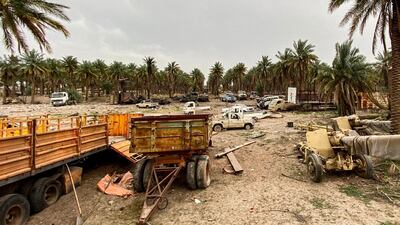
US air strikes targeting pro-Iranian military factions in Iraq killed one civilian and five security personnel early on March 13, the Iraqi military said. AFP -
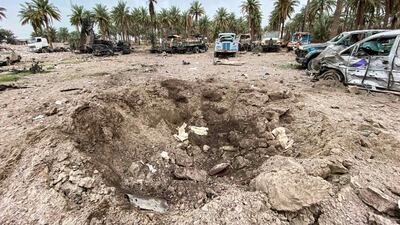
The Pentagon said the strikes were in retaliation for rocket fire against an Iraqi base the night of March 12 that killed one British and two US military personnel in the deadliest such attack in years. AFP -
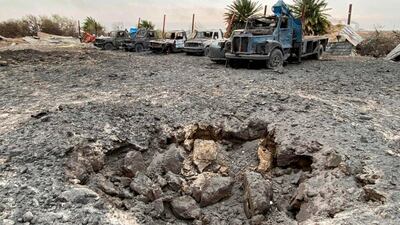
An impact crater in the aftermath of US military air strikes at a militarized zone in the Jurf Al Sakhr area in Iraq's Babylon province. AFP -
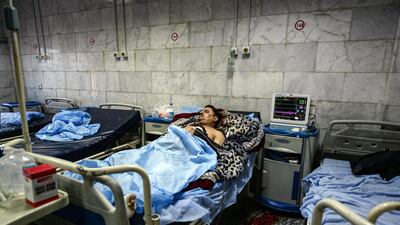
A member of the Hashed Al Shaabi paramilitaries injured in an area targeted by US military air strikes, receives treatment while lying on a bed at Hilla General Teaching Hospital in Iraq's central city of Hilla on March 13, 2020. AFP -
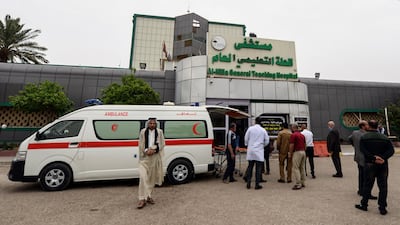
An ambulance that transported members of the Hashed Al Shaabi paramilitaries, injured in an area targeted by US military air strikes, arrives at Hilla General Teaching Hospital. AFP -
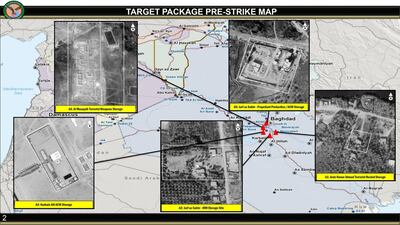
This annotated image provided by the US Department of Defense showing aerial images of sites targeted in airstrikes on Friday, March 13, 2020. US Department of Defense via AP -
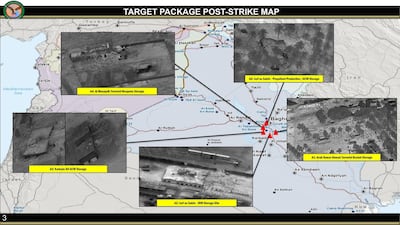
This annotated image provided by the US Department of Defense showing aerial images of sites targeted in airstrikes on Friday, March 13, 2020. US Department of Defense via AP -
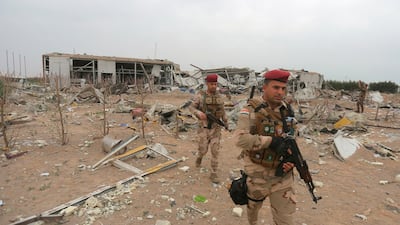
Iraqi army soldiers inspect the destruction at an airport complex under construction in Karbala. AP -

Marine Corps Gen Kenneth F McKenzie, commander of US Central Command, talks to journalists about the military response to rocket attacks that killed two US and one UK service members in Iraq. Getty Images via AFP -
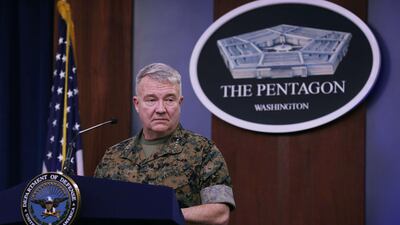
Marine Corps Gen Kenneth F McKenzie, commander of US Central Command, talks to journalists about the military response to rocket attacks that killed two US and one UK service members in Iraq. Getty Images via AFP


“We received a letter from the US State Department that proposed the negotiations, which will be based on the concepts presented in the strategic framework and a comprehensive review of the economic, cultural, commercial and security relations,” Mr Al Hakim said on Twitter.
Their current relationship, and the US presence in the country, is based on a strategic framework agreement signed in 2008.
It called for close defence co-operation to deter threats to Iraqi “sovereignty, security and territorial integrity".
Experts believe that a revision of the agreement is necessary to maintain relations between the two sides.
"I would advise the two sides to revisit the entire 2008 Strategic Framework Agreement. It is inadequate and unsuitable for the current prospects and challenges of their bilateral relations," said Abbas Kadhim, senior fellow at the Atlantic Council.
“The US cannot benefit from trying to impose unwanted posture in Iraq and Iraq does not gain by alienating the US.”
An American strike in early January which killed Iranian general Qassem Suleimani escalated tension between Washington and Iran and angered Iraqi officials.
The move prompted parliament to vote for the expulsion of foreign troops from the country.
More than 5,000 US troops remain in Iraq, most in an advisory role.
Washington has reduced its troop presence to a smaller number of bases with missile defences.
The US-led coalition announced a significant troop withdrawal from five military bases in the country last month.
It said the move was part of an agreement with the Iraqi government and coalition partners and was in response to risks imposed by the outbreak of coronavirus pandemic.
Prime minister-designate Adnan Al Zurfi said on Saturday the US had vowed that half of its troops would leave Iraq before the end of the year.
The US invaded Iraq in 2003 to remove dictator Saddam Hussein, leaving a trail of destruction and chaos that the country and region is still recovering from.
US troops returned in 2014 as part of a coalition to fight ISIS and train Iraqi security forces.

