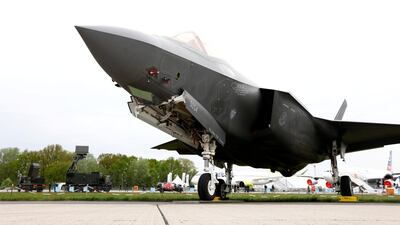

Turkey has officially lost an order of eight F-35 jets that has now gone to the US Air Force after Ankara decided to buy the Russian S-400 missile defence system last year.
The Department of Defence announced the decision to requisition the F-35s in its daily contract updates on Monday.
The contract involved buying the eight F-35A jets built by Lockheed Martin as part of a $861.7 million modification.
"This modification exercises options to procure eight Lot 14 F-35A Lightning II aircraft as a result of the Republic of Turkey's removal from the F-35 programme, and six Lot 14 F-35A aircraft for the air force," the contract read.
The decision came a year after Turkey was removed from the F-35 consortium in 2019 following its purchase of the S-400 system. The US also ended its F-35 training programme for Turkish personnel and blocked the transfer of the jets to its Nato ally.
Turkey joined the US' F-35 consortium in 2002, alongside the United Kingdom, Italy, the Netherlands, Canada, Turkey, Australia, Norway and Denmark. It had planned to buy 100 of the jets before deciding on the controversial deal with Russia. Each F-35 costs about $90 million (Dh331m).
The S-400 acquisition was deemed as a violation of Congress’ Countering America’s Adversaries through Sanctions Act (CAATSA) that passed overwhelmingly in 2017 to sanction any significant transactions with Russia. Leading US Senators urged swift sanctions on Turkey and its complete removal from the F-35 supply chain.
US officials also feared Russia could use the S-400 to acquire intelligence on the F-35 and Nato members' defence systems.
Katie Wheelbarger, acting assistant secretary of defence for international security, said last year that the two systems were incompatible.
"The S-400 is a computer. The F-35 is a computer. You don't hook your computer to your adversary's computer and that's basically what we would be doing.”
In losing its F-35 jet deliveries, Turkey now has an operability problem, according to Aaron Stein, the director of research at the Foreign Policy Research Institute think tank in Philadelphia, Pennsylvania.
“It is getting very hard to see how Turkey will operate this [F-35] jet in the future. It is also unknown what choices Turkey will make for a future fourth generation fighter,” he wrote in a tweet.
Turkey was negotiating with Russia last year to acquire its Su-35 Flanker-E fighter jets as an alternative to the F-35.
Such a deal, if agreed, will deepen the divide between Turkey and Nato, and accelerate US sanctions. US President Donald Trump has delayed the imposition of CAATSA sanctions on Ankara.
Mr Trump has fostered a close relationship with Turkish counterpart Recep Tayyip Erdogan, whom he called last week and discussed trade negotiations, according to the White House.

