• A woman sits in shock at a make-shift hospital in Kafr Batna following Syrian government bombardments on the besieged Eastern Ghouta rebel enclave on the outskirts of the capital Damascus. Ammar Suleiman / AFP Photo
    A woman sits in shock at a make-shift hospital in Kafr Batna following Syrian government bombardments on the besieged Eastern Ghouta rebel enclave on the outskirts of the capital Damascus. Ammar Suleiman / AFP Photo
  • A wounded boy waits for treatment a make-shift hospital. Amer Almohibany / AFP Photo
    A wounded boy waits for treatment a make-shift hospital. Amer Almohibany / AFP Photo
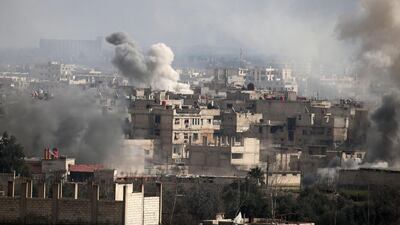
  • Smoke rises from buildings in Kafr Batna. Amer Almohibany / AFP Photo
    Smoke rises from buildings in Kafr Batna. Amer Almohibany / AFP Photo
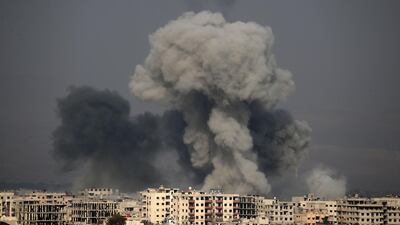
  • Smoke rises from another regime air strike in the rebel-held enclave of Hamouria. Abdulmonam Eaasa / AFP Photo
    Smoke rises from another regime air strike in the rebel-held enclave of Hamouria. Abdulmonam Eaasa / AFP Photo
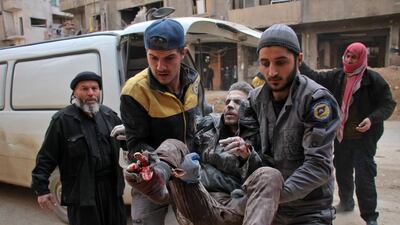
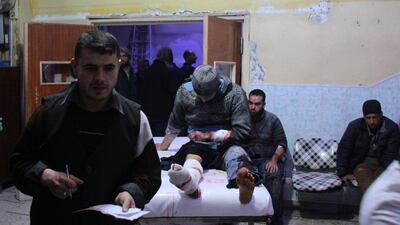
  • A wounded man is assisted by another at the makeshift hospital. Amer Almohibany / AFP Photo
    A wounded man is assisted by another at the makeshift hospital. Amer Almohibany / AFP Photo
  • Wounded Syrians seek treatment at a make-shift hospital in Kafr Batna. Amer Almohibany / AFP Photo
    Wounded Syrians seek treatment at a make-shift hospital in Kafr Batna. Amer Almohibany / AFP Photo
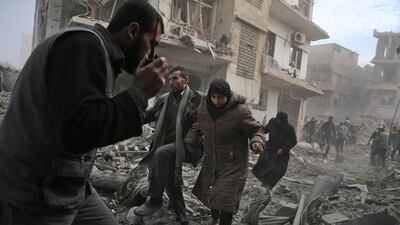
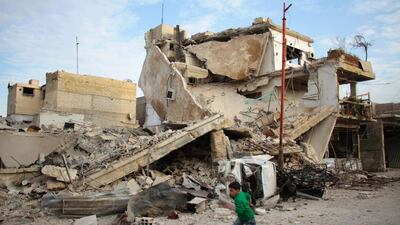
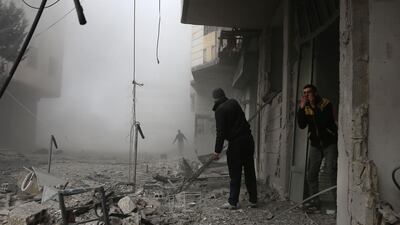
  • Syrians search for victims under the rubble of a building destroyed by Syrian government forces airstrikes. Ghouta Media Center via AP
    Syrians search for victims under the rubble of a building destroyed by Syrian government forces airstrikes. Ghouta Media Center via AP
  • A member of the Syrian Civil Defence group carries a boy away from the shelling. Syrian Civil Defense White Helmets via AP
    A member of the Syrian Civil Defence group carries a boy away from the shelling. Syrian Civil Defense White Helmets via AP
  • A Syrian girl who was wounded during airstrikes cries at a makeshift hospital in Ghouta. Ghouta Media Center via AP
    A Syrian girl who was wounded during airstrikes cries at a makeshift hospital in Ghouta. Ghouta Media Center via AP

US condemns Syrian 'siege tactics' on civilians, calls Assad regime 'deplorable'


  • English
  • Arabic

The US strongly condemned recent attacks on Eastern Ghouta, blaming Russian and Syrian regime strikes for the escalating violence in the rebel-held enclaves.

"The targeted destruction of medical facilities in Eastern Ghouta and the continued use of siege tactics, which starve Syrian civilians and prevent humanitarian access, are especially troubling," said the release.

In the statement the US Press Secretary calls Bashar Al Assad's government a "deplorable regime" and urged Damascus to "stop committing additional atrocities and must not be further abetted by backers in Moscow and Tehran."

A Syrian regime air campaign has killed almost 300 civilians in three days in the eastern suburbs of Damascus, intensifying President Bashar Al Assad's efforts to reclaim one of the country's last rebel-held enclaves.

On the same day in which the country's capital reached unprecedented levels of violence, a new batch of pro-Damascus forces arrived in the northern region of Afrin in support of Kurdish militias fighting against Turkey.

The spokesman for President Recep Tayyip Erdogan on Wednesday warned of “serious consequences” for any Syrian government forces backing the People's Protection Units (YPG) - a Kurdish militia they equate to the outlawed Kurdistan Workers' Party, or PKK.

Turkish-backed Syrian opposition fighters move in a vehicle as they battle for control of the village of Al Bayyah, northeast of Afrin near the Turkish border. Nazeer Al Khatib / AFP Photo

"Any step by the regime or other elements in this direction will surely have serious consequences," Ibrahim Kalin told reporters.

The Syrian government has not had a considerable presence in Afrin since 2012 but deployed forces on Tuesday in support of the YPG, as Turkey pressed ahead with its offensive to drive the Kurds out of the canton. Turkish forces reportedly shelled the area in response.

Ramon Penas / The National

On Wednesday, the Turkish military and allied Syrian rebel militias had nearly captured the entirety of the Syrian side of the Turkey-Syria border near Afrin. A victory would give Turkey a contiguous buffer zone inside Syria stretching some 150 km across northern portions of Idlib and Aleppo provinces.

The statement by Mr Erdogan’s spokesman did little to add clarity to one of the most complicated episodes in Syria’s nearly seven-year-old civil war.

_____________

Read more:

Editorial: Words haven't failed Syrian children; human compassion has

Syria is becoming a black hole of Cold War entanglements

_____________

The YPG is considered both a terrorist group by Turkey and an ally against ISIL by the US. It has also maintained a stable relationship with the Syrian government, which largely withdrew its armed forces from Kurdish-controlled areas in 2012 to focus on fighting rebels elsewhere, leaving those areas in control of the YPG.

In return for relative autonomy, the YPG and its political branch the PYD, have often stifled anti-government sentiments in areas under their control, while also cracking down harshly on political challenges to their own control.

"Every step taken in support for the YPG terror organisation would mean (any forces intervening on the Kurdish militants' side) are on the same level as terror organisations. And for us, that would make them legitimate targets," said Mr Erdogan's spokesman.

A Syrian journalist in Afrin said that the arrival of pro-government forces had so far not affected the fighting around the city, where clashes continued, or Turkish air and artillery strikes closer to the city.

"The situation is normal," the journalist told The National. "The shelling is continuing."

The international nature of Syria’s conflict was also evident in Damascus' Ghouta on Wednesday, when the Russian government, which frequently carries out airstrikes in support of the Syrian government, denied it had been involved in this week’s strikes.

  • Smoke plumes rise following a reported regime air strike in the rebel-held town of Hamouria, in the besieged Eastern Ghouta region. Abbdulmonam Eassa / AFP
    Smoke plumes rise following a reported regime air strike in the rebel-held town of Hamouria, in the besieged Eastern Ghouta region. Abbdulmonam Eassa / AFP
  • Civil Defence volunteers, known as the White Helmets, carry a wounded man into a makeshift hospital in the rebel-held town of Douma, following air strikes by regime forces on the besieged Eastern Ghouta region on the outskirts of the capital Damascus on February 20, 2018. Hamza Al-Ajweh / AFP
    Civil Defence volunteers, known as the White Helmets, carry a wounded man into a makeshift hospital in the rebel-held town of Douma, following air strikes by regime forces on the besieged Eastern Ghouta region on the outskirts of the capital Damascus on February 20, 2018. Hamza Al-Ajweh / AFP
  • A member of the Syrian civil defence speaks on a wireless transmitter as other civilians flee from an area hit by a reported regime air strike in the rebel-held town of Saqba, in the besieged Eastern Ghouta region. Abdulmonam Eassa / AFP
    A member of the Syrian civil defence speaks on a wireless transmitter as other civilians flee from an area hit by a reported regime air strike in the rebel-held town of Saqba, in the besieged Eastern Ghouta region. Abdulmonam Eassa / AFP
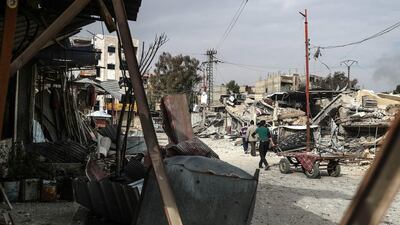
  • People walk next to destroyed buildings from an alleged barrel bomb attack, at rebel-held Douma, Syria. Mohammed Badra / EPA
    People walk next to destroyed buildings from an alleged barrel bomb attack, at rebel-held Douma, Syria. Mohammed Badra / EPA
  • A Russian-made Syrian army attack helicopter dropping a payload over the rebel-held town of Arbin, in the besieged Eastern Ghouta region. Amer Almohibany / AFP
    A Russian-made Syrian army attack helicopter dropping a payload over the rebel-held town of Arbin, in the besieged Eastern Ghouta region. Amer Almohibany / AFP
  • A Syrian boy runs past a destroyed building during air strikes by regime forces in the rebel-held town of Douma, in the besieged Eastern Ghouta region. Hamza Al-Ajweh / AFP
    A Syrian boy runs past a destroyed building during air strikes by regime forces in the rebel-held town of Douma, in the besieged Eastern Ghouta region. Hamza Al-Ajweh / AFP
  • Smoke plumes rising following a reported regime air strike in the rebel-held town of Hamouria, in the besieged Eastern Ghouta region. Abdulmonam Eassa / AFP
    Smoke plumes rising following a reported regime air strike in the rebel-held town of Hamouria, in the besieged Eastern Ghouta region. Abdulmonam Eassa / AFP
  • Members of the Syrian civil defence search for injured victims through the rubble of destroyed buildings in an area hit by a reported regime air strike in the rebel-held town of Hamouria, in the besieged Eastern Ghouta region. Abdulmonam Eassa / AFP
    Members of the Syrian civil defence search for injured victims through the rubble of destroyed buildings in an area hit by a reported regime air strike in the rebel-held town of Hamouria, in the besieged Eastern Ghouta region. Abdulmonam Eassa / AFP
  • A wounded Syrian sits on a gurney as victims pour into a makeshift hospital in the rebel-held town of Douma, following air strikes by regime forces on the besieged Eastern Ghouta region. Hamza Al-Ajweh / AFP
    A wounded Syrian sits on a gurney as victims pour into a makeshift hospital in the rebel-held town of Douma, following air strikes by regime forces on the besieged Eastern Ghouta region. Hamza Al-Ajweh / AFP

The Syrian Observatory for Human Rights, which monitors the county’s civil war, said the strikes have killed at least 274 people since Sunday in the rebel-held suburbs. Eastern Ghouta has been under rebel control and a government siege for more than five years.

The siege intensified last year when government forces cut one of the last supply routes into the area. Between 300,000 and 400,000 people are affected, with an increase in malnutrition rates and hundreds of deaths from lack of proper medical care or complications from treatable conditions.

The last three days have seen the bloodiest wave of strikes on the enclave since the start of the civil war in 2011.

UN Secretary-General Antonio Guterres on Wednesday called for an immediate halt in fighting.

"My appeal to all those involved is for an immediate suspension of all war activities in Eastern Ghouta allowing for humanitarian aid to reach all those in need," Mr Guterres told the UN Security Council.

The siege has restricted access to medical supplies, while three clinics were hit and put out of service this week, overwhelming medics.

The hospital in the town of Arbin, east of Ghouta, was hit twice on Tuesday and the Observatory said Russian warplanes had carried out the strike.

The Kremlin on Wednesday denied any involvement in the strikes and rejected reports to the contrary as "groundless accusations."

The International Committee of the Red Cross asked on Wednesday for access to Eastern Ghouta.

"The fighting appears likely to cause much more suffering in the days and weeks ahead, and our teams need to be allowed to enter Eastern Ghouta to aid the wounded," said Marianne Gasser, ICRC's head of delegation in Syria.

Brief scores:

Toss: Northern Warriors, elected to field first

Bengal Tigers 130-1 (10 ov)

Roy 60 not out, Rutherford 47 not out

Northern Warriors 94-7 (10 ov)

Simmons 44; Yamin 4-4

The Way It Was: My Life with Frank Sinatra by Eliot Weisman and Jennifer Valoppi
Hachette Books

GAC GS8 Specs

Engine: 2.0-litre 4cyl turbo

Power: 248hp at 5,200rpm

Torque: 400Nm at 1,750-4,000rpm

Transmission: 8-speed auto

Fuel consumption: 9.1L/100km

On sale: Now

Price: From Dh149,900

What the law says

Micro-retirement is not a recognised concept or employment status under Federal Decree Law No. 33 of 2021 on the Regulation of Labour Relations (as amended) (UAE Labour Law). As such, it reflects a voluntary work-life balance practice, rather than a recognised legal employment category, according to Dilini Loku, senior associate for law firm Gateley Middle East.

“Some companies may offer formal sabbatical policies or career break programmes; however, beyond such arrangements, there is no automatic right or statutory entitlement to extended breaks,” she explains.

“Any leave taken beyond statutory entitlements, such as annual leave, is typically regarded as unpaid leave in accordance with Article 33 of the UAE Labour Law. While employees may legally take unpaid leave, such requests are subject to the employer’s discretion and require approval.”

If an employee resigns to pursue micro-retirement, the employment contract is terminated, and the employer is under no legal obligation to rehire the employee in the future unless specific contractual agreements are in place (such as return-to-work arrangements), which are generally uncommon, Ms Loku adds.

Ten tax points to be aware of in 2026

1. Domestic VAT refund amendments: request your refund within five years

If a business does not apply for the refund on time, they lose their credit.

2. E-invoicing in the UAE

Businesses should continue preparing for the implementation of e-invoicing in the UAE, with 2026 a preparation and transition period ahead of phased mandatory adoption. 

3. More tax audits

Tax authorities are increasingly using data already available across multiple filings to identify audit risks. 

4. More beneficial VAT and excise tax penalty regime

Tax disputes are expected to become more frequent and more structured, with clearer administrative objection and appeal processes. The UAE has adopted a new penalty regime for VAT and excise disputes, which now mirrors the penalty regime for corporate tax.

5. Greater emphasis on statutory audit

There is a greater need for the accuracy of financial statements. The International Financial Reporting Standards standards need to be strictly adhered to and, as a result, the quality of the audits will need to increase.

6. Further transfer pricing enforcement

Transfer pricing enforcement, which refers to the practice of establishing prices for internal transactions between related entities, is expected to broaden in scope. The UAE will shortly open the possibility to negotiate advance pricing agreements, or essentially rulings for transfer pricing purposes. 

7. Limited time periods for audits

Recent amendments also introduce a default five-year limitation period for tax audits and assessments, subject to specific statutory exceptions. While the standard audit and assessment period is five years, this may be extended to up to 15 years in cases involving fraud or tax evasion. 

8. Pillar 2 implementation 

Many multinational groups will begin to feel the practical effect of the Domestic Minimum Top-Up Tax (DMTT), the UAE's implementation of the OECD’s global minimum tax under Pillar 2. While the rules apply for financial years starting on or after January 1, 2025, it is 2026 that marks the transition to an operational phase.

9. Reduced compliance obligations for imported goods and services

Businesses that apply the reverse-charge mechanism for VAT purposes in the UAE may benefit from reduced compliance obligations. 

10. Substance and CbC reporting focus

Tax authorities are expected to continue strengthening the enforcement of economic substance and Country-by-Country (CbC) reporting frameworks. In the UAE, these regimes are increasingly being used as risk-assessment tools, providing tax authorities with a comprehensive view of multinational groups’ global footprints and enabling them to assess whether profits are aligned with real economic activity. 

Contributed by Thomas Vanhee and Hend Rashwan, Aurifer

DUBAI SEVENS 2018 DRAW

Gulf Men’s League
Pool A – Dubai Exiles, Dubai Hurricanes, Bahrain, Dubai Sports City Eagles
Pool B – Jebel Ali Dragons, Abu Dhabi Saracens, Abu Dhabi Harlequins, Al Ain Amblers

Gulf Men’s Open
Pool A – Bahrain Firbolgs, Arabian Knights, Yalla Rugby, Muscat
Pool B – Amman Citadel, APB Dubai Sharks, Jebel Ali Dragons 2, Saudi Rugby
Pool C – Abu Dhabi Harlequins 2, Roberts Construction, Dubai Exiles 2
Pool D – Dubai Tigers, UAE Shaheen, Sharjah Wanderers, Amman Citadel 2

Gulf U19 Boys
Pool A – Deira International School, Dubai Hurricanes, British School Al Khubairat, Jumeirah English Speaking School B
Pool B – Dubai English Speaking College 2, Jumeirah College, Dubai College A, Abu Dhabi Harlequins 2
Pool C – Bahrain Colts, Al Yasmina School, DESC, DC B
Pool D – Al Ain Amblers, Repton Royals, Dubai Exiles, Gems World Academy Dubai
Pool E – JESS A, Abu Dhabi Sharks, Abu Dhabi Harlequins 1, EC

Gulf Women
Pool A – Kuwait Scorpions, Black Ruggers, Dubai Sports City Eagles, Dubai Hurricanes 2
Pool B – Emirates Firebirds, Sharjah Wanderers, RAK Rides, Beirut Aconites
Pool C – Dubai Hurricanes, Emirates Firebirds 2, Abu Dhabi Saracens, Transforma Panthers
Pool D – AUC Wolves, Dubai Hawks, Abu Dhabi Harlequins, Al Ain Amblers

Gulf U19 Girls
Pool A – Dubai Exiles, BSAK, DESC, Al Maha
Pool B – Arabian Knights, Dubai Hurricanes, Al Ain Amblers, Abu Dhabi Harlequins

How does ToTok work?

The calling app is available to download on Google Play and Apple App Store

To successfully install ToTok, users are asked to enter their phone number and then create a nickname.

The app then gives users the option add their existing phone contacts, allowing them to immediately contact people also using the application by video or voice call or via message.

Users can also invite other contacts to download ToTok to allow them to make contact through the app.


Washmen Profile

Date Started: May 2015

Founders: Rami Shaar and Jad Halaoui

Based: Dubai, UAE

Sector: Laundry

Employees: 170

Funding: about $8m

Funders: Addventure, B&Y Partners, Clara Ventures, Cedar Mundi Partners, Henkel Ventures

F1 The Movie

Starring: Brad Pitt, Damson Idris, Kerry Condon, Javier Bardem

Director: Joseph Kosinski

Rating: 4/5

PROFILE BOX:

Company/date started: 2015

Founder/CEO: Rami Salman, Rishav Jalan, Ayush Chordia

Based: Dubai, UAE

Sector: Technology, Sales, Voice, Artificial Intelligence

Size: (employees/revenue) 10/ 100,000 downloads

Stage: 1 ($800,000)

Investors: Eight first-round investors including, Beco Capital, 500 Startups, Dubai Silicon Oasis, Hala Fadel, Odin Financial Services, Dubai Angel Investors, Womena, Arzan VC


A State of Passion

Directors: Carol Mansour and Muna Khalidi

Stars: Dr Ghassan Abu-Sittah

Rating: 4/5

The%20specs%20
%3Cp%3E%3Cstrong%3EEngine%3A%20%3C%2Fstrong%3EDual%20permanently%20excited%20synchronous%20motors%3Cbr%3E%3Cstrong%3EPower%3A%20%3C%2Fstrong%3E516hp%20or%20400Kw%3Cbr%3E%3Cstrong%3ETorque%3A%20%3C%2Fstrong%3E858Nm%3Cbr%3E%3Cstrong%3ETransmission%3A%20%3C%2Fstrong%3ESingle%20speed%20auto%3Cbr%3E%3Cstrong%3ERange%3A%20%3C%2Fstrong%3E485km%3Cbr%3E%3Cstrong%3EPrice%3A%20%3C%2Fstrong%3EFrom%20Dh699%2C000%3C%2Fp%3E%0A

Expert input

If you had all the money in the world, what’s the one sneaker you would buy or create?

“There are a few shoes that have ‘grail’ status for me. But the one I have always wanted is the Nike x Patta x Parra Air Max 1 - Cherrywood. To get a pair in my size brand new is would cost me between Dh8,000 and Dh 10,000.” Jack Brett

“If I had all the money, I would approach Nike and ask them to do my own Air Force 1, that’s one of my dreams.” Yaseen Benchouche

“There’s nothing out there yet that I’d pay an insane amount for, but I’d love to create my own shoe with Tinker Hatfield and Jordan.” Joshua Cox

“I think I’d buy a defunct footwear brand; I’d like the challenge of reinterpreting a brand’s history and changing options.” Kris Balerite

 “I’d stir up a creative collaboration with designers Martin Margiela of the mixed patchwork sneakers, and Yohji Yamamoto.” Hussain Moloobhoy

“If I had all the money in the world, I’d live somewhere where I’d never have to wear shoes again.” Raj Malhotra

How to wear a kandura

Dos

  • Wear the right fabric for the right season and occasion 
  • Always ask for the dress code if you don’t know
  • Wear a white kandura, white ghutra / shemagh (headwear) and black shoes for work 
  • Wear 100 per cent cotton under the kandura as most fabrics are polyester

Don’ts 

  • Wear hamdania for work, always wear a ghutra and agal 
  • Buy a kandura only based on how it feels; ask questions about the fabric and understand what you are buying
Ms Yang's top tips for parents new to the UAE
  1. Join parent networks
  2. Look beyond school fees
  3. Keep an open mind