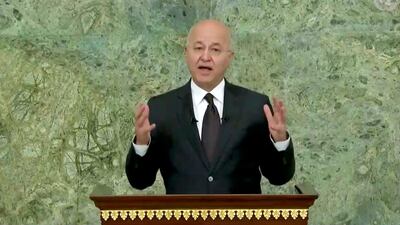

Iraqis on the streets of the country demanding change represent a nation embittered by corruption and thirsty for democratic reform, said President Barham Salih on Wednesday as he used his appearance at the UN General Assembly to back to year-long protest movement.
“The Iraqi people are deeply bitter when it comes to the impact of corruption. They are angry," Mr Salih told the world.
"[Corruption has] contributed to the destruction of Iraq for many years,” he added as he called for the formation of an international organisation to recover stolen assets.
He said the Iraq uprising, which started last October, is justified in demanding fundamental reform and the imposition of the rule of law even as he recognised the challenges of bringing arms under state control.
"It has been a year since Iraq has seen a popular movement emanating from the desire to make a change in the country,'' he said. "The Iraqis are looking for a new political contract to deal with the structural flaws in the government system since 2003 [when the US-led invasion removed Saddam Hussein].”
Government forces and pro-Iranian militias attempted to crush the uprising by April this year, killing and abducting hundreds of demonstrators and independent civilian figures.
In in the midst of an economic crisis in May a reformist government headed by Mustafa Al Kadhimi, a former intelligence chief supported by the United States, assumed office, breathing life in the protest movement. But he faces challenges, including from the street that is demanding the removal of the entire political class.
The economic crisis was prompted by collapsing oil prices and the coronavirus pandemic. But the acute crises came against a backdrop of years of corruption, mismanagement and collapsed infrastructure and public services.
Mr Salih said debate is raging in Iraq about how the state is managed and about basic rights.
"Faced with popular will, the government has a huge responsibility," he said.
Without naming the Iran-backed militias, Mr Salih recognised the scale of the challenge of bringing weapons under the control of the state and called for outside powers not to use the country to settle scores.
"There is a growing will not to maintain the existing status quo," he said as he called for a fairer representation of the people through a new election law.
The mostly young demonstrators have been demanding an end to corruption, poor public services, unemployment and a change in the political system that has entrenched nepotism and poor government since 2003.
At least 600 protesters and activists have been killed by security forces and Iran-backed militias since the protests started and tens of thousands left with life-changing wounds.
He assured demonstrators that "peaceful and constitutional change" was possible.
"No less important is to keep weapons only within the realm of the state. It is not an easy task but has to be done if we want civil peace in our country," he said.
"We don’t want Iraq to be an arena to settle scores. It is enough what Iraq has been through."
"We look forward to effective support from our neighbours."
Mr Salih also called on the world to help resettle Yezidis uprooted by ISIS.
“We have to stop at the genocide against the Yezidi’s which happened in our country and which requires from the international community to stop against these crimes,” Mr Salih said as he warned of the continuing threat of terrorism in Iraq.

