
Turkey and Russia have agreed on a deal to establish a "terrorism-free safe zone" in northern Syria, with Kurdish fighters expected to vacate the area within 150 hours.
A five-day truce between Turkey and the mostly Kurdish Syrian Defence Forces ended at 10pm on Tuesday.
Kurdish officials said earlier that they had complied with Turkey's demands and withdrawn from the border area between the towns of Tel Abyad and Ras Al Ain.
Turkey had threatened to relaunch its offensive if the Kurdish troops did not withdraw.
But on Wednesday, Turkey said there was "no need" to restart its attacks against Kurdish fighters in Syria, saying that it had been informed by the US that their withdrawal from the border areas had been "completed".
"At this stage, there is no further need to carry out a new operation," the defence ministry said in a statement.
During peace talks between Turkish President Recep Tayyip Erdogan and Russian leader Vladimir Putin in Sochi on Tuesday, it was agreed that the two countries would jointly patrol an area of up to 10 kilometres inside the Syrian border.
Mr Erdogan said that under the deal, Syrian Kurdish fighters would move 30 kilometres away from the Turkish border area in north-east Syria within 150 hours, starting at noon on Wednesday.
Turkey began its cross-border operation nearly two weeks ago after US President Donald Trump's decision to withdraw troops from northern Syria.
The withdrawal has been criticised in the US, including by some of Mr Trump's fellow Republicans, where it is seen as a betrayal of Kurdish allies who helped in the fight against ISIS and has stoked fears of a resurgence of the group.
On Tuesday the US special representative for Syria, James Jeffrey, said that "dozens" of ISIS fighters had been freed since Turkey began its incursion in northeastern Syria.
"I would say dozens at this point," Mr Jeffrey told a congressional hearing when Senator Chris Coons asked if he knew how many "hardened" extremist fighters had been released.
There have been reports of much larger numbers, and on Tuesday Russia's defence minister said up to 500 people who were being held in prisons for ISIS fighters in northern Syria had escaped.
The UN said on Tuesday that more than 176,000 people were displaced during the incursion, including nearly 80,000 children, and “critical infrastructure has been damaged”.
-

Turkey-backed Syrian rebel fighters patrol in the border town of Tal Abyad, Syria. Reuters -
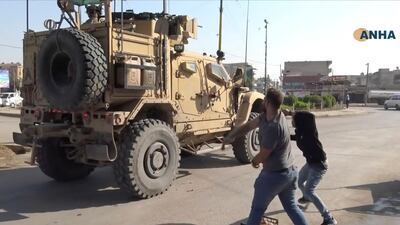
In this frame grab from video provided by Hawar News, ANHA, the Kurdish news agency, residents who are angry over the U.S. withdrawal from Syria hurl potatoes at American military vehicles in the town of Qamishli, northern Syria. AP -
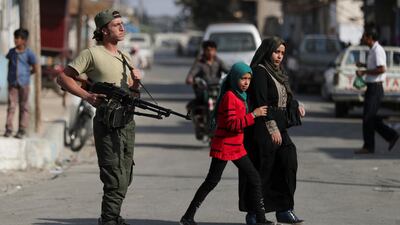
A Turkey-backed Syrian rebel fighter patrols in the border town of Tal Abyad, Syria. Reuters -
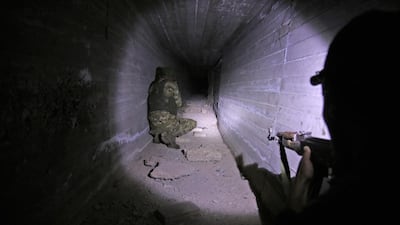
Turkish-backed Syrian fighters inspect a tunnel, said to have been built by Kurdish fighters, in the Syrian border town of Tal Abyad. TAFP -
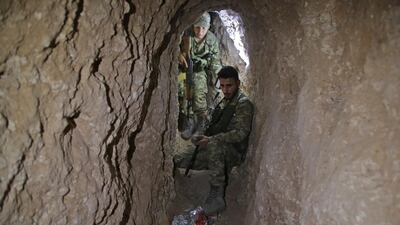
Turkish-backed Syrian fighters inspect a tunnel, said to have been built by Kurdish fighters, in the Syrian border town of Tal Abyad. AFP -
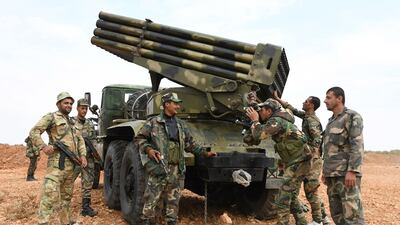
A handout picture released by the official Syrian Arab News Agency shows Syrian regime units deploying in the northern city of Manbij, near the Turkish border. AFP PHOTO -

Syrian regime forces during a deployment operations in the Manbij area. EPA -

A Turkey-backed Syrian rebel fighter rides a bicycle down a street in the border town of Tal Abyad, Syria. Reuters -

People attend funerls of Syrian Democratic Forces fighters killed recently fighting Turkish forces in the twon of al-Hasakeh, North Syria. AP Photo -
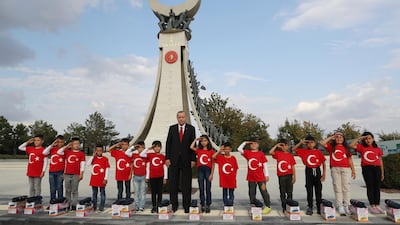
Turkish President Recep Tayyip Erdogan poses for photos with primary school students from a village of Black Sea city of Samsun, who give a military salute outside the presidential palace, in Ankara. Erdogan has responded angrily to widespread criticism in the West of Turkey's incursion in northeast Syria. AP, Pool


UN spokesman Stephane Dujarric said that powerlines were damaged, affecting at least four hospitals.
Ankara considers the Kurdish groups that control northern Syria to be a national security threat because of their ties to the Kurdistan Workers’ Party, an armed group that has waged an insurgency in Turkey for decades.
But Mr Erdogan’s offensive met resistance from Syrian President Bashar Al Assad’s ally Russia.
Kremlin spokesman Dmitry Peskov said on Tuesday that only Damascus could authorise the presence of Turkish troops in Syria.
Ankara has dismissed any notion of direct Turkey-Syria talks about its offensive, which it called Operation Peace Spring.
Since Moscow rallied to aid the struggling Syrian regime in 2015, Mr Putin has continuously said that full control of the country must be handed back to Damascus.
A spokesman for Iran’s Foreign Ministry, Abbas Mousavi, on Monday also objected to Turkey setting up military posts in Syria.
“Syria's integrity should be respected," Mr Mousavi said.
-

Handout photos made available by the official Syrian Arab News Agency (Sana) shows Syrian President Bashar Al Assad meeting with Syrian regime army personnel in the Idlib countryside. EPA -
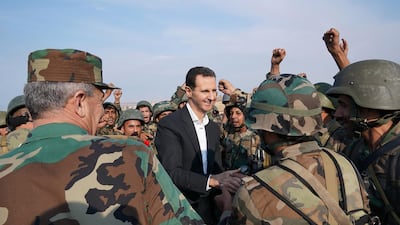
Sana repored that Assad visited regime troops "on the front line" with militants in Idlib. AFP -
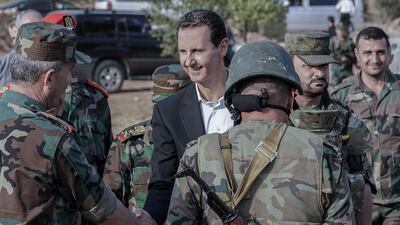
It's his first visit to the northwestern province since the start of the Civil War. -
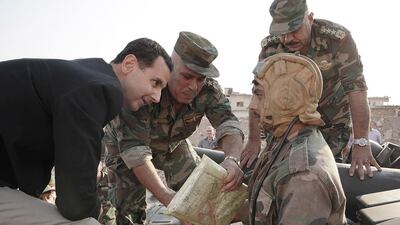
According to Sana, Assad criticised Turkish President Recep Tayyip Erdogan describing him as a 'robber' who is trying to take the Syrian land. EPA -
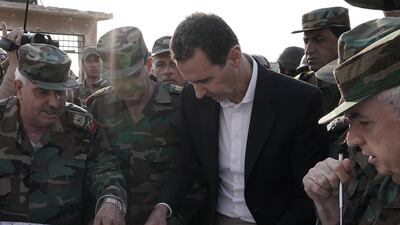
Turkey launched an offensive targeting Kurdish forces in northeastern Syria on October 9, days after the US withdrew troops from the area. EPA -

Assad shakes hands with regime troops in Idlib. EPA


In an unexpected visit to the north-western Idlib province on Tuesday, Mr Al Assad lashed out at Mr Erdogan for his offensive, calling him a “thief who robbed factories, wheat and fuel, and is today stealing territory”.
Despite backing opposing sides of the eight-year conflict, Turkey and Russia have maintained close ties since reconciling after Turkey shot down a Russian jet over the Syrian border in 2015.
Mr Erdogan has already visited Russia four times this year, while the Russian president travelled to Turkey in September.
Mr Trump’s decision to pull troops out of Syria has created tension and was seen as approval of Mr Erdogan’ offensive.
It left Washington’s close allies all but defenceless against a much better equipped advancing force.
On Monday, Russian state news agencies reported that Syrian and Russian troops had claimed control of Tabqa airfield in Raqqa.
And Germany’s Defence Minister proposed a security zone in Syria that would be patrolled by international troops, a suggestion that Mr Putin’s spokesman Dmitry Peskov said the Kremlin would study.

