
The chaos at the heart of Iran’s response to tackling coronavirus at its most notorious jail is exposed today in a series of searing dispatches from behind the prison walls.
In a week-long audio diary, political prisoner Anoosheh Ashoori recounts how medicine and food shortages have compounded the failures of authorities to keep inmates safe despite a major release programme aimed at checking its spread.
Mr Ashoori detailed in daily phone updates how sick prisoners suspected to have coronavirus have disappeared from the wings and how disease prevention measures have been undermined by incompetent staff.
Mr Ashoori told his wife Sherry Izadi that he lived in constant fear of catching a disease that could prove fatal and was concerned that the regime was presenting a false image of life inside Evin. "I want the world to know what's happening here," he told her.
He details how the prison appeared to have breached guidance issued by the World Health Organisation (WHO) on treating prisoners during the pandemic. Prisoners cooped together in small rooms are more vulnerable than the rest of the population.
The WHO has warned that the disease could be incubated among the prison population before being transmitted into the wider population by visitors and guards.
In the diary, Mr Ashoori details how:
- Sick prisoners were treated with sleeping pills because of a short supply of medicines
- Officials blocked the release of prisoners through incompetence
- Prison guards handed some duties to inmates because they feared infection
- Fights broke out between inmates because of food shortages
Mr Ashoori, 66, a married father-of-two, is a “security prisoner” serving 10 years in prison after he was arrested in 2017 and accused of spying for Mossad.
His supporters say he is an innocent man being held by the Iranian regime as a pawn in a broader geopolitical game with the UK government, which is seeking his release.
-

Anoosheh Ashoori with his wife before his arrest in Iran in 2017. Image provided by family -
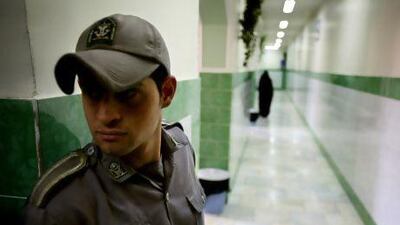
A guard stands along a corridor in Tehran's Evin prison. Reuters -
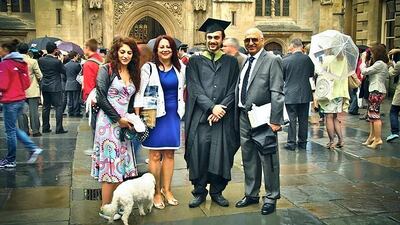
Anoosheh Ashoori (far-right) with his family in the UK before his arrest and detention in Iran. Image provided by family -
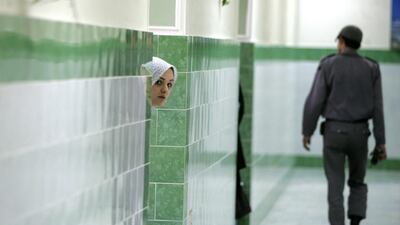
Anoosheh Ashoori told how sick prisoners suspected to have coronavirus have disappeared. AFP -

Nazanin Zaghari-Ratcliffe, a British-Iranian, embraces her daughter Gabriella during a brief period of release from Tehran's Evin jail. AFP


Mr Ashoori calls Sherry daily from a monitored telephone within his wing and recordings passed to The National details the trials of the remaining prisoners after the temporary release of some 100,000 inmates across the country.
The prison, built in 1971, is home to both men and women, and was described by one campaigning organisation as the “gold standard for human rights abuses in Iran.”
It earned notoriety in the late 1980s when thousands of political prisoners were executed there after summary trials, according to Human Rights Watch.
It is under the effective control of the judicial authorities, the Islamic Revolutionary Guard Corps and military intelligence with threats of torture, humiliation and hours of daily interrogations commonplace, it said.
Hadi Ghaemi, executive director of the New York-based Centre for Human Rights in Iran, accused the authorities of using the epidemic as a way to torture political prisoners who were not released, while others went free.
“Prisoners are very nervous and that keeps them constantly on a psychological edge which is no difference from torture,” he said.
Iran's foreign ministry was approached for comment.
Edited extracts
Wednesday April, 8
It’s been raining all day. Most of the inmates are staying in their dull rooms. And the kitchen is packed with smokers, making it unbearable to sit there.
Today there was a rumour that Moslem, one of the inmates, has been taken to the medical centre on suspicion of having contracted the virus. He was not feeling well from two days before his departure and he spent most of the time in bed. This is usually, as far as we know, because once an inmate leaves wing four and he does not return. Nobody knows any more about his fate.
Thursday April 9
The rain of yesterday has now turned into an unprecedented light snow for this time of the year. So we are again confined to our rooms. It is almost impossible to have privacy in here except when you are taking a shower or you are in the toilet.
Today someone who embezzled over a billion dollars and is now serving time in hall three was visiting our hall hoping he could transfer himself here. The guy who referred to himself as doctor swaggered into our hall with such an assumed air of defiance. His bravado disappeared when he was criticised for intruding into our hall without any mask or gloves.
Friday April 10
There is a rumour that two of the security prisoners have returned as their furloughs were not extended. It is said that Hall two has been turned into a quarantine and all those returning will be kept there for 14 days before being sent to their wings.
It is just enough for one contaminated person to arrive and the rest will soon contract the virus. Another inmate said go and be thankful that they are not killing us yet. A rumour was spreading that the inmates in a number of prisons in different cities were somehow allowed to flee the prisons only to be shot in the back.
Saturday April 11
I was lying on my bed with my curtain drawn to have a rest when someone started howling. His voice became increasingly loud but his words were unintelligible. The floors and walls of our corridors are covered with white ceramic tiles. Sound echoes in it badly.
Later it was discovered that the screaming was from room three. Mohammed, who is 21, suffers from a mental condition and had received the wrong medicine. This happens here frequently. Soon hell broke loose and he went out of control. He raised a chair and at the last moment hit it on his own head breaking it in two.
Sunday April 12
Hall One of wing four is on the ground floor. Room two, where I live, is about 9m by 4m and can accommodate 30 prisoners in its bunk beds. I just confirmed the news about the quarantine. As I was sitting in the yard, the window opened on the first floor and one of the brothers who returned from furlough waved his hand from behind the window bars. We greeted and I particularly asked him about the conditions in the quarantine. This is the most bizarre quarantine with no common sense behind it.
Monday April 13
The name of a roommate, ‘Max’, was mentioned through the loudspeaker. He was told to pack his belongings and go to the front desk where a soldier was waiting to escort him to the prison’s entrance to be released. He grew increasingly impatient waiting for any moment to be summoned. Soon [the desk] was closed and those who were not called, despite their eligibility, were left behind and their hopes utterly shattered. Their awaiting families were left dumbfounded on the other side. He was told that the prison offices were closed and the authorities did not attend regularly for fear of the coronavirus.
Wednesday April 15
Last night we placed a large saucepan under the radiator and you could hear the drops all through the night. It was leaking and our elderly roommate, ‘Moses’, could not sleep in his bed as it was soaking wet.
Later, as I was on the phone talking to my mum, I saw Moses coming down the stairs. His legs suddenly gave way. He was taken to the medical centre. Luckily, the conscientious doctor was there. He went through his papers and started shaking his head.
Moses asked him to hand over the prescription so he can ask his wife to buy the medicine and bring it for him. Most of the medicine we take has been bought and delivered to us by our families. The medicine that is given by the prison, if it’s given, is of a very low quality.
_____________
READ MORE: Fear and fights inside Iran's most notorious jail

