
Turkish jets shot down two Syrian war planes on a combat mission over the north-west province of Idlib on Sunday, the Syrian military said, as clashes between the two escalated.
Four Syrian pilots ejected from the fighters and parachuted to safety, said the country's state news agency, Sana.
Turkey's state-owned Anadolu agency also reported on Sunday that Turkish forces had bombed Nayrab military airport in the northern province of Aleppo and rendered it unusable.
Turkey’s Defence Ministry confirmed it had shot down two SU-24 aircraft and destroyed air defence systems after one of its drones was brought down.
The Syrian government has closed its airspace for flights and drones across the country’s north-west region.
“Any jet that violates our airspace will be treated as a hostile target that must be shot down and prevented from achieving its goals,” the Syrian military said.
Syrian state media initially denied that a government plane was brought down on Sunday and said the army had downed a Turkish drone over the town of Saraqib in Idlib. It said it had shot down three Turkish drones on Sunday.
The Russian Defence Ministry said on Sunday that Moscow could not guarantee the safety of Turkish planes flying in Syria, the Tass news agency reported.
"In these conditions the leadership of Russia's military contingent cannot guarantee the safety of Turkish flights in Syrian skies," Adml Oleg Zhuravlev said.
The developments followed two days of Turkish attacks in Idlib province that caused heavy losses to Syrian government forces, Syrian activists said.
Earlier on Sunday, Turkey announced that a military operation against the Syrian regime was under way two days after Turkish troops sustained heavy losses after a regime air strike in Idlib.
"Following the heinous attack on February 27 in Idlib, operation 'Spring Shield' successfully continues," said Hulusi Akar, the Turkish Defence Minister.
The retaliatory Turkish drone strikes and artillery fire have killed 74 Syrian soldiers and 14 allied fighters since Friday, the Syrian Observatory for Human Rights said from Britain.
The operation is Turkey's fourth in Syria since 2016.
The latest confrontations have added to soaring tensions between Turkey and Russia, who support opposing sides of the Syrian civil war.
Mr Akar said that Turkey did not wish to clash with Moscow, which is backing the Syrian regime.
Speaking from a military headquarters near the Syrian border, he said Turkey aimed to confront Syrian government forces rather than Russian troops.
Mt Akar called on Moscow to persuade Syrian President Bashar Al Assad to withdraw to 2018 ceasefire lines on the edges of Idlib.
But tensions between the two countries continue to mount.
On Saturday, Turkish President Recep Tayyip Erdogan told Mr Putin to step aside in Syria.
"I asked Mr Putin, 'What's your business there? If you establish a base, do so but get out of our way and leave us face-to-face with the regime'," Mr Erdogan said.
The two spoke in a phone call on Saturday.
-
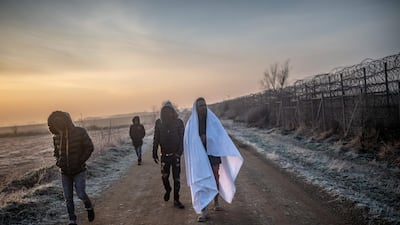
Migrants walk towards the Greek border in Pazarkule, in the Edirne district. Thousands of migrants stuck on the Turkey-Greece border clashed with Greek police. AFP -

Children sit on a beach near Skala Sykamineas on the Greek Lesbos island after crossing the Aegean sea between Turkey and Greece. AFP -
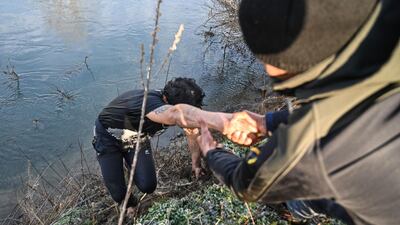
Migrants help each other after an attempt to enter Greece from a location near Edirne, Turkey, by crossing the Maritsa river. AFP -
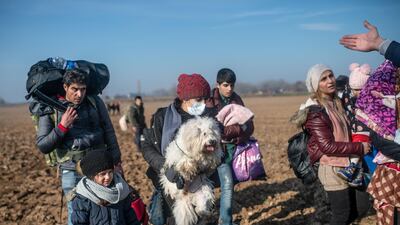
Migrants walk towards the Greek border in Pazarkule, in the Edirne district. AFP -

Migrants on a dinghy cross the Evros river to reach Greece, pictured from the Turkish border city of Edirne, Turkey. Reuters -
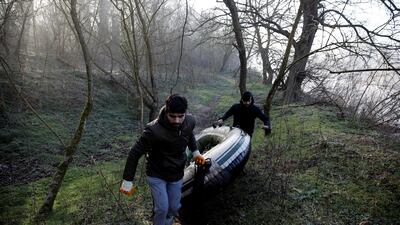
Migrants carry a dinghy to cross the Evros river to reach Greece, pictured near the Turkish border city of Edirne, Turkey. Reuters -
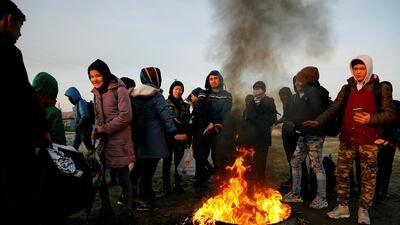
Migrants gather around a fire as they wait to cross the Evros river to reach Greece, near Doyran Village, near the Turkish border city of Edirne, Turkey. Reuters -
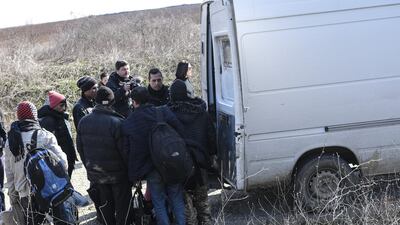
A group of migrants are detained after being caught by police on the side of the highway near the Greek-Turkish border. Getty Images -
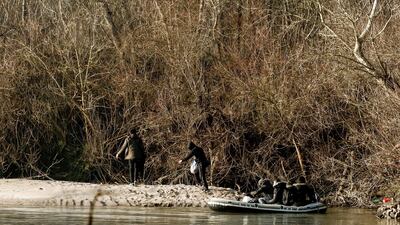
Migrants on a dinghy cross the Evros river and reach Greece, pictured from the Turkish border city of Edirne, Turkey. Reuters -
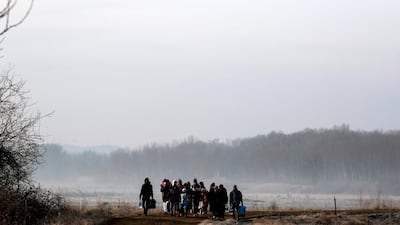
Migrants walk along the Evros river to reach Greece, near the Turkish border city of Edirne, Turkey. Reuters -

Migrants sit waiting near the buffer zone at Turkey-Greece border, at Pazarkule, in Edirne district. AFP -
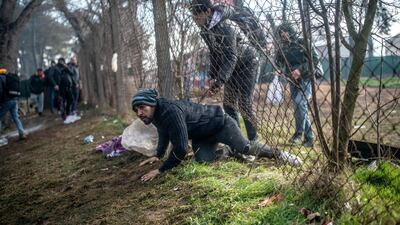
A migrant passes to the buffer zone during clashes with Greek police at the Turkey-Greece border, at Pazarkule, in Edirne distric. Thousands of migrants stuck on the Turkey-Greece border clashed with Greek police. AFP -
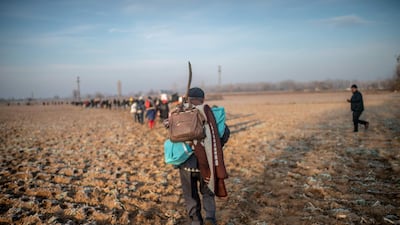
A migrant walk towards the Greek border in Pazarkule, in the Edirne district. AFP


Russian-backed government forces are engaged in a major assault to regain territory in Idlib, which is the last-remaining stronghold of opposition forces backed by Turkey.
In recent weeks, Turkish forces have been hitting Syrian government targets.
Referring to losses inflicted on Syria, Mr Akar said Turkey had “neutralised” more than 2,200 Syrian troops, 103 tanks and eight helicopters.
In February, a total of 55 Turkish soldiers were killed in Syrian government attacks, including air strikes, in Idlib.
Turkey said it would retaliate after 33 soldiers were killed in the regime air strike on Thursday and warned of an imminent operation against Mr Al Assad's forces if they failed to withdraw from Turkish lines by the end of February.
As the deadline passed on Saturday night, Turkish drones bombed Syrian government targets in Idlib, and Turkey-backed rebels shelled Syrian army positions.
Fighting raged near the strategic town of Saraqib as government troops sought to take it back from rebels, opposition activists said.
The town, which lies on the Damascus-Aleppo motorway, had changed hands several times in last month.
The heavy fighting in north-west Syria has also triggered a humanitarian catastrophe and the single largest wave of displacement in the nine-year Syrian civil war.
Nearly 950,000 Syrian civilians have been displaced and pushed towards the Turkish border to escape the violence.
Ankara is worried it might come under renewed international pressure to open its sealed border with Syria and offer refuge to hundreds of thousands more Syrian civilians.
Turkey already hosts about 3.5 million Syrian refugees and has said it cannot accommodate any more.
Mr Erdogan's decision to open his country's borders with Europe made good on a long-standing threat to let refugees into the continent.
His announcement marked a dramatic departure from the current policy and was an apparent attempt to pressure Europe into offering Turkey more support in dealing with the fallout from the Syrian war.

