
Martin Griffiths, the UN special envoy for Yemen, warned on Monday that attacks on Saudi Arabian oil plants at the weekend made a larger regional conflict more likely.
Calling it a military escalation, Mr Griffiths said the drone strikes on Saudi Aramco production sites created a terrifying situation that could block an end to the four-year war in Yemen.
“At a minimum, this kind of action carries the risk of dragging Yemen into a regional conflagration,” Mr Griffiths told the UN Security Council.
“Of one thing we can be certain, that this very serious incident makes the chances of a regional conflict that much higher, with Yemen in some way linked. None of that is good for Yemen.”
Houthi rebels, who have been fighting government forces in Yemen since late 2014 when they seized the capital Sanaa, claimed responsibility for the attacks in Saudi Arabia.
The Iran-backed rebels, who are backed by Iran, have been conducting such attacks for years.
But the US blamed Iran for the latest drone attacks, saying there was no evidence that strikes on Abqaiq, the world's largest oil processing plant, and the Khurais oilfield had come from Yemen.
The damage resulted in a major cut to global supplies of crude oil.
Mr Griffiths, speaking by video link from Amman, said that regardless of who was behind the strikes “the fact that Ansar Allah [the Houthis] claimed responsibility is bad enough”.

“Whatever we will discover of the attack it is a sure sign that Yemen seems to be moving even further away from the peace we all seek,” he said.
Mr Griffiths has for almost two years led the international push for peace in Yemen, holding talks with government officials and the Houthis.
US ambassador to the UN Kelly Craft repeated Secretary of State Mike Pompeo's claim that Iran was responsible, but other members of the Security Council said they would investigate before assigning blame.
The UK's permanent representative to the UN, Karen Pierce, called the attacks “reckless, despicable and totally unjustifiable”, and said there was a great danger of letting the Yemen situation slide backwards.
Instability in Yemen has deepened in recent months with the secessionist South Transitional Council taking control of government buildings in Aden.
Mr Griffiths urged all sides to embrace a Saudi-led reconciliation effort.
“I welcome the presence of delegations from the government of Yemen and Southern Transitional Council in Jeddah,” he said.
“I know this council joins me to wish the Saudis and the two delegations every success.”
The humanitarian situation in Yemen also remains dire.
-
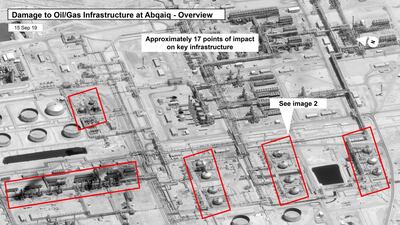
This image provided by the U.S. government and DigitalGlobe and annotated by the source, shows damage to the infrastructure at Saudi Aramco's Abaqaiq oil processing facility in Buqyaq, Saudi Arabia. The drone attack Saturday on Saudi Arabia's Abqaiq plant and its Khurais oil field led to the interruption of an estimated 5.7 million barrels of the kingdom's crude oil production per day, equivalent to more than 5% of the world's daily supply. AP -
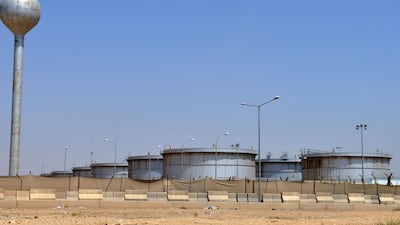
an Aramco oil facility at the edge of the Saudi capital Riyadh. Saudi Arabia raced today to restart operations at oil plants hit by drone attacks which slashed its production by half, as Iran dismissed US claims it was behind the assault. The Tehran-backed Huthi rebels in neighbouring Yemen, where a Saudi-led coalition is bogged down in a five-year war, have claimed thi weekend's strikes on two plants owned by state giant Aramco in eastern Saudi Arabia. AFP -
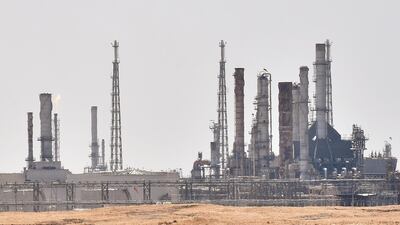
An Aramco oil facility near al-Khurj area, just south of the Saudi capital Riyadh. Saudi Arabia raced today to restart operations at oil plants hit by drone attacks which slashed its production by half, as Iran dismissed US claims it was behind the assault. The Tehran-backed Huthi rebels in neighbouring Yemen, where a Saudi-led coalition is bogged down in a five-year war, have claimed thi weekend's strikes on two plants owned by state giant Aramco in eastern Saudi Arabia. AFP -
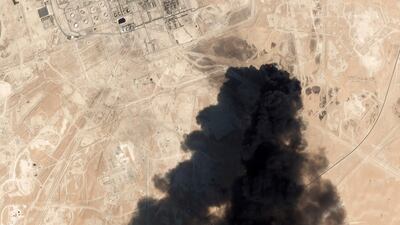
A satellite image from Planet Labs Inc., shows thick black smoke rising from Saudi Aramco's Abqaiq oil processing facility in Buqyaq, Saudi Arabia.The weekend drone attack on one of the world’s largest crude oil processing plants that dramatically cut into global oil supplies is the most visible sign yet of how Aramco’s stability and security is directly linked to that of its owner -- the Saudi government and its ruling family. AP -
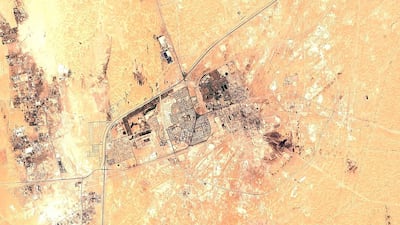
A false-color image from the European Commission's Sentinel-2 satellite shows Saudi Aramco's Abqaiq oil processing facility in Buqyaq, Saudi Arabia. Yemen's Houthi rebels claimed to have launched drone attacks on the world's largest oil processing facility in Saudi Arabia and a major oil field Saturday, sparking huge fires and halting about half of the supplies from the world's largest exporter of oil. Black char marks at the center of the facility suggest the attack struck at the heart of the processing facility. AP -
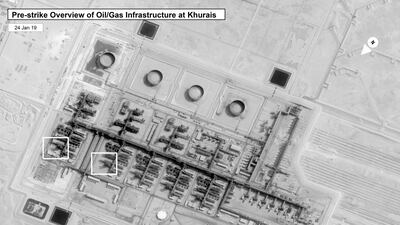
This image provided by the U.S. government and DigitalGlobe and annotated by the source, shows a pre-strike overview at Saudi Aramco's Khurais oil field in Buqyaq, Saudi Arabia. The drone attack Saturday on Saudi Arabia's Abqaiq plant and its Khurais oil field led to the interruption of an estimated 5.7 million barrels of the kingdom's crude oil production per day, equivalent to more than 5% of the world's daily supply. AP -
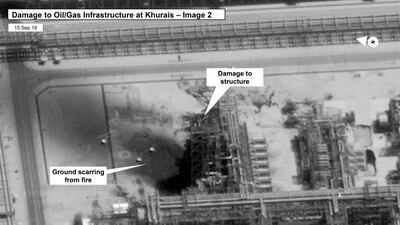
This image provided by the U.S. government and DigitalGlobe and annotated by the source, shows damage to the infrastructure at at Saudi Aramco's Kuirais oil field in Buqyaq, Saudi Arabia. The drone attack Saturday on Saudi Arabia's Abqaiq plant and its Khurais oil field led to the interruption of an estimated 5.7 million barrels of the kingdom's crude oil production per day, equivalent to more than 5% of the world's daily supply. AP -
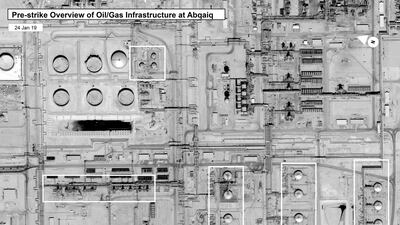
This image provided by the U.S. government and DigitalGlobe and annotated by the source, shows a pre-strike overview at Saudi Aramco's Abaqaiq oil processing facility in Buqyaq, Saudi Arabia. The drone attack Saturday on Saudi Arabia's Abqaiq plant and its Khurais oil field led to the interruption of an estimated 5.7 million barrels of the kingdom's crude oil production per day, equivalent to more than 5% of the world's daily supply. AP -
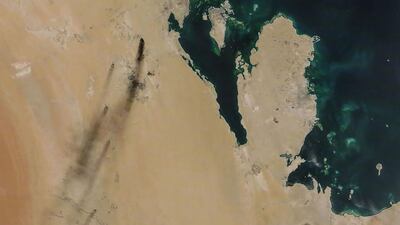
A satellite image provided by NASA Worldview shows fires following drone strikes on two major oil installation owned by the state giant Aramco, in eastern Saudi Arabia, and claimed by the Tehran-backed Huthi rebels in neighbouring Yemen, where a Saudi-led coalition is bogged down in a five-year war. Saudi Arabia raced on September 15, 2019 to restart operations at oil plants hit by drone attacks which slashed its production by half, as Iran dismissed US claims it was behind the assault. The peninsula in the image is Qatar and the island (top) is Bahrain. AFP PHOTO / NASA Worldview -
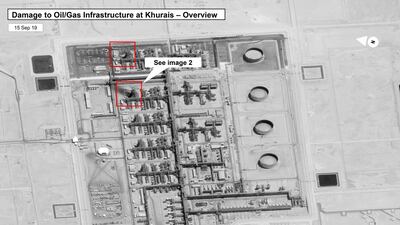
This image provided by the U.S. government and DigitalGlobe and annotated by the source, shows damage to the infrastructure at Saudi Aramco's Khurais oil field in Buqyaq, Saudi Arabia. The drone attack Saturday on Saudi Arabia's Abqaiq plant and its Khurais oil field led to the interruption of an estimated 5.7 million barrels of the kingdom's crude oil production per day, equivalent to more than 5% of the world's daily supply. AP


Mark Lowcock, the UN's undersecretary general for humanitarian affairs, told the council on Monday that the environment for aid agencies “has perhaps never been worse”.
Most incidents “are due to restrictions imposed by Houthi authorities”, Mr Lowcock said.
He said there were 300 incidents in June and July that hindered humanitarian assistance.

