

The United States intends to maintain a policy of “maximum pressure” to isolate Iran, while not ruling out a military strike if that is what is required “to keep Americans safe”.
That is the message US Secretary of State Mike Pompeo conveyed in an interview with The National, stressing that a "policy of appeasement" with Iran would be detrimental. He also stated that assessing US troop levels in the region is based on "the threats of today, not twenty years ago".
The National spoke to Mr Pompeo in Abu Dhabi at the end of his seven-country, 10-day trip that focused on US policy priorities. Throughout the interview, he stressed the importance of a "realistic" approach to foreign policy.
He said US President Donald Trump’s national security and foreign policy strategy is “realistic, it recognises the facts on the ground, it doesn’t pretend… it acknowledges that if we get it right in America, if we protect American citizens, we can be a force for good all across the world”.
Mr Pompeo spoke about his and Mr Trump’s commitment to delivering results based on “America first”, saying “it takes an America that's prepared to engage economically, diplomatically, and only militarily once absolutely necessary”.
When it comes to the Middle East, Mr Pompeo said that strategy “recognises a couple of central facts, first that the primary instigator of instability in the region is in fact the regime of the Islamic Republic of Iran and second that Israel could be a great partner for the Gulf states”.
It is based on these two organising principles that the Trump administration has been working with its allies in the region.
On Israel and despite UN Security Council resolutions, Mr Pompeo said his country acknowledged realities on the ground “and we said not every settlement is per se illegal. These are just facts; the world knows this”.
He added: “When you see a policy and American policy that recognises the threat as from Iran, when you recognise that Israel's effective democracy that is a force for good in the region, you see, countries recognise this through the Abraham Accords mechanism and say: ‘We want to be at peace with Israel.’
"I think the Palestinian people can see that. And so you know, the choices the Palestinian leadership makes, I think, will reflect that central understanding.”
Mr Pompeo was positive about the resumption of talks between the Palestinians and Israelis.
He said: “I was happy with the fact that they now began having more conversations with Israelis. We still need to get them to have a conversation about what the ultimate resolution will be.
"We laid out a vision for peace that proposes some central understanding all based on facts and reality, things that everyone knows will be in that final resolution, there will be debates about precisely how and where and when.
"But we laid out a framework that just was very realistic about what I think the whole world expects, and I hope that the Palestinian people will demand that their leadership engage in that conversation. It would be a lovely thing to see them join an accord that looks something like what we've seen with the Abraham Accords."
On Iran, Mr Pompeo stressed that the US has built “an enormous coalition that understood the threat from Iran and its leadership… we have also ensured that we establish real deterrence. We struck down [leader of Iran’s Islamic Revolutionary Guard Corps Quds Force leader] Qassem Suleimani. We built out an effort to defeat the [so-called] caliphate which was sitting in ISIS which gave space to the Iranians inside of Syria.
"We've tried our best to deliver good outcomes for the Iraqi people. So in each nation, we had a set of policies that further continued to recognise that the isolation of Iran was the right approach."
He explained that through the “maximum pressure campaign we have denied the regime the billions of dollars that the previous administration had provided to them, the very money that has American blood on its hands”.
Mr Pompeo added: “People all across the world, certainly American people, recognise that returning to that failed policy of appeasement presents real risk to the United States. More money in the hands of the ayatollahs can't possibly lead to more freedom, more security for the American people, or, frankly, more safety for the people of Israel as well. And so we will stay hard at it."
Last week, media reports suggested that Mr Trump was considering military action in Iran, but was dissuaded by senior US officials, including Mr Pompeo.
Asked whether a strike was being considered, Mr Pompeo succinctly said: “The President of the United States always retains the right to do what's needed to ensure that Americans are safe. It's been our policy for four years. It'll be our policy, so long as we have the responsibility to keep America protected.”
However, there are concerns that Iran will feel emboldened if the US continues with its plans to withdraw its troops from Iraq.
Mr Pompeo appeared confident that would not be a concern, stating: “We're going to get it just right in Iraq. We need to do what the Iraqi people want – they want a free, independent, sovereign Iraq. We have two missions there, one to help the Iraqi people get just that, because that's in America's best security interest to do.
"They see the freedom of the United States. They want to be alongside of us. I've watched these protests in Iraq... they're not burning American flags. They're burning Iranian flags. This is because the United States is engaged. When we weren't, when we didn't engage, they had a different view of America."
However, he added that “it is also the case that the Iraqis need to deliver security for themselves. And we have spent a lot of time and blood and treasure assisting them in building out the Iraqi security forces.
"So, along with our coalition partners that we have continued to grow, the Nato forces, they're now much greater, much more enhanced than they were when we came in”.
Mr Pompeo said that Nato forces in Iraq will “continue to operate there to support the Iraqi security capabilities and we'll get it just right, we'll get our force levels right. We'll get American kids back home, which is absolutely the right direction of travel”.
Mr Pompeo has just signed off on a 45-day waiver for Iraq to continue importing energy products from Iran, in an exemption from the current US sanctions.
“These are difficult, difficult decisions. Every time we impose a restriction, designation or sanction, there are often complexities. There are real lives, human beings that we want to make sure that we don't impose excessive harm on and so we take that responsibility seriously.
"And so we try to balance it in each case that we've provided that waiver. We've made clear there were higher expectations for progress with Iraqis, in this case, mostly energy from a dollar perspective, mostly energy where we said, 'OK, we'll give you this waiver, but you must invest, you must begin to create systems and processes so that you will become more free, more independent from Iranian energy'.
-

Sheikh Mohamed bin Zayed, Crown Prince of Abu Dhabi and Deputy Supreme Commander of the Armed Forces, meets with Mike Pompeo, Secretary of State of the United States, at Al Shati Palace. MOPA -
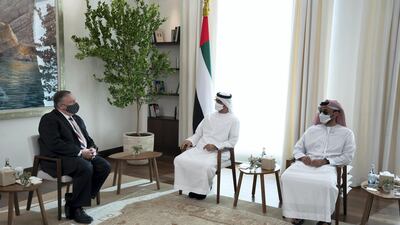
Sheikh Mohamed bin Zayed, Crown Prince of Abu Dhabi and Deputy Supreme Commander of the Armed Forces (C), meets with Mike Pompeo, Secretary of State of the United States of America (L), at Al Shati Palace. Seen with Sheikh Tahnoon bin Zayed, UAE National Security Advisor (R). MOPA -

US Secretary of State Mike Pompeo and his wife Susan speak with US Ambassador to the United Arab Emirates John Rakolta and his wife Terry after stepping off a plane at al-Bateen Executive Airport in Abu Dhabi on November 20, 2020. AFP -
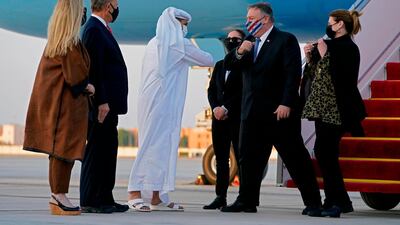
UAE's Protocol Chief Shihab al-Faheem greets US Secretary of State Mike Pompeo alongside his wife Susan in the presence of US Ambassador to the United Arab Emirates John Rakolta and his wife Terry, at al-Bateen Executive Airport in Abu Dhabi on November 20, 2020. AFP -
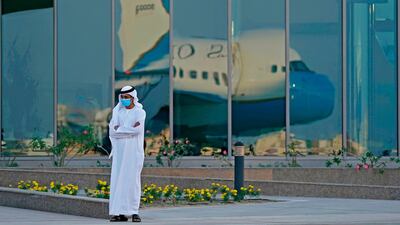
USAF Boeing C-40B (737-700) carrying US Secretary of State Mike Pompeo is reflected behind a man after landing at al-Bateen Executive Airport in Abu Dhabi on November 20, 2020. AFP


"We've made real progress there over the last 20-21 months, there's obviously more work to do. I can't recall when that waiver comes up again. But we will, again, evaluate whether Iraq has made sufficient progress, and we'll try to get the balance just right then as well."
In addition to the withdrawal of US troops in Iraq, Mr Trump has also said that he will draw down troops in Afghanistan to 2,500.
Mr Pompeo appeared clear-eyed on the decision to withdraw from Afghanistan, saying there were fewer than 200 Al Qaeda fighters still in the country.
On Saturday, Mr Pompeo met the Taliban’s political deputy and head of the group’s political office, Mullah Beradar.
On the same day, there was an attack on the Afghan Presidential Palace in Kabul, as violence continues to escalate in the country.
One of the primary conditions for the political talks with the Taliban had been a “significant reduction of violence” but the attacks on Afghan government and security forces, in addition to educational and civil institutions, continue to rise.
Mr Pompeo acknowledged these attacks, but said: “We want to make sure we get the American effort right, calibrated to meet the threat of today, not one from 20 years ago. But the one for today”.
He went on to say: “That is something President Trump and I are both really proud of; we've been pretty realistic. What may have made sense in 2002 doesn't make sense today. Let's fix it. Let's take it on. And there will be glass that has to be broken. And there will be people who cling to the past, but who are unwilling to recognise reality.
"I think that's Afghanistan. As we stare [at] the terrorism problem, we went there to defeat Al Qaeda, there are fewer than 200 of Al Qaeda left inside of Afghanistan. And we have taken off some of Al Qaeda’s most senior leaders from the battlefield and we will continue to do that.”
Mr Pompeo said the mission of the US in Afghanistan is two-fold, to protect the US from terrorism strikes and to allow for American troops to come home. He explained that “to focus on the number of troops misunderstands the responsibility, the obligation, the duty, the mission, the objective that President Trump has laid out, the mission is to make sure that we reduce the risk of the terror attack ever coming to America from Afghanistan. And second, to make sure we're not putting our young men and women at risk in ways that are inconsistent with our duty to the families back in the United States of America”.
He added: “We entered into a conversation with the Taliban, to set out a set of conditions upon which we would begin to further reduce the number of troops that we have in Afghanistan. The violence today is lower than it was when we began that conversation. It is not remotely close enough to where it is that they need to be.
"I shared that with Mullah Beradar. I talked to him very much about the need to continue to reduce violence levels; we need to ultimately get to a ceasefire in Afghanistan. It's the right place from which these negotiations between the Taliban and the Afghan government ought to be conducted while there’s still killing taking place. So there's still work to do.
"I've watched them make progress, they have the rules and procedures settled. I know the history of long conflicts and peace negotiation almost always take years and years and years. We're trying to do this in months and months. We have set the Afghan people all across Afghanistan on a better course for them and a safer course for America as well.
“I am hopeful that while it will undoubtedly be difficult, I am hopeful that we can put Afghanistan on a trajectory where America can reduce the risk and costs associated with its commitment there because we have real challenges from the Chinese Communist Party and from Iran, and from other places across the world so that we are structured appropriately to do what President Trump talked about in his campaign right, America First, when we get that right, when we get America First right, we're more free in America, we're more prosperous. And we have the capacity to be a force for good all across the world.”
Part of the current administration’s strategy has been to widen and tighten sanctions on adversaries and particularly those aligned with Iran.
Last week, Foreign Policy magazine said that Mr Pompeo was considering designating the Houthis in Yemen as a terrorist organisation.
Asked whether a designation was on the horizon, he declined to elaborate, stating “we're constantly evaluating what we are going to do with respect to designations. I don't have anything I can share on that”.

