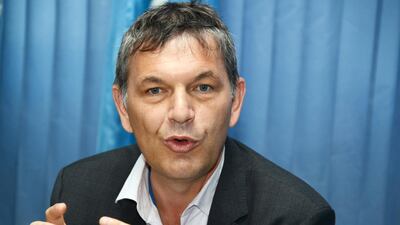
Philippe Lazzarini, who took over the UNRWA on April 1, says he recognises the challenges the organisation faces. AFP, file

Philippe Lazzarini sets out to fix cash-strapped, crisis-hit UNRWA


  • English
  • Arabic

The new head of the UN department supporting millions of Palestinian refugees says he plans to use the "overwhelming political support" around the world to save the cash-strapped agency.

In his first English language interview since taking office on April 1, UN Relief and Works Agency Commissioner General Philippe Lazzarini told The National that he needed to rebuild trust with donors.

Mr Lazzarini said the agency needed to move past a damaging management crisis, meet the aspirations of Palestinians and help in the fight against coronavirus.

He inherits an agency under a dark cloud after the abrupt departure of his predecessor.

Mr Lazzarini's agency, maligned by the Israeli government as an unnecessary relic, also faces pressure from a White House that has axed hundreds of millions in funding.

The administration of US President Donald Trump has described the agency as "irredeemably flawed", but Mr Lazzarini said he remained optimistic of its future and that ceasing operations was "not an option".

Despite US lobbying, the UN member states overwhelmingly voted at the end of 2019 to extend the mandate of UNRWA for another three years. Only the US and Israel voted against it.

Mr Lazzarini said the support shown during the vote demonstrated that the international community regarded the UNRWA as crucial.

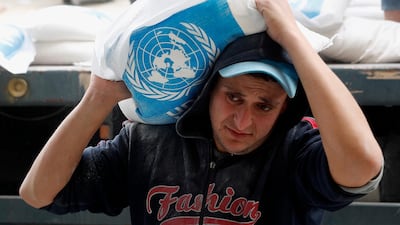
  • A Palestinian worker carries sacks of flour distributed by the United Nations Relief and Works Agency in Gaza City. AP
    A Palestinian worker carries sacks of flour distributed by the United Nations Relief and Works Agency in Gaza City. AP
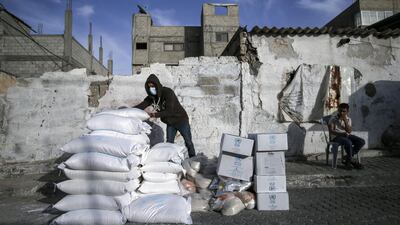
  • A Palestinian man wearing a protective mask sorts food aid provided by UNRWA to be delivered to refugee homes at the Al Shati camp in Gaza city. AFP
    A Palestinian man wearing a protective mask sorts food aid provided by UNRWA to be delivered to refugee homes at the Al Shati camp in Gaza city. AFP
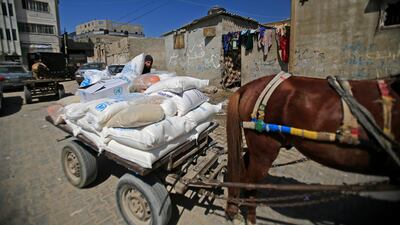
  • A Palestinian loads a cart with aid food provided by the UN's World Food Programme and its agency for Palestinian refugees, UNRWA, in the Gaza Strip's Al Shati refugee camp. AFP
    A Palestinian loads a cart with aid food provided by the UN's World Food Programme and its agency for Palestinian refugees, UNRWA, in the Gaza Strip's Al Shati refugee camp. AFP
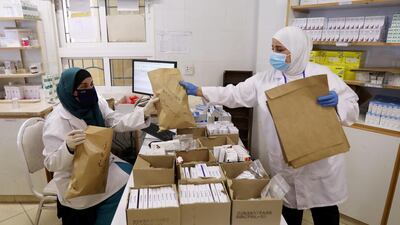
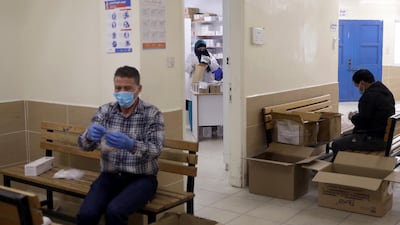
  • Members of the medical staff at UNRWA prepare prescription medicines to deliver to Palestinian refugees in their homes at Amman New camp amid concerns over the spread of the coronavirus in Amman, Jordan. REUTERS
    Members of the medical staff at UNRWA prepare prescription medicines to deliver to Palestinian refugees in their homes at Amman New camp amid concerns over the spread of the coronavirus in Amman, Jordan. REUTERS
  • Members of the medical staff at UNRWA prepare prescription medicines to deliver to Palestinian refugees in their homes at Amman New. REUTERS
    Members of the medical staff at UNRWA prepare prescription medicines to deliver to Palestinian refugees in their homes at Amman New. REUTERS
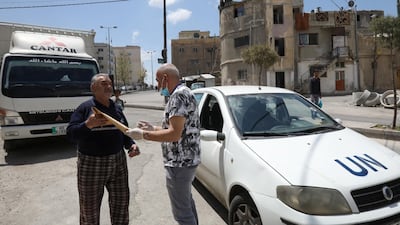
  • A refugee receives his prescription medicine from a member of the medical staff at UNRWA in front of his home at Amman New camp. REUTERS
    A refugee receives his prescription medicine from a member of the medical staff at UNRWA in front of his home at Amman New camp. REUTERS
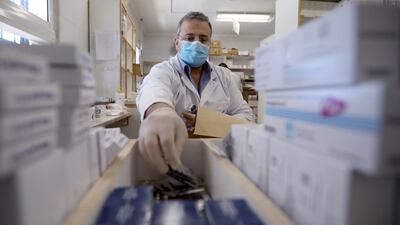
  • A member of the medical staff at UNRWA prepares prescription medicines to deliver to Palestinian refugees. REUTERS
    A member of the medical staff at UNRWA prepares prescription medicines to deliver to Palestinian refugees. REUTERS
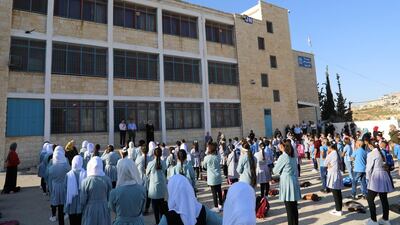
  • The Director of UNRWA Operations in West Bank, Gwyn Lewis, in a visit to Sur Baher Girls school. © 2019 UNRWA/ Kazem Abu Khalaf
    The Director of UNRWA Operations in West Bank, Gwyn Lewis, in a visit to Sur Baher Girls school. © 2019 UNRWA/ Kazem Abu Khalaf
  • Health staff at Shaboura health centre in Rafah packing and delivering medications to elderly people. © 2020 UNRWA/ Khalil Adwan
    Health staff at Shaboura health centre in Rafah packing and delivering medications to elderly people. © 2020 UNRWA/ Khalil Adwan
  • Noon Briefing by the Spokesperson for the Secretary-General Guest: Mr. Philippe Lazzarini, Humanitarian Coordinator for Somalia. UNRWA
    Noon Briefing by the Spokesperson for the Secretary-General Guest: Mr. Philippe Lazzarini, Humanitarian Coordinator for Somalia. UNRWA

He said the question was whether this support and the renewed mandate matched the resources being made available after the US decision in August 2018 to cut nearly $300 million (Dh11.01 billion) in funding hit the already stretched budget.

"Unfortunately there are too many cash-strapped deadlines, and the next one is at the end of May because we have no visibility anymore beyond," Mr Lazzarini said.

He said these could have a "devastating impact on our activities" but he hoped to have outstanding pledges from donor countries in place before that.

The UNRWA was given a mandate in 1949 to assist Palestinian refugees until a political solution was found.

The agency operates in Lebanon, Jordan, Syria, the occupied West Bank, occupied East Jerusalem and the Gaza Strip.

Even before the US froze funds for the UNRWA it was lurching between financial crises and reliant on regular large donations from states.

A crisis of management, reputation and relevance

But the agency has faced an "internal management crisis, reputational issues and the relevancy was also questioned".

Mr Lazzarini's predecessor, Pierre Krahenbuhl, stood down last November amid an investigation into misconduct.

Mr Krahenbuhl denied the claims, saying he and the agency were being politically targeted.

The new UNRWA head admitted the agency had faced a tough year but he said he was working to move past it.

Finding funds

Mr Lazzarini said his role would be to change the relationship between donors and the agency, particularly in Europe where some politicians have questioned its efficiency.

Germany, the EU, the UK and Sweden were the four top donors in 2019.

It's important that it's perceived as this agency focusing and delivering on the right of Palestinian refugees and its services

"We have to bring the necessary confidence back to solidify this partnership that we have," he said.

Mr Lazzarini said the UNRWA had to give donors confidence to continue championing the agency.

His and the agency's role, he said, would be to answer questions over how the money was being used and if it were being spent on tasks the UNRWA had been given.

This means agreeing on the importance of the delivery of core services to Palestinian refugees and on the work being done to achieve the broader 2030 agenda set by the UN.

"When we talk about sustainable goals or social and economic rights, leaving no one behind, we also mean Palestinian refugees are not left behind," Mr Lazzarini said.

"It's important that it's perceived as this agency focusing and delivering on the right of Palestinian refugees and its services.

"That's a starting point because if we agree that this is what is expected from UNRWA, this is what makes it easier to support it financially and politically."

White House peace plan

Asked about the White House peace plan announced last year, Mr Lazzarini said the position of the UN was to support dialogue anchored in relevant resolutions.

But he said that until there was a state for Palestinians, the role of the UNRWA would be to provide dignity and education, which would contribute to promoting peace and security in the region.

"By doing so, we will contribute to having a future generation ready and educated to take over or be part of a future country where they will be full citizens," Mr Lazzarini said.

He said that while talking to the international community and donors was key, so was having an honest and transparent relationship with Palestinian officials and the refugees the agency helps.

"I will be in listening mode at the beginning to make sure that the decisions which will be taken are in line with the aspirations," Mr Lazzarini said. "You need to have an honest dialogue."

  • Amman Rajara ,20, carries a plate of humus and her child in the Aida refugee camp near Bethlehem. Aida is an urban slum with narrow winding streets and few sources of services besides the United Nations Relief and Works Agency. All photo by Heidi Levine for The National
    Amman Rajara ,20, carries a plate of humus and her child in the Aida refugee camp near Bethlehem. Aida is an urban slum with narrow winding streets and few sources of services besides the United Nations Relief and Works Agency. All photo by Heidi Levine for The National
  • Palestinians carry cooking gain the entrance of the Aida refugee camp. It is one of the 19 camps for Palestinians in the West Bank.
    Palestinians carry cooking gain the entrance of the Aida refugee camp. It is one of the 19 camps for Palestinians in the West Bank.
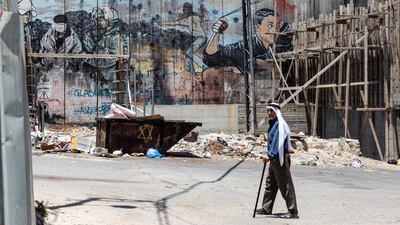
  • Palestinian Abdel Hadeef Abu Sul, 87, walks along Israel's separation camp near his home/
    Palestinian Abdel Hadeef Abu Sul, 87, walks along Israel's separation camp near his home/
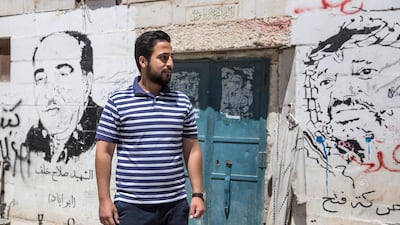
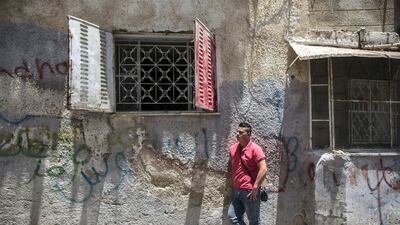
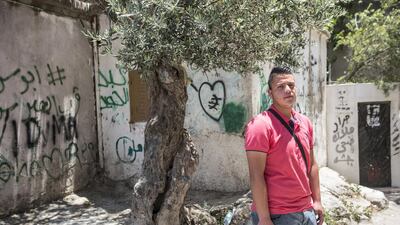
  • Anas Abu Srour, 30, was born and raised in the camp and feels that it is his obligation to stay.
    Anas Abu Srour, 30, was born and raised in the camp and feels that it is his obligation to stay.
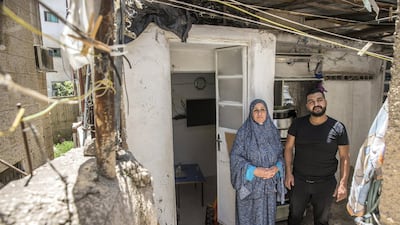
  • Motes Abu Khader, 26, and his mother Nada.47. Eight family members live in the home .
    Motes Abu Khader, 26, and his mother Nada.47. Eight family members live in the home .
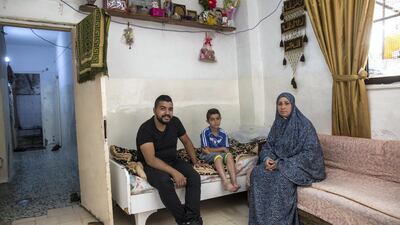
  • Mutasem Abu Kheidar, 26, and his mother Nada.47,.They live in a simple home off of one of Aida’s narrow alleyways.
    Mutasem Abu Kheidar, 26, and his mother Nada.47,.They live in a simple home off of one of Aida’s narrow alleyways.
  • A family seen in a street in the camp.
    A family seen in a street in the camp.
  • as never known life without the Palestinian Authority, the semi-autonomous, nominally interim Palestinian government based in the occupied West Bank that the 1994 Oslo Accords instated. He has also not known life as a Palestinian refugee without UNRWA
    as never known life without the Palestinian Authority, the semi-autonomous, nominally interim Palestinian government based in the occupied West Bank that the 1994 Oslo Accords instated. He has also not known life as a Palestinian refugee without UNRWA
  • Momen Zboun, 20, spent 18 months in an Iraeli jail after being arrested at a demonstration. Heidi Levine for The National
    Momen Zboun, 20, spent 18 months in an Iraeli jail after being arrested at a demonstration. Heidi Levine for The National
  • The symbolism of UNRWA is everywhere in Palestinian refugee camps across the West Bank and Gaza Strip: it is part and parcel to the workings of everyday life.
    The symbolism of UNRWA is everywhere in Palestinian refugee camps across the West Bank and Gaza Strip: it is part and parcel to the workings of everyday life.
  • Residents UNRWA “services used to be better” in their quality and quantity. He was not sure now what would happen to it – or to people like him in the absence of sufficient PA services to serve as an alternative.
    Residents UNRWA “services used to be better” in their quality and quantity. He was not sure now what would happen to it – or to people like him in the absence of sufficient PA services to serve as an alternative.

He said that just as important will be the message to Palestinian refugees that they will not be left behind; that they will have access to universal care, an end to hunger and poverty, and that peace and justice will be achieved.

Two weeks into his new role, Mr Lazzarini has already spoken to officials of countries hosting Palestinian refugees.

Building long-term support

Initially after the US decision to freeze funding, other donors mobilised to help cover the $360m shortfall with multi-year pledges and contributions to the organisation to provide urgent money.

The UAE, Saudi Arabia, Kuwait and Qatar each stepped in immediately with $50m for a total of $200m.

And in 2019, the UAE and Saudi Arabia were still among the top six donors.

But some of the donors who stepped in in 2018 were not so forthcoming last year, Mr Lazzarini said.

The peace process through the years

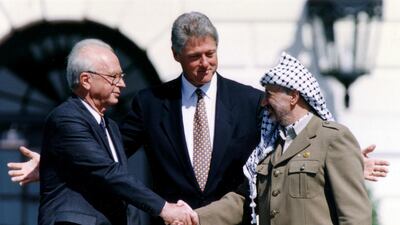
  • PLO chairman Yasser Arafat shakes hands with Israeli prime minister Yitzhak Rabin, as US president Bill Clinton stands between them, after the signing of the Israeli-PLO peace accord, at the White House September 13, 1993. Reuters
    PLO chairman Yasser Arafat shakes hands with Israeli prime minister Yitzhak Rabin, as US president Bill Clinton stands between them, after the signing of the Israeli-PLO peace accord, at the White House September 13, 1993. Reuters
  • United States' special envoy Dennis Ross looks on as Saeb Erekat, left, the chief Palestinian negotiator, and Dan Shomron, the chief Israeli negotiator, initial the documents that bring to a conclusion the long-delayed and overdue Israeli troop redeployment in the West Bank city of Hebron. Reuters
    United States' special envoy Dennis Ross looks on as Saeb Erekat, left, the chief Palestinian negotiator, and Dan Shomron, the chief Israeli negotiator, initial the documents that bring to a conclusion the long-delayed and overdue Israeli troop redeployment in the West Bank city of Hebron. Reuters
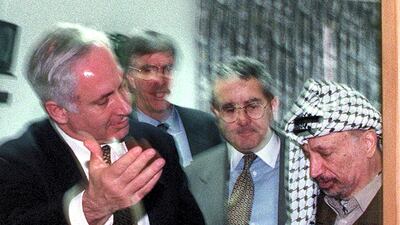
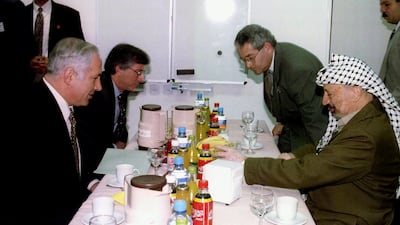
  • Palestinian president Yasser Arafat and Israeli Prime Minister Benjamin Netanyahu both gesture for the other to leave a meeting December 24 1996 in the Israeli Civil Administration headquarters located along the Israeli - Gaza Strip border area. The two leaders met for for over three hours in a bid to clinch the agreement on the long-delayed Israeli troop redeployment in Hebron. Although no agreement was reached US envoy Dennis Ross said that "real progress" was made towards the long-elusive accord. Reuters
    Palestinian president Yasser Arafat and Israeli Prime Minister Benjamin Netanyahu both gesture for the other to leave a meeting December 24 1996 in the Israeli Civil Administration headquarters located along the Israeli - Gaza Strip border area. The two leaders met for for over three hours in a bid to clinch the agreement on the long-delayed Israeli troop redeployment in Hebron. Although no agreement was reached US envoy Dennis Ross said that "real progress" was made towards the long-elusive accord. Reuters
  • Israeli Prime Minister Benjamin Netanyahu shakes hands with a smiling Palestinian Authority president Yasser Arafat at a meeting at the Erez crossing between Israel and the Gaza Strip Wednesday Jan 15, 1997. Israel and the PLO concluded a long-elusive agreement on extending Palestinian rule to Hebron in the West Bank. Reuters
    Israeli Prime Minister Benjamin Netanyahu shakes hands with a smiling Palestinian Authority president Yasser Arafat at a meeting at the Erez crossing between Israel and the Gaza Strip Wednesday Jan 15, 1997. Israel and the PLO concluded a long-elusive agreement on extending Palestinian rule to Hebron in the West Bank. Reuters
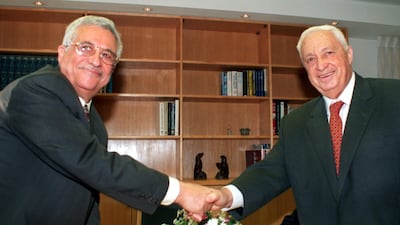
  • Mahmoud Abbas, left, and Ariel Sharon turn to the cameras and smile as they shake hands at the start of their meeting in Sharon's office November 18. The two met to review the work of all the Israeli-Palestinian peace committees and to set a date for the resumption of final status talks. Reuters
    Mahmoud Abbas, left, and Ariel Sharon turn to the cameras and smile as they shake hands at the start of their meeting in Sharon's office November 18. The two met to review the work of all the Israeli-Palestinian peace committees and to set a date for the resumption of final status talks. Reuters
  • Israeli Prime Minister Benjamin Netanyahu and Palestinian president Yasser Arafat during their meeting at Erez crossing point, northern Gaza Strip, December 24, 1996. Arafat and Netanyahu met here in search of an agreement to end the Israeli occupation of Hebron and revive the peace process. In the background at left is US mediator Dennis Ross. Reuters
    Israeli Prime Minister Benjamin Netanyahu and Palestinian president Yasser Arafat during their meeting at Erez crossing point, northern Gaza Strip, December 24, 1996. Arafat and Netanyahu met here in search of an agreement to end the Israeli occupation of Hebron and revive the peace process. In the background at left is US mediator Dennis Ross. Reuters
  • PLO chairman Yasser Arafat holds the second phase of the Oslo peace accords after the initialling of the document, September 24, 1995, as Israeli Foreign Minister Shimon Peres looks on. Israel and the PLO will officially sign the agreement in Washington later this week. Reuters
    PLO chairman Yasser Arafat holds the second phase of the Oslo peace accords after the initialling of the document, September 24, 1995, as Israeli Foreign Minister Shimon Peres looks on. Israel and the PLO will officially sign the agreement in Washington later this week. Reuters
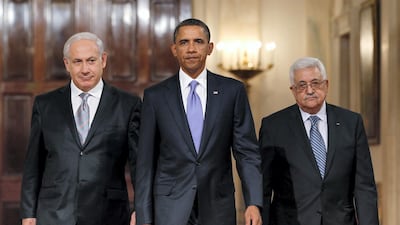
  • US President Barack Obama arrives with Israeli Prime Minister Benjamin Netanyahu, left, and Palestinian President Mahmoud Abbas to make a statement on Middle East Peace talks in the East Room of the White House, September 1, 2010. Reuters
    US President Barack Obama arrives with Israeli Prime Minister Benjamin Netanyahu, left, and Palestinian President Mahmoud Abbas to make a statement on Middle East Peace talks in the East Room of the White House, September 1, 2010. Reuters
  • Israeli Prime Minister Ehud Barak jokingly pushes Palestinian president Yasser Arafat into the Laurel cabin on the grounds of Camp David as US President Bill Clinton watches during peace talks, July 11, 2000. Arafat and Barak were insisting that the other proceed through the door first. Camp David is the venue where Egypt and Israel made peace in September 1978, and the Laurel cabin was the site of many of the meetings. Reuters
    Israeli Prime Minister Ehud Barak jokingly pushes Palestinian president Yasser Arafat into the Laurel cabin on the grounds of Camp David as US President Bill Clinton watches during peace talks, July 11, 2000. Arafat and Barak were insisting that the other proceed through the door first. Camp David is the venue where Egypt and Israel made peace in September 1978, and the Laurel cabin was the site of many of the meetings. Reuters
  • France's President Nicolas Sarkozy, centre, shakes hands with Palestinian President Mahmoud Abbas, left and Israel's prime minister Ehud Olmert after a joint news briefing at the Elysee Palace July 13, 2008. Reuters
    France's President Nicolas Sarkozy, centre, shakes hands with Palestinian President Mahmoud Abbas, left and Israel's prime minister Ehud Olmert after a joint news briefing at the Elysee Palace July 13, 2008. Reuters
  • Palestinian President Yasser Arafat shakes hands with Israeli Prime Minister Benjamin Netanyahu after US special envoy Dennis Ross, centre, spoke, early January 15, 1997 after the two leaders met and agreed on the term for an Israeli troop redeployment in Hebron. The talks lasted less than two hours and concluded months of negotiations. Reuters
    Palestinian President Yasser Arafat shakes hands with Israeli Prime Minister Benjamin Netanyahu after US special envoy Dennis Ross, centre, spoke, early January 15, 1997 after the two leaders met and agreed on the term for an Israeli troop redeployment in Hebron. The talks lasted less than two hours and concluded months of negotiations. Reuters
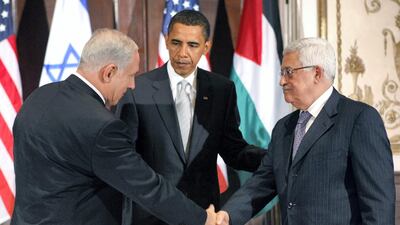
  • US President Barack Obama watches Israeli Prime Minister Benjamin Netanyahu, left, and Palestinian President Mahmoud Abbas shake hands during a trilateral meeting in New York September 22, 2009. Reuters
    US President Barack Obama watches Israeli Prime Minister Benjamin Netanyahu, left, and Palestinian President Mahmoud Abbas shake hands during a trilateral meeting in New York September 22, 2009. Reuters
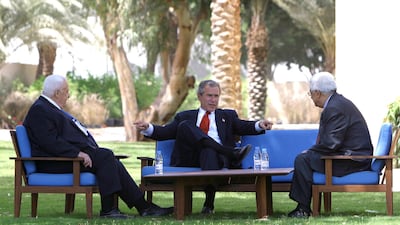
  • US President George W. Bush discusses the Middle East peace process with prime minister Ariel Sharon of Israel, left, and Palestinian Prime Minister Mahmoud Abbas in Aqaba, Jordan, June 4, 2003. Reuters
    US President George W. Bush discusses the Middle East peace process with prime minister Ariel Sharon of Israel, left, and Palestinian Prime Minister Mahmoud Abbas in Aqaba, Jordan, June 4, 2003. Reuters
  • Palestinian and Israeli top negotiators Abu Ala, left, and Uri Savir shake hands after signing the second phase of the Oslo peace accords September 24 1995. PLO chairman Yasser Arafat is in the middle speaking to team member Sait Barecat, (L), after eight days of talks. Reuters
    Palestinian and Israeli top negotiators Abu Ala, left, and Uri Savir shake hands after signing the second phase of the Oslo peace accords September 24 1995. PLO chairman Yasser Arafat is in the middle speaking to team member Sait Barecat, (L), after eight days of talks. Reuters
  • Israel's Prime Minister Ehud Olmert, right, greets Palestinian President Mahmoud Abbas during their meeting in Jerusalem September 16, 2008. Reuters
    Israel's Prime Minister Ehud Olmert, right, greets Palestinian President Mahmoud Abbas during their meeting in Jerusalem September 16, 2008. Reuters
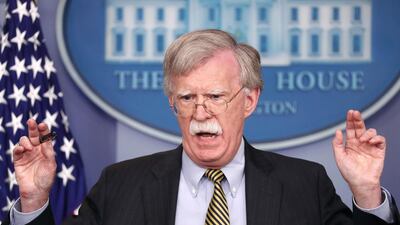
  • US National Security Advisor John Bolton answers a question from a reporter about how he refers to Palestine during a news conference in the White House briefing room in Washington, U.S., October 3, 2018. Reuters
    US National Security Advisor John Bolton answers a question from a reporter about how he refers to Palestine during a news conference in the White House briefing room in Washington, U.S., October 3, 2018. Reuters

The agency will be looking to Gulf and Arab countries for financial and political support.

"I do believe the Gulf countries are important partners to UNRWA and it is important to develop a lasting, predictable partnership with the Gulf countries," Mr Lazzarini said.

He is eyeing longer-term mutual commitment between donors beyond just the Gulf countries, such as those from the Organisation of Islamic Co-operation, "European and traditional supporters like Japan, Canada and possibly South Korea stepping in here in the region".

He will also be in contact with European countries.

I do believe the Gulf countries are important partners to UNRWA

But Mr Lazzarini was quick to note that countries are not just regarded as financial supporters.

They have to be seen as genuinely associated and partners to the mandate of the UNRWA.

"That the organisation is working to address poverty among Palestinian refugees," he said. "In doing so, we are also contributing to the broader peace and stability in the region."

Mr Lazzarini said he planned to build trust in what the agency did to focus on securing the flow and predictability of donor contributions.

The fight against coronavirus

Health staff at Shaboura health centre in Rafah pack and deliver medication to elderly people. © 2020 UNRWA Photo by Khalil Adwan

The head said he welcomed but had not been officially told about a US decision to direct $5m to the Palestinian Authority in response to an appeal to fight the coronavirus pandemic. There are 431 confirmed cases and two deaths.

Mr Lazzarini said the agency would begin its own Covid-19 emergency response appeal next week.

"Obviously, if this could trigger similar support it would be a welcome development," he said.

But so far, Mr Lazzarini said he had been very impressed with the work of the agency amid the pandemic.

He said all health centres remained open in the five areas of UNRWA's operations.

E-learning has continued and there is a strong push to increase the number of children who can access remote schooling.

Yet the coronavirus is a pandemic on top of a crisis for the agency. With 30,000 staff members working for more than 5 million refugees, the "chronic crisis" continues, he said.

But Mr Lazzarini said he would put all necessary energy and attention into ensuring services continue.

"It's clear today it's a struggle," he said.

"And unfortunately, the organisation has known far too much of this unsettling financial crisis, especially for a group of the population that is among the most vulnerable in the world, and definitely one of the most vulnerable in the Middle East."


Play-off fixtures

Two-legged ties to be played November 9-11 and November 12-14


  • Northern Ireland v Switzerland
  • Croatia v Greece
  • Denmark v Ireland
  • Sweden v Italy
The smuggler

Eldarir had arrived at JFK in January 2020 with three suitcases, containing goods he valued at $300, when he was directed to a search area.
Officers found 41 gold artefacts among the bags, including amulets from a funerary set which prepared the deceased for the afterlife.
Also found was a cartouche of a Ptolemaic king on a relief that was originally part of a royal building or temple. 
The largest single group of items found in Eldarir’s cases were 400 shabtis, or figurines.

Khouli conviction

Khouli smuggled items into the US by making false declarations to customs about the country of origin and value of the items.
According to Immigration and Customs Enforcement, he provided “false provenances which stated that [two] Egyptian antiquities were part of a collection assembled by Khouli's father in Israel in the 1960s” when in fact “Khouli acquired the Egyptian antiquities from other dealers”.
He was sentenced to one year of probation, six months of home confinement and 200 hours of community service in 2012 after admitting buying and smuggling Egyptian antiquities, including coffins, funerary boats and limestone figures.

For sale

A number of other items said to come from the collection of Ezeldeen Taha Eldarir are currently or recently for sale.
Their provenance is described in near identical terms as the British Museum shabti: bought from Salahaddin Sirmali, "authenticated and appraised" by Hossen Rashed, then imported to the US in 1948.

- An Egyptian Mummy mask dating from 700BC-30BC, is on offer for £11,807 ($15,275) online by a seller in Mexico

- A coffin lid dating back to 664BC-332BC was offered for sale by a Colorado-based art dealer, with a starting price of $65,000

- A shabti that was on sale through a Chicago-based coin dealer, dating from 1567BC-1085BC, is up for $1,950

The%20Emperor%20and%20the%20Elephant
%3Cp%3E%3Cstrong%3EAuthor%3A%20%3C%2Fstrong%3ESam%20Ottewill-Soulsby%3C%2Fp%3E%0A%3Cp%3E%3Cstrong%3EPublisher%3A%20%3C%2Fstrong%3EPrinceton%20University%20Press%3C%2Fp%3E%0A%3Cp%3E%3Cstrong%3EPages%3A%20%3C%2Fstrong%3E392%3C%2Fp%3E%0A%3Cp%3E%3Cstrong%3EAvailable%3A%20%3C%2Fstrong%3EJuly%2011%3C%2Fp%3E%0A
Classification of skills

A worker is categorised as skilled by the MOHRE based on nine levels given in the International Standard Classification of Occupations (ISCO) issued by the International Labour Organisation. 

A skilled worker would be someone at a professional level (levels 1 – 5) which includes managers, professionals, technicians and associate professionals, clerical support workers, and service and sales workers.

The worker must also have an attested educational certificate higher than secondary or an equivalent certification, and earn a monthly salary of at least Dh4,000. 

Milestones on the road to union

1970

October 26: Bahrain withdraws from a proposal to create a federation of nine with the seven Trucial States and Qatar. 

December: Ahmed Al Suwaidi visits New York to discuss potential UN membership.

1971

March 1:  Alex Douglas Hume, Conservative foreign secretary confirms that Britain will leave the Gulf and “strongly supports” the creation of a Union of Arab Emirates.

July 12: Historic meeting at which Sheikh Zayed and Sheikh Rashid make a binding agreement to create what will become the UAE.

July 18: It is announced that the UAE will be formed from six emirates, with a proposed constitution signed. RAK is not yet part of the agreement.

August 6:  The fifth anniversary of Sheikh Zayed becoming Ruler of Abu Dhabi, with official celebrations deferred until later in the year.

August 15: Bahrain becomes independent.

September 3: Qatar becomes independent.

November 23-25: Meeting with Sheikh Zayed and Sheikh Rashid and senior British officials to fix December 2 as date of creation of the UAE.

November 29:  At 5.30pm Iranian forces seize the Greater and Lesser Tunbs by force.

November 30: Despite  a power sharing agreement, Tehran takes full control of Abu Musa. 

November 31: UK officials visit all six participating Emirates to formally end the Trucial States treaties

December 2: 11am, Dubai. New Supreme Council formally elects Sheikh Zayed as President. Treaty of Friendship signed with the UK. 11.30am. Flag raising ceremony at Union House and Al Manhal Palace in Abu Dhabi witnessed by Sheikh Khalifa, then Crown Prince of Abu Dhabi.

December 6: Arab League formally admits the UAE. The first British Ambassador presents his credentials to Sheikh Zayed.

December 9: UAE joins the United Nations.

Moon Music

Artist: Coldplay

Label: Parlophone/Atlantic

Number of tracks: 10

Rating: 3/5

RUGBY CHAMPIONSHIP FIXTURES

September 30
South Africa v Australia
Argentina v New Zealand

October 7
South Africa v New Zealand
Argentina v Australia

F1 The Movie

Starring: Brad Pitt, Damson Idris, Kerry Condon, Javier Bardem

Director: Joseph Kosinski

Rating: 4/5

The five pillars of Islam

1. Fasting 

2. Prayer 

3. Hajj 

4. Shahada 

5. Zakat 

Common OCD symptoms and how they manifest

Checking: the obsession or thoughts focus on some harm coming from things not being as they should, which usually centre around the theme of safety. For example, the obsession is “the building will burn down”, therefore the compulsion is checking that the oven is switched off.

Contamination: the obsession is focused on the presence of germs, dirt or harmful bacteria and how this will impact the person and/or their loved ones. For example, the obsession is “the floor is dirty; me and my family will get sick and die”, the compulsion is repetitive cleaning.

Orderliness: the obsession is a fear of sitting with uncomfortable feelings, or to prevent harm coming to oneself or others. Objectively there appears to be no logical link between the obsession and compulsion. For example,” I won’t feel right if the jars aren’t lined up” or “harm will come to my family if I don’t line up all the jars”, so the compulsion is therefore lining up the jars.

Intrusive thoughts: the intrusive thought is usually highly distressing and repetitive. Common examples may include thoughts of perpetrating violence towards others, harming others, or questions over one’s character or deeds, usually in conflict with the person’s true values. An example would be: “I think I might hurt my family”, which in turn leads to the compulsion of avoiding social gatherings.

Hoarding: the intrusive thought is the overvaluing of objects or possessions, while the compulsion is stashing or hoarding these items and refusing to let them go. For example, “this newspaper may come in useful one day”, therefore, the compulsion is hoarding newspapers instead of discarding them the next day.

Source: Dr Robert Chandler, clinical psychologist at Lighthouse Arabia

Results

5.30pm: Maiden (TB) Dh82,500 (Dirt) 1,600m, Winner: Panadol, Mickael Barzalona (jockey), Salem bin Ghadayer (trainer)

6.05pm: Maiden (TB) Dh82,500 (Turf) 1,400m, Winner: Mayehaab, Adrie de Vries, Fawzi Nass

6.40pm: Handicap (TB) Dh85,000 (D) 1,600m, Winner: Monoski, Mickael Barzalona, Salem bin Ghadayer

7.15pm: Handicap (TB) Dh102,500 (T) 1,800m, Winner: Eastern World, Royston Ffrench, Charlie Appleby

7.50pm: Handicap (TB) Dh92,500 (D) 1,200m, Winner: Madkal, Adrie de Vries, Fawzi Nass

8.25pm: Handicap (TB) Dh92,500 (T) 1,200m, Winner: Taneen, Dane O’Neill, Musabah Al Muhairi

SPECS
%3Cp%3E%3Cstrong%3EEngine%3A%3C%2Fstrong%3E%20Dual%20electric%20motors%20with%20102kW%20battery%20pack%3C%2Fp%3E%0A%3Cp%3E%3Cstrong%3EPower%3A%20%3C%2Fstrong%3E570hp%3C%2Fp%3E%0A%3Cp%3E%3Cstrong%3ETorque%3A%3C%2Fstrong%3E%20890Nm%3C%2Fp%3E%0A%3Cp%3E%3Cstrong%3ERange%3A%3C%2Fstrong%3E%20Up%20to%20428km%3C%2Fp%3E%0A%3Cp%3E%3Cstrong%3EOn%20sale%3A%3C%2Fstrong%3E%20Now%3C%2Fp%3E%0A%3Cp%3E%3Cstrong%3EPrice%3A%20%3C%2Fstrong%3EFrom%20Dh1%2C700%2C000%3C%2Fp%3E%0A
How to register as a donor

1) Organ donors can register on the Hayat app, run by the Ministry of Health and Prevention

2) There are about 11,000 patients in the country in need of organ transplants

3) People must be over 21. Emiratis and residents can register. 

4) The campaign uses the hashtag  #donate_hope

F1 drivers' standings

1. Lewis Hamilton, Mercedes 281

2. Sebastian Vettel, Ferrari 247

3. Valtteri Bottas, Mercedes 222

4. Daniel Ricciardo, Red Bull 177

5. Kimi Raikkonen, Ferrari 138

6. Max Verstappen, Red Bull 93

7. Sergio Perez, Force India 86

8. Esteban Ocon, Force India 56