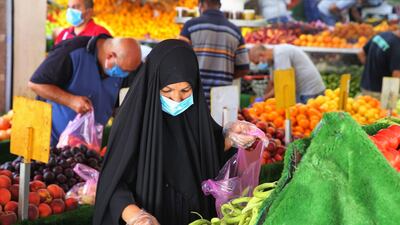

The coronavirus not only infected Bassim Al Kaabi and his family but also took away their livelihood.
The Baghdad taxi driver’s earnings have dried up since Iraqi authorities imposed long lockdowns in mid-March to contain the local outbreak of the Covid-19 pandemic.
"We thought life would be back to normal in a short period of time," Mr Al Kaabi, 45, told The National. "But things have gone from bad to worse. The virus is still around and work is gone."
The coronavirus crisis is having a devastating socio-economic impact in the war-ravaged nation and threatens to increase poverty, according to an assessment by Iraq’s Ministry of Planning.
A ministry report published last week said the outbreak would push an additional 4.5 million Iraqis, about 11.7 per cent of the population, into poverty this year.
That would increase the national poverty rate to 31.7 per cent from 20 per cent in 2018, bringing the total number of poor to 11.4 million, it added. Iraq’s population stands at about 40 million.
“The results capture a worrying situation especially for the most vulnerable segments of the population,” Minister of Planning, Khaled Al Najem, said in the report.
The situation requires “a more effective response and one that focuses on social protection and cash transfers to the poorest”, according to Mr Al Najem.
At the same time, the government needs to continue and increase “investments in services such as health and education, and to support poor families, especially the younger members, to find employment”, he said.
But that goal could be hard to achieve.
Falling global prices have reduced Iraq’s oil revenue, which makes up nearly 95 per cent of state income, by more than 50 per cent. The economy had already been affected by mass anti-government protests over poor service and official corruption that began in October.
As a result, the government is struggling to pay salaries, is forced to delay projects and is working to introduce unpopular financial reforms.
_______________
Coronavirus in the Middle East
-
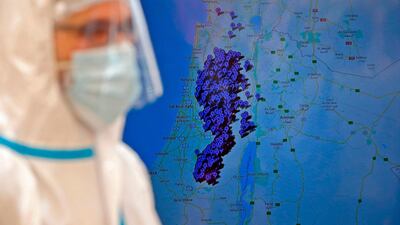
A doctor from the Palestinian ministry of health stands next to a map tracking the location of people infected with the coronavirus, in Hebron in the occupied West Bank. AFP -
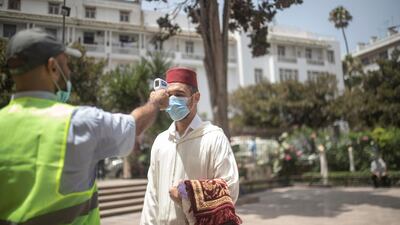
A worker checks the temperature of people who are going to pray at a mosque in Rabat, Morocco. With the exception of Friday prayer, mosques reopened for the first time since their closure in March following the coronavirus outbreak. AP Photo -

A Palestinian youth sells sweets by the beach in Gaza City as coronavirus restriction eases. AFP -
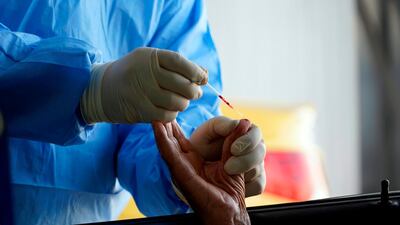
A health worker conducts a coronavirus test at a drive-through testing centre in the central Iraqi city of Najaf. AFP -
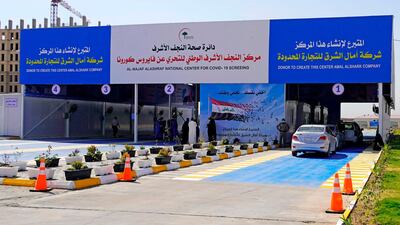
A drive-through testing facility for coronavirus in the central Iraqi city of Najaf. AFP -
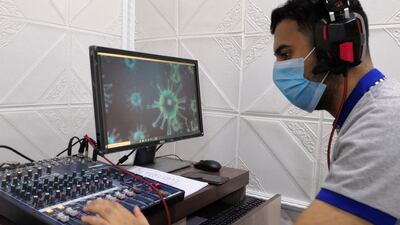
An employee from the ministry of health during a radio broadcast that offers advice about the coronavirus precautionary measures at a radio station in Basra, Iraq. Reuters -
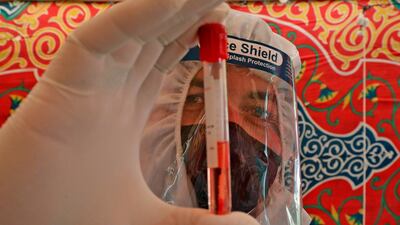
A doctor displays a blood sample taken from a person suspected of being infected with the coronavirus in Hebron in the occupied West Bank. AFP -
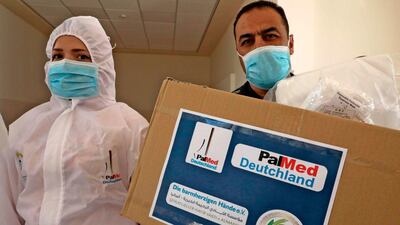
Dr Issam Mujahed, right, a member of the Pal-Med Europe, presents medical donations to doctors battling the coronavirus in Hebron in the occupied West Bank. AFP -

A Palestinian man rides a bicycle with his child in Gaza City as coronavirus lockdown eases. AFP -
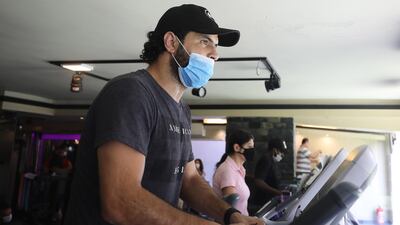
People training at a gym after its reopening in Cairo, Egypt. EPA -

People train at a gym after its reopening in Cairo, Egypt. EPA -

A policeman wears a face mask as he reviews the passport of a traveller at Mohammed V International Airport in Casablanca, Morocco. AP Photo


_______________
In the good times, Mr Al Kaabi’s daily net income averaged $40 (Dh147). Now he earns about $6 a day selling fuel on the street to support his wife, four children and his father.
The poverty threshold in Iraq is $3.20 per person per day.
“I was happy whenever I came back to my kids with full pockets,” said the resident of Baghdad’s eastern suburb of Sadr City. “We used to go out during the night, mainly to the park, have drinks and dinner.”
The family has now been reduced to just essentials, and the list of what they can afford is steadily shrinking – one chicken a week, a few eggs and dairy products with bread for breakfast. Dinner is falafel provided by a friend.
To make ends meet, Mr Al Kaabi had to sell his wife's gold ring and chain, followed by their oven. Using the air cooler is a luxury they cannot afford despite the scorching summer heat.
In early June, Mr Al Kaabi’s wife contracted the coronavirus, followed by him and his daughter. They stayed at home after testing positive for the virus, with Mr Al Kaabi relying on help from friends to pay for medicines and food until they recovered early this month.
“It’s a tragedy,” he said. “We have nothing but patience.”
The government can do nothing for people like Mr Al Kaabi, according Ministry of Labour and Social Affairs spokesman Najim Al Akabi.
Mr Al Akabi said that due to a delay in approving this year's budget, the ministry failed to add about 600,000 new poor families – who were identified before the outbreak – to the list of nearly 1.4 million families eligible for cash assistance. The monthly payments range from $160 to $264 depending on the size of the family, he said.
“We expect the poverty rate to go even higher, to at least 34 per cent, as large segments of society are badly hit by the outbreak,” said Mr Al Akabi. “We are unable to help all those due to lack of funding.”
Hadi Jalo Marie, chairman of the Political Decision Centre think tank in Baghdad, said the increase in poverty increased the risk of unrest across the country.
“There are no policies to solve problems in Iraq; instead there is only a patchwork approach,” Mr Marie said.
“Along with other woes, the poverty rate will definitely fuel the anti-government sentiment and we’ll see more demonstrations.”

