

Hosni Mubarak, the former Egyptian president who was swept out of office by the Arab uprisings nine years ago after almost 30 years in power, died on February 25, 2020. He was 91 years old.
One of his two sons, businessman Alaa, tweeted earlier this week that his father had been admitted to intensive care. He asked supporters to pray for his father but did not say what was ailing the former air force commander and war hero. Security officials said he was being treated at a Nile-side military hospital in the Maadi suburb of Cairo, the Egyptian capital.
Mubarak, who hailed from a village in the Nile Delta, unexpectedly assumed the presidency of the most populous Arab nation when President Anwar Sadat was gunned down by Islamic militants during a 1981 military parade.
Then a diligent vice president, Mubarak was seated next to Sadat when the latter was gunned down. He escaped with a superficial hand wound. After such a close brush with death, Mr Mubarak cancelled the annual pomp-filled military parade marking the 1973 war with Israel.
Still, Mubarak was the target of at least six assassination attempts during his decades in power, including one in Addis Ababa in 1995 and another in the Egyptian coastal city of Port Said.
Mubarak’s knack for surviving assassination attempts was matched by his ability to hold on to power, building up a reputation as a reliable western ally, while ensuring the loyalty of the powerful military.
-
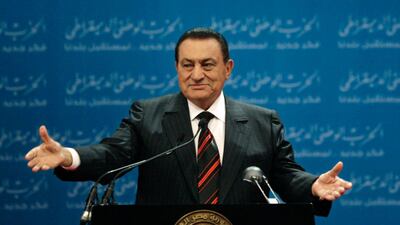
Former Egyptian President Hosni Mubarak delivers a speech in Cairo in 2008. Mubarak died on February 25, 2020 aged 91. AP Photo -

Mubarak, left, took power after the assassination of President Anwar Sadat, right. AFP PHOTO -
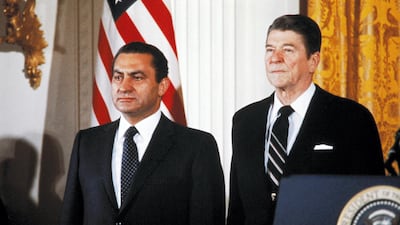
US President Ronald Reagan with Mubarak attend the arrival ceremonies in the east room of the White House on February 3, 1982 in Washington DC. AFP -
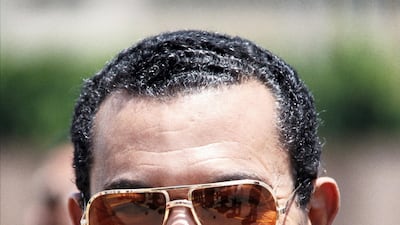
Egyptian President Hosni Mubarak welcomes French President François Mitterrand on July 11, 1984 in Cairo. AFP -
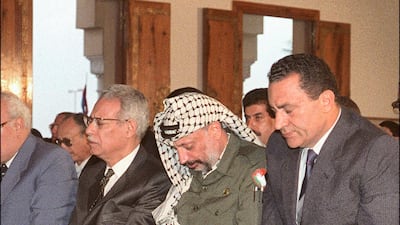
Mubaraka prays with Yasser Arafat (c), President of Palestine Liberation Organisation (PLO) shown in a picture dated 13 July 1989 in Cairo. AFP -
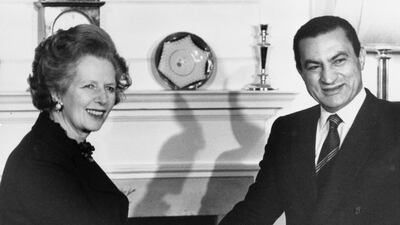
Britain's Prime Minister Margaret Thatcher greets Egypt's President Hosni Mubarak inside 10 Downing Street in March, 1985. Reuters -
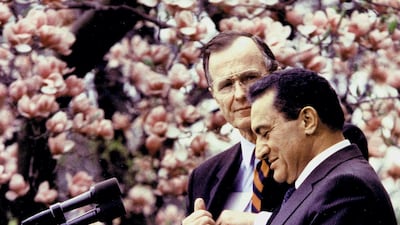
Hosni Mubarak prepares to makes a speech in the Rose Garden 03 April 1989, in Washington,DC, as former US President George Bush looks on. AFP -
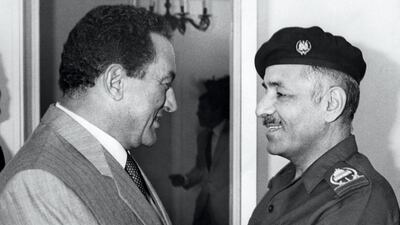
Egyptian president Hosni Mubarak greets Iraqi Prime minister Taha Yassin Ramadan on August 8, 1988, in Alexandria. AFP -
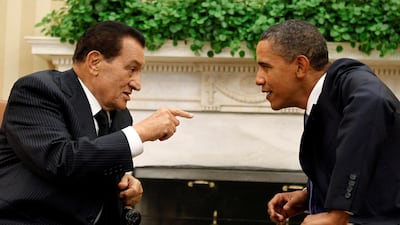
Former US President Barack Obama, right, meets Mubarak in the Oval Office of the White House in Washington September 1, 2010. Mubarak led Egypt for 30 years before stepping down amid mass protests in 2011. Reuters -
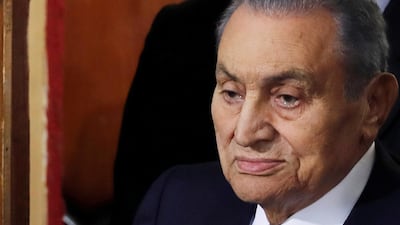
Mubarak has suffered ill health in recent years and was transferred to intensive care earlier in February 2020. Reuters -
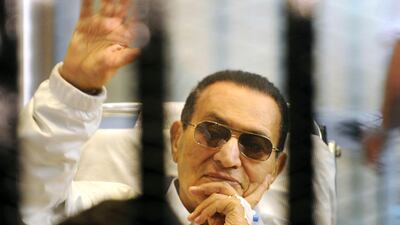
Former Egyptian President Hosni Mubarak waves to his supporters from behind bars during his retrial in April 2013. He was tried on charges of killing protesters and corruption. AP Photo -
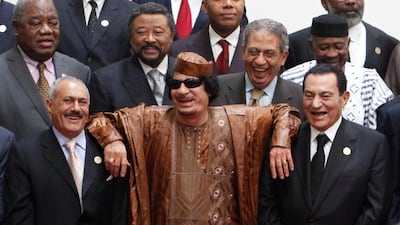
Hosni Mubarak with other Arab leaders who lost power during widespread protests in the region; Libya's Muammar Qaddafi, centre, and then Yemeni President Ali Abdullah Saleh at the second Afro-Arab Summit in Sirte, Libya October 10, 2010. Reuters -
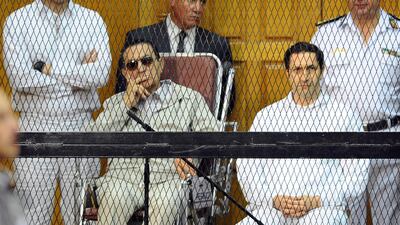
Former Egyptian President Hosni Mubarak, seated centre left, and his two sons, Gamal Mubarak, left, and Alaa Mubarak attend a hearing in a courtroom in Cairo, Egypt. AP -
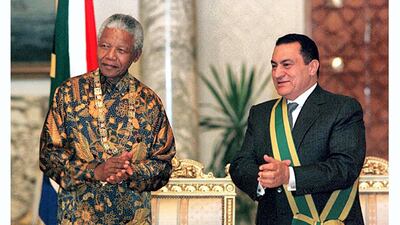
South African President Nelson Mandela, left, and Egyptian President Hosni Mubarak award each other their countries highest honours, 21 October in Cairo. AFP -
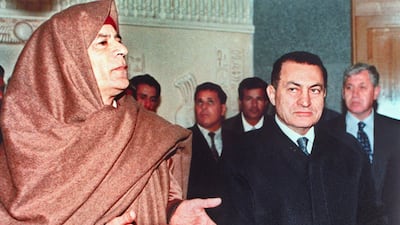
Mubarak with Muammar Qadaffi on January 18, 1996. AFP -
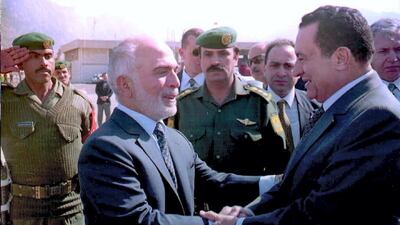
King Hussein of Jordan greets Egyptian President Hosni Mubarak. AFP -
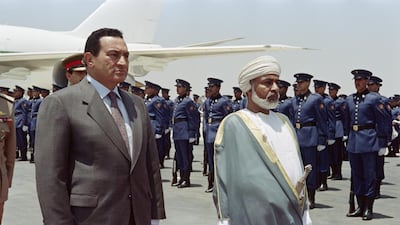
Egytian President Hosni Mubarak and Oman's Sultan Qaboos bin Said review the honor guard, on June 22, 1992 at Alexandria. AFP -
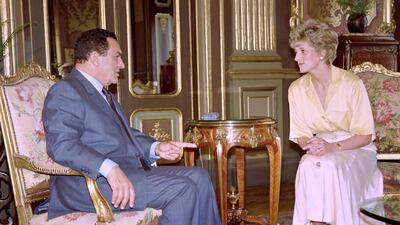
Princess Diana of Wales listens to Egyptian President Hosni Mubarak on May 12, 1992 on the second day of her five-day visit to Egypt. AFP -
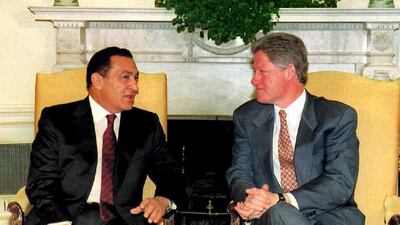
US President Bill Clinton meets Egyptian President Hosni Mubarak at the White House 06 April 1993. AFP -
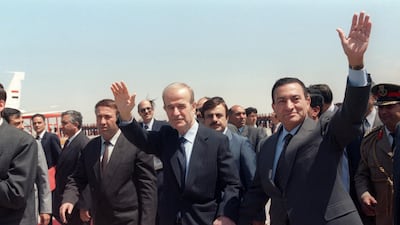
Syrian President Hafez Al Assad and Egyptian President Hosni Mubarak hold hands during a meeting in Damascus. AFP -
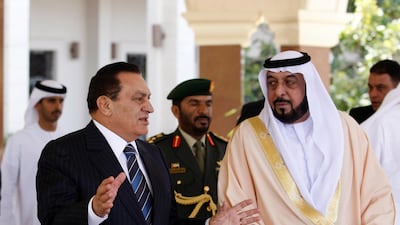
Mubarak meets UAE President Sheikh Khalifa in Abu Dhabi on February 12, 2008. Photo: WAM -
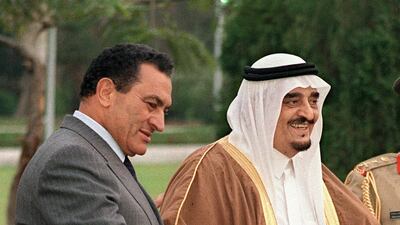
King Fahd bin Abdul Aziz of Saudi Arabia smiles as Egyptian President Hosni Mubarak welcomes him 27 March 1989 in Cairo. AFP -
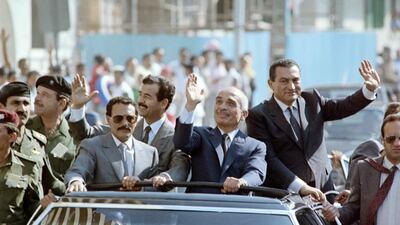
From left to right: Then North Yemeni President Ali Abdullah Saleh, Iraqi President Saddam Hussein, Jordanian King Hussein and Egyptian President Hosni Mubarak, wave to the crowd, on June 15, 1989 during a motorcade rally prior to the opening of the Arab Cooperation Council in Alexandria, Egypt. AFP -
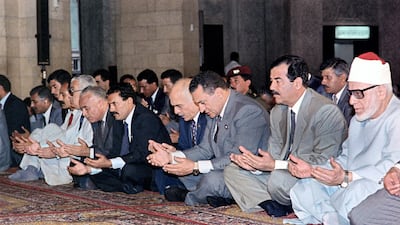
From right to left; Grand Sheikh of Al Azhar, Iraqi President Saddam Hussein, Egyptian President Hosni Mubarak, Jordanian King Hussein and North Yemeni President Ali Abdullah Saleh attend Friday prayers, on June 16, 1989 during the Arab Cooperation Council in Alexandria, Egypt. AFP -
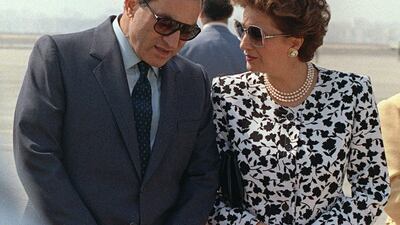
Egyptian President Hosni Mubarak speaks to his wife Susan, at Cairo airport, 11 October 1987 AFP -
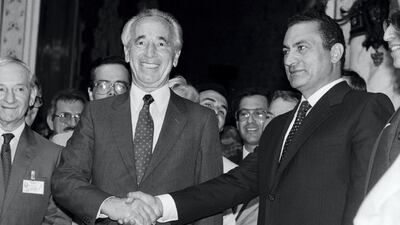
Israeli Prime Minister Shimon Peres and Egypt's President Hosni Mubarak during a summit in Alexandria on September 11, 1986. AFP -
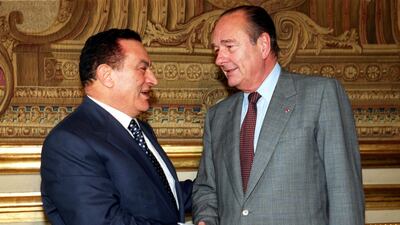
French President Jacques Chirac (R) shakes hands with his Egyptian counterpart Hosni Mubarak at the Elysee Palace in Paris 03 July 1999. AFP -
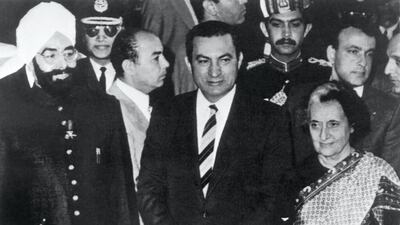
Egyptian President Hosni Mubarak, centre, is flanked by President of India Giani Zail Singh (L) and Prime Minister of India Indira Gandhi (R), on November 30, 1982 in New Delhi. AFP -
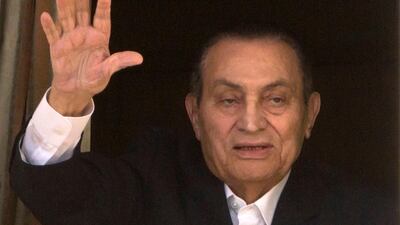
April 25, 2016: Egyptian President Hosni Mubarak waves to his supporters from his room at the Maadi Military Hospital, where he is hospitalised, in Cairo, Egypt. AP -
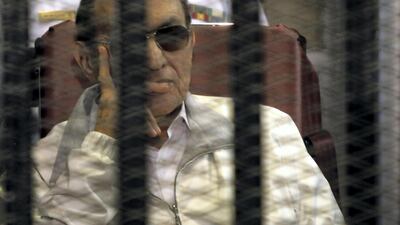
Egypt's ousted President Hosni Mubarak sits inside a dock at the police academy, on the outskirts of Cairo June 8, 2013. Reuters -
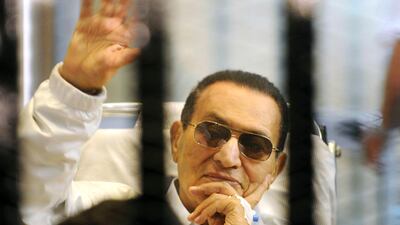
FILE - In this April 13, 2013 file photo, former Egyptian President Hosni Mubarak waves to his supporters from behind bars as he attends a hearing in his retrial on appeal in Cairo, Egypt. Egypt's state TV said Tuesday, Feb. 25, 2020, that the country's former President Hosni Mubarak, ousted in the 2011 Arab Spring uprising, has died at 91. Mubarak, who was in power for almost three decades, was forced to resign on Feb. 11, 2011, after following 18 days of protests around the country. The Arab Spring uprisings had convulsed autocratic regimes across the Middle East. (AP Photo, File) -
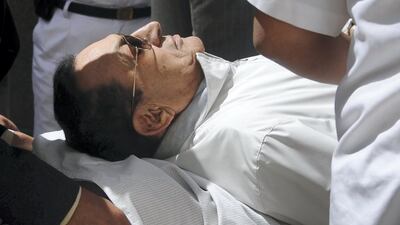
Former Egyptian President Hosni Mubarak is wheeled out of the courtroom after his trial, at the police academy in Cairo April 13, 2013. Reuters


That worked well for Mubarak, but his grip began to loosen in the last decade of his rule. His other son, Gamal, rapidly climbed the ladder of the ruling National Democratic Party and positioned himself as his father’s heir apparent. That succession scheme did not sit well with a powerful military accustomed to presidents emerging from its own ranks.
The final straw did not come from the military but from a nascent opposition movement led and fuelled by youths outraged by the beating death of a young man by the police in the coastal city of Alexandria. An 18-day popular uprising began on January 25, 2011.
Faced with continued protests, a breakdown in law and order and a series of crippling strikes, Mubarak halted his attempts to stay in power through making political concessions and delegated his newly appointed vice president, intelligence chief Omar Suliman, to announce that he was stepping down and handing the reins of power to the military.
It was not long afterwards that Mubarak was charged alongside his security chief and several top policemen with the shooting deaths of some 800 protesters during the 2011 uprising. That case, from which he was later acquitted, brought Mubarak to the public eye for the first time since he stepped down. He sat in the defendants’ cage in an upright stretcher and wearing sunglasses, an image that he maintained during a series of court appearances for several years after his removal from power.
In 2014, Mubarak and his two sons were convicted of embezzlement, sentenced to three years in prison and fined millions of pounds. All three were eventually released for time already served.
All told, Mubarak faced six years of legal proceedings since his detention in April 2011. For the entirety of this period, he was in either a prison hospital or prestigious military medical facilities where he was treated with the respect and dignity befitting a former president.
Mubarak has continued to have the support and adulation of a significant segment of society after he left office, with many crediting him with the high GDP growth of his years, record number of foreign tourists and a foreign policy that won Egypt reliable friends in the West.
By stepping down, however, Mubarak is given credit for sparing Egypt what could have been a bloody struggle similar to that in Libya, where a 2011 uprising against Muammar Qaddafi turned into a years-long conflict.
Mubarak also refused to flee the country, selecting to stay put and face what comes his way, a stand that won him accolades as a patriot and a loyal soldier.
"This dear nation... is where I lived, I fought for it and defended its soil, sovereignty and interests. On its soil I will die. History will judge me like it did others," he told the nation in a televised address during the uprising.

