

The US Treasury Department decision to sanction the chairman of Iraq’s Popular Mobilisation Forces, an umbrella group of paramilitary troops made up mainly of Iran-backed militias, has drawn mixed reactions in Iraq.
A day after the US designation for Falih Al Fayyadh, who is also a former national security adviser, Iraq’s Foreign Ministry said it was surprised.
“We stress that the decision was an unacceptable surprise,” the ministry said in a statement on Saturday.
It said it “will carefully follow up with the current and new administration in Washington all decisions issued by the US Treasury Department against Iraqi names and work to address this matter.”
The US Treasury Department said on Friday that the designation was prompted by Mr Al Fayyadh’s “connection to serious human rights abuse” during the unprecedented pro-reform protests that broke out in central and southern Iraq in October 2019.
He was part of a “crisis cell” comprised primarily of PMF militia leaders formed in late 2019 to suppress the protests with the support of Iran’s Islamic Revolutionary Guard Corps' Quds Force, it added.
“By directing and supervising the murder of peaceful Iraqi demonstrators, Iran-aligned militants and politicians such as Falih Al Fayyadh have been waging a violent campaign against Iraqi democracy and civil society,” Treasury Secretary Steven Mnuchin said in the statement.
-
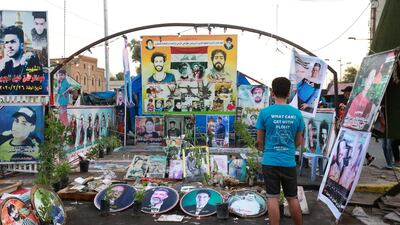
A protester stands next to the pictures of protesters who were killed in clashes with security forces during the anti-government protests at Tahrir Square in central Baghdad. EPA -
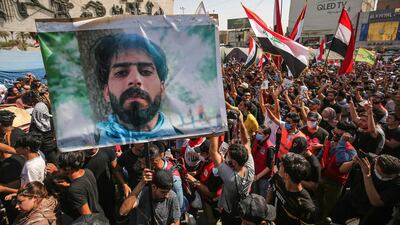
People hold up a picture of a slain protester as they gather with national flags for a demonstration in Tahrir Square in the centre of Iraq's capital Baghdad. AFP -
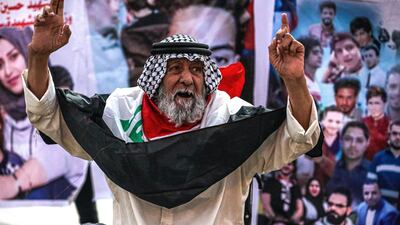
A demonstrator gestures during a protest to mark the first anniversary of the anti-government protests in Basra, Iraq on October 1, 2020. AP Photo -
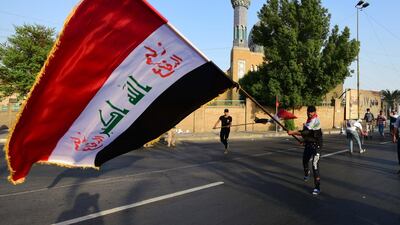
A protester waves the Iraqi national flag during a demonstration at the Al-Firdus square in central Baghdad. EPA -
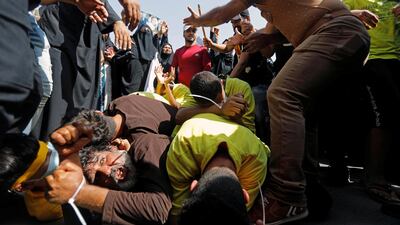
Demonstrators play the role of detainees as they gather to mark the first anniversary of the anti-government protests at Tahrir Square in Baghdad. Reuters -
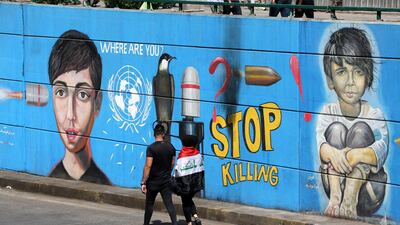
Protesters walk next to a wall with graffiti near Tahrir square in central Baghdad. EPA -
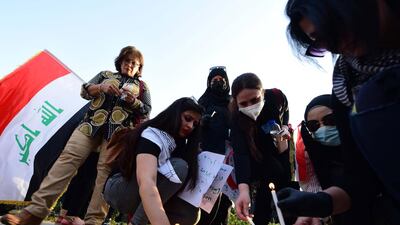
Women light candles and pray for the victims of protests at Tahrir Square in central Baghdad. EPA -
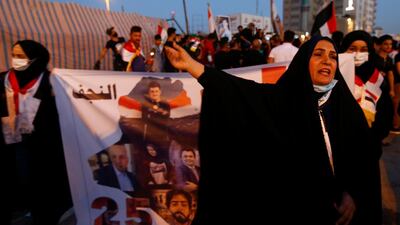
Demonstrators gather to mark the first anniversary of the anti-government protests, in Najaf, Iraq. Reuters -
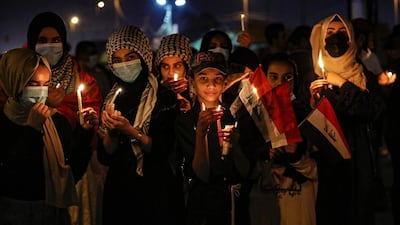
Demonstrators light candles to mark the first anniversary of the anti-government protests in Basra, Iraq. AP Photo -

A protester lights candles and prays for the victims of protests at Tahrir Square in central Baghdad. EPA -
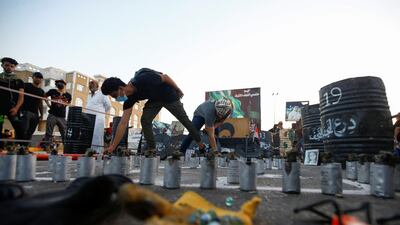
Men prepare torches as Iraqi demonstrators gather to mark the first anniversary of the anti-government protests, in Najaf. Reuters -
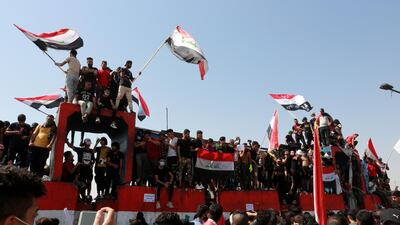
Protesters carry the Iraqi national flag as they stand on concrete blocks which are used by security forces to block the Al-Jumhuriya bridge, close to Tahrir square in central Baghdad. EPA -
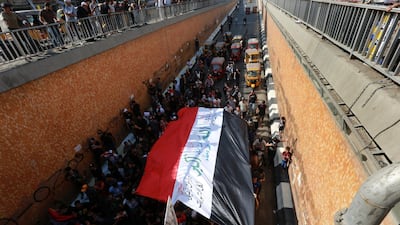
Iraqis carry the Iraqi national flag and chant slogans during a demonstration at Tahrir square in central Baghdad. EPA -
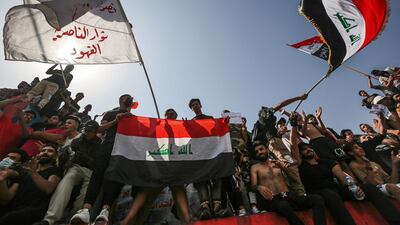
Protesters wave Iraqi national flags as they gather for a demonstration in Tahrir Square in the centre of Iraq's capital Baghdad. AFP -
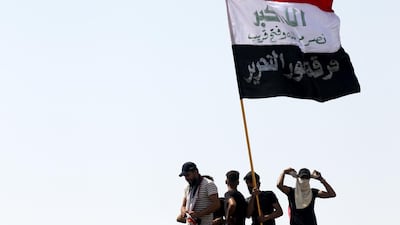
Iraqi protesters wave the national flag as they gather for a demonstration in Tahrir Square in the centre of Iraq's capital Baghdad. AFP


Under the sanctions, any property or interests that Mr Al Fayyadh has in the United States will be blocked.
When Iraqi security forces crumbled in mid-2014 as ISIS swept through northern and western Iraq, Shiite volunteers and militias answered a call from the country’s influential Shiite cleric, grand ayatollah Ali Al Sistani, to join the fight. Since then, Iran-backed militias have joined the PMF.
The decision drew mixed reactions from the activists.
"That is a right decision," a female activist told The National, requesting anonymity for her safety. "But it's not enough against a criminal like Al Fayyadh," she added.
“We are eager to see him arrested to be tried for every drop of blood he has shed,” she said.
“He dubbed the October protests as ‘conspiracy’ and played a role in the killing and kidnapping of protesters through the Hashed security service,” she added, using the Arabic name for the PMF.
Others see the move as part of the Iran-US conflict in Iraq.
"The US-Iran conflict on the Iraqi soil takes different forms, sometimes it comes with military actions and sometimes with legal moves,” activist Hashem Al Jabouri said.
Mr Al Jabouri added that the timing of the decision gives the impression that it came as a reply to the arrest warrant issued on Thursday by a Baghdad court against the outgoing US President, Donald Trump, for ordering the killing of Iran’s General Qassem Suleimani and the leader of Iran-backed Iraqi militia Kataib Hezbollah, Abu Mahdi Al Muhandis.
The PMF and militias have also decried Washington’s financial sanctions against figures linked to the Iranian regime.
“We congratulate the friend of the martyrs, the chairman of Hashed Al Shaabi, Falih Al Fayyadh, for joining the honourable people who are considered by the American administration as enemies,” the PMF said in a statement on its Twitter account with a picture for Mr Al Fayyadh brandishing a sword while standing next to Al Muhandis.
The Al Fattah bloc in parliament, which represents the main pro-Iran militias, described the decision as “childish and reckless”.
It called Mr Al Fayyadh a “patriotic figure” and said the sanctions would “further strengthen the Hashed and its leadership”.
Friday’s sanctions are the latest by the US to target Iraqi individuals close to Tehran for their alleged role in quelling the anti-government protesters.
In December 2019, the Treasury Department blacklisted the leader of Asaib Ahl Al Haq militia, Qais Al Khazali, along with two militia leaders.
The previous government and PMF have denied any role in targeting the protesters. The government accused a “third party” of the killings and kidnappings of protesters without identifying it.
When he took office in May, Prime Minister Mustafa Al Kadhimi pledged to investigate the killings. But his government has so far failed to hold anyone to account, offering only promises of justice and financial aid to victims.
Based on statistics released by the government on July 30, at least 560 protesters and members of security forces have been killed, while tens of thousands of others were wounded – many suffering life-changing injuries – since the protests began.
Most of those killed or wounded are protesters, hit by security forces and state-sanctioned militias firing live rounds and military-grade smoke bombs.

