

Palestinian President Mahmoud Abbas has rejected US leader Donald Trump's peace proposal, saying the deal "annuls Palestinian rights".
Mr Abbas on Tuesday told the UN Security Council that the deal "legitimised what is illegal” and he stressed the Palestinians' anger at the proposal.
The deal, released in January, would allow Israel to annex settlements in the occupied West Bank and the eventual creation of a demilitarised Palestinian state, over which Israeli security would have near total control.
Mr Abbas said the deal "cannot achieve peace and security because it cancelled international legitimacy. It cancels all the rights of the Palestinian people".
He thanked members of the international community for standing with Palestinian people against the deal.
Mr Abbas said the EU, Russia, China and the UN supported the Palestinian view that any deal should include UN resolutions.
-
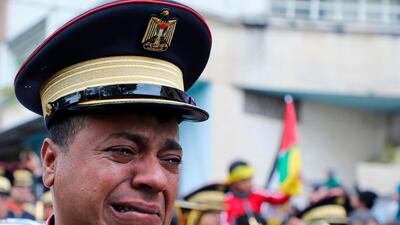
A policeman cries during the funeral of Palestinian policeman Tareq Badwan, shot by Israeli troops during confrontations with demonstrators in the northern West Bank town of Jenin, in his village of Azun. AFP -
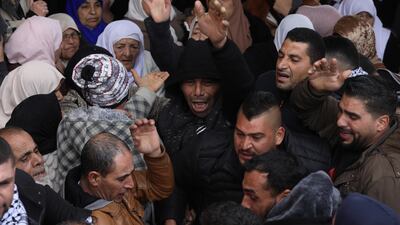
People mourn as others carry the body of Bader Nidal Nafleh (19) during his funeral n the West Bank village of Qafen near Tulkarem city. EPA -
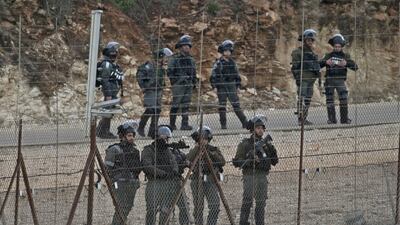
Israeli security forces stand behind a wire fence as Palestinians demonstrate in the northern West Bank city of Tulkarem following the funeral of 19-year-old Badr Nafla in the same city. AFP -
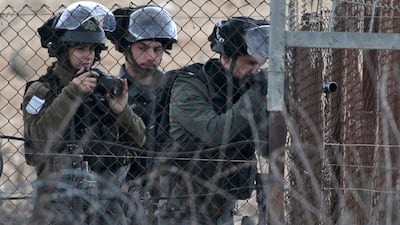
An Israeli soldier takes aim amid clashes with Palestinian protesters in the northern West Bank city of Tulkarem following the funeral of 19-year-old Badr Nafla in the same city. AFP -
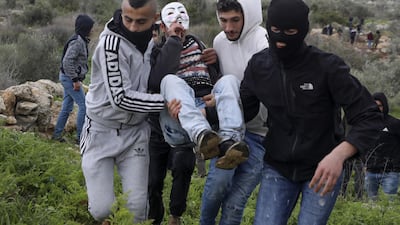
Palestinian protesters carry away a comrade amid clashes with Israeli forces in the northern West Bank city of Tulkarem following the funeral of 19-year-old Badr Nafla in the same city. AFP -
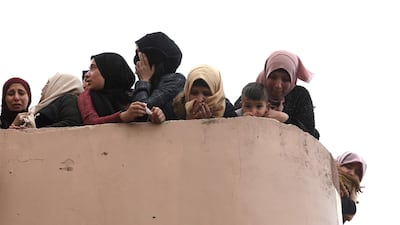
Spectators watch as Palestinians carry the body of Bader Nidal Nafleh (19) during his funeral, in the West Bank village of Qafen near Tulkarem city. EPA -
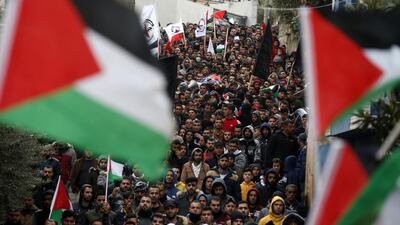
Palestinians carry the body of Badr Nafla, 19, who died after reportedly being shot by Israeli forces in the neck in the midst of confrontations near the northern West Bank city of Tulkarem yesterday, during his funeral in the same city. AFP -
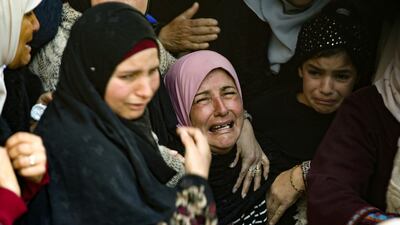
The mother (C) of Badr Nafla, 19, who died after reportedly being shot by Israeli forces in the neck in the midst of confrontations near the northern West Bank city of Tulkarem yesterday, reacts during his funeral in the same city. AFP -
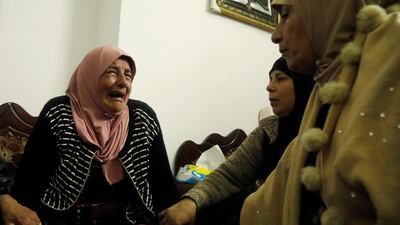
Relatives of Palestinian Bader Nafilah, who was killed during clashes with Israeli troops, mourn during his funeral in Qaffin in the Israeli-occupied West Bank. REUTERS


"If this council's resolutions are disregarded then who will we resort to?" he asked.
He thanked the Israeli people, who he said "took to the streets" to oppose the bill, and US politicians who criticised it.
Mr Abbas held up a petition he said was signed by 300 Israeli officers against the deal, and a map showing the proposed make-up of the Palestinian and Israeli states under Mr Trump's deal.
He said the proposal for a Palestinian state was like “Swiss cheese” and asked who among those gathered in New York would accept such a map of statehood.
Mr Abbas said it “strengthened the apartheid regime" that the Palestinians thought they had got rid of years ago.
Mr Trump's son-in-law Jared Kushner, an architect of the plan, presented it to a closed session of the Security Council last week.
Mr Kushner's plan hands all of Jerusalem inside the security barrier to Israel, including the Old City that hosts the third-holiest site in Islam.
Mr Abbas angrily rejected the idea.
"Jerusalem is an occupied land," he said. "Who has the right to give this as a gift to one state or another?"
Israel's ambassador to the UN, Danny Danon, said what the plan "does differently is refuse to accept the same out-of-date concepts of previous plans".
He said that if Mr Abbas really wanted a peaceful solution, he would be in Washington or Jerusalem, not addressing the UN.
Mr Abbas called into question the advice Mr Trump was receiving on the issue, saying this plan was very different from what was promised when the two men met in 2017.
He criticised the US decision to close the Palestine Liberation Organisation's Washington office and withdraw $840 million (Dh3.08 billion) of aid to the UN agency helping Palestinian refugees.
“I don't know who gave him this unacceptable advice," Mr Abbas said. "I know Mr Trump is not like that."
He repeated a call he made in February 2018 for a UN Security Council-backed Middle East peace conference, saying he had faith this would pay dividends.
Britain's permanent representative to the UN, Karen Pierce, said her country's attitude towards the Middle East Peace Process had not changed.
Ms Pierce said the UK supported a negotiated settlement leading to a safe and secure Israel living alongside a viable and sovereign Palestinian state, based on 1967 borders with allowance for land swap agreements.
She repeated that Britain also supported recognising Jerusalem as the shared capital of both states.
"Israelis and Palestinians deserve better,' Ms Pierce said. "They deserve a durable resolution that provides all with dignity and security.
"Palestinians deserve self-determination and freedom from occupation.
"Israelis deserve to live free of terrorist rocket fire and a future characterised by fruitful co-operation with their neighbours in the region.
"This can only be achieved by finding a path back to negotiations, and securing the settlement that is acceptable to all parties. No other path to peace exists."
Meanwhile, in Strasbourg at the European Parliament, the EU's top diplomat Josep Borrell urged Israel not to annex the Jordan Valley, a large part of the occupied West Bank, warning of Palestinian reprisals if it went ahead.
Israeli Prime Minister Benjamin Netanyahu announced his intention on Tuesday to annex the valley if he wins re-election.
“This may happen. You can be sure it’s not going to be peaceful,” Mr Borrell said on Tuesday.

