
The lifting of Saudi Arabia's ban on women driving from Sunday is a long-awaited move for both local women and those in neighbouring countries, many of whom expect the freedom to travel independently across borders to be transformative to their careers and relationships.
Apart from travel between Oman and the UAE, driving from one GCC country to another requires passing through Saudi Arabia, journeys which the Saudi ban has so far made impossible for women.
While many women may now drive to or from Saudi Arabia simply to take advantage of the facility of visa-free travel within the GCC for citizens of member states, others will be doing so because it makes it significantly easier to stay connected to family and maintain long-distance marriages and working arrangements.
Many Bahraini and Saudi women commute between the two countries on a weekly or even daily basis, with the drive along the King Fahd Causeway taking less than an hour in good traffic. However, it has been impossible to make the trip alone. To do so required employing a dedicated male driver — usually from outside of the GCC, meaning that on top of paying their salary they had to pay for employee registration on both sides of the bridge.
“I work in Bahrain, live in Bahrain, but my parents live in Khobar. Every weekend a driver has to to pick me up so I can go spend the weekend with them in Saudi, and after the weekend I come back,” said Hinda Al Rawaf, general manager at Quby Group.
On busy days, the Bahrain-Saudi bridge crossing can take more than four hours. Thursday evenings and Saturday nights are peak crossing times, which happen to be when Ms Al Rawaf makes the commute with her driver.
“Beginning Sunday, after work on a given day, if I have a meeting or I want to see my parents for dinner, I can just go. It makes life so much easier,” she said.
“The driver can stay with my parents. I am fortunate to have the arrangement, but many didn’t have that luxury. I’m glad it changes on Sunday.”
_______________
Read more:
Saudi Crown Prince Mohammed bin Salman's dynamic year of reform
Vogue puts Saudi princess in the driver's seat
First Saudi women given driving licences ahead of law change
_______________
For lower-income women, driving will open up the previously unaffordable options of studying and working in Bahrain, or vice versa.
Ms Al Rawaf is among many who live between the two countries — it is so common that special passes are available to expedite travel for regular commuters.
Other women see the chance to drive themselves between the two countries as a chance to maintain relationships.
“I’m married to a Saudi and honestly it’s been hard being away from my family,” said SK, A Bahrain who asked to remain anonymous. “We got married a year ago, but sometimes I just want to see my family. Now I think that can be much easier to do.”
Previously, visiting her family in Manama meant either convincing her husband to drive her from Dammam or taking a flight.
“Honestly, I really think this is going to help make our marriage thrive,” she said. “At the end of the day, my love is spread between two countries, so knowing I can have both is making me so satisfied.”
Razan Alkhatib, 26, is a Saudi doctor who says the opportunity to drive will allow her to kick-start her career in Bahrain. Despite her young age, she is surprised to see the lifting of the driving ban come about so quickly.
“I never thought that I’d live to see it. I’m proud and so happy to witness this change during this time of my life. Especially at a very critical time at the beginning of my career,” she said.
-
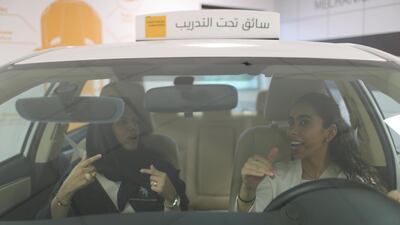
A driving instructor teaches trainee Maria Al Faraj, right, during a lesson at Saudi Aramco Driving Center in Dhahran, Saudi Arabia. Ahmed Jadallah / Reuters -
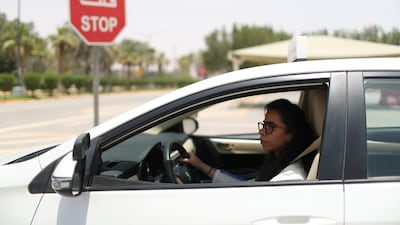
Learner-driver Maria Al Faraj stops the car at a junction. Ahmed Jadallah / Reuters -
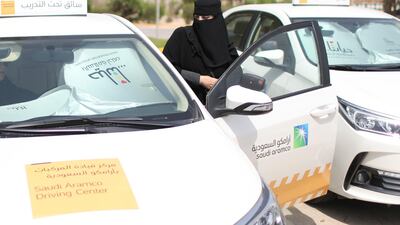
Learner Amira Abdelgader gets into a car for her driving lesson. Ahmed Jadallah / Reuters -
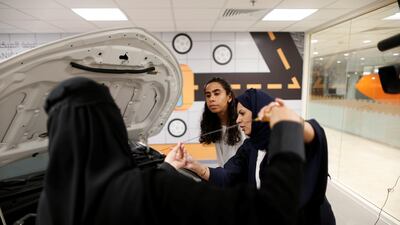
The women are given practical advice such as checking oil levels in the engine. Ahmed Jadallah / Reuters -
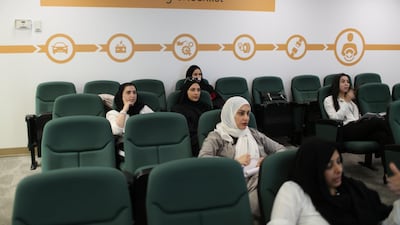
The learner drivers take part in a theory lesson. Ahmed Jadallah / Reuters -
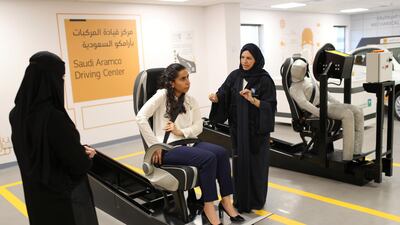
A driving instructor, right, explains the importance of buckling up. Ahmed Jadallah / Reuters -
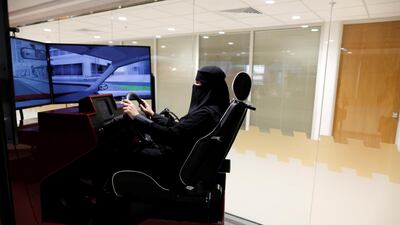
Trainee Amira Abdulgader practices on a simulator. Ahmed Jadallah / Reuters -

A driving instructor teaches how to negotiate a T-junction. Ahmed Jadallah / Reuters -
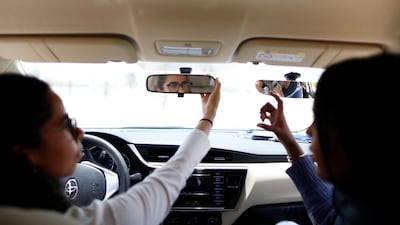
Maria Al Faraj, left, adjusts her rear-view mirror. Ahmed Jadallah / Reuters -
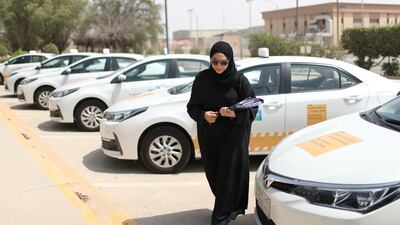
A driving instructor arrives at Saudi Aramco Driving Centre in Dhahran, Saudi Arabia. Ahmed Jadallah / Reuters -
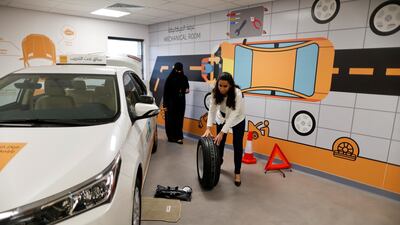
Practical lessons include how to change a tyre. Ahmed Jadallah / Reuters -
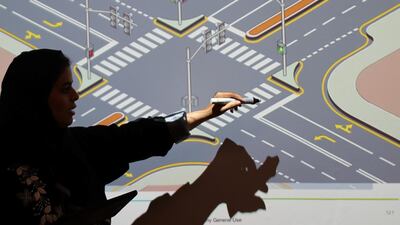
The instructor explains the theory of negotiating a cross-roads Ahmed Jadallah / Reuters -

An illustration is seen on a wall at the Driving Centre. Ahmed Jadallah / Reuters


She said many decisions were dictated by her limited mobility, including taking her job in Bahrain, which required her family to get a driver.
Although her family has been supportive, she joked that the decision to allow women to drive would almost certainly be celebrated more by her father and brother “who no longer have to run all the errands”.
“Now I feel like a free bird, I can basically live wherever I want and move freely without any restrictions. The country is growing very quickly and I’m proud of the changes that are happening,” she said.

