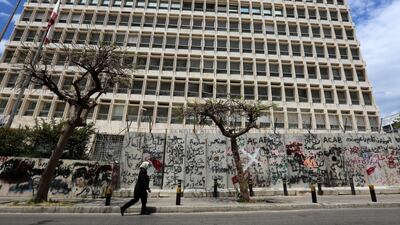

Lebanon’s failure to reform its subsidy programme looks set to exacerbate a deepening financial crisis.
Central bank governor Riad Salameh sounded the alarm bells last month, warning the nation could only afford to subsidise vital imports at the official rate of 1,500 Lebanese pounds to the dollar for an additional two months.
The national currency has lost over 80 per cent of its value on the black market since the crisis unfolded in late 2019.
Mr Salameh’s remarks prompted meetings with caretaker Prime Minister Hassan Diab and members of his Cabinet to discuss plans to ration subsidies.
A month later, Mr Diab and his Cabinet have yet to agree on a plan to reduce the import bill, a source familiar with the talks told The National.
The dwindling foreign currency reserves held by Banque du Liban, as Lebanon's central bank is known, are currently estimated at $17 billion.
The situation threatens to plunge the country into complete darkness and over half of its population into poverty.
Among the floated proposals is a plan to replace import subsidies with direct cash assistance to low-income households.
Experts say this would reduce the burden on the central bank and curb the illegal smuggling of subsidised goods into Syria.
Redesigning the current subsidy programme to target only low to middle-income earners would also limit attempts to circumvent capital controls that banks imposed in late 2019, says Dan Azzi, a financial expert and former banking executive.
“Even if every family in Lebanon received up to $100 per month, this would save around 75 per cent of the cost of subsidisation, which is also subject to abuse through smuggling of funds abroad with fraudulent receipts to get around the capital controls,” Mr Azzi argues.
-
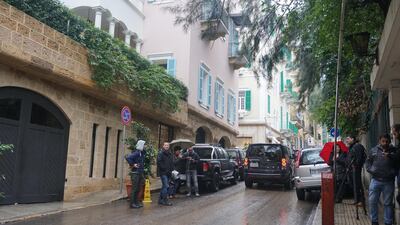
Carlos Ghosn's home at Ashrafieh St., in Beirut, Lebanon. Sunniva Rose for The National -

Japanese journalists that were waiting outside, including when they were filming a car leaving Ghosn's house (unfortunately the driver did not look like him). Sunniva Rose for The National -
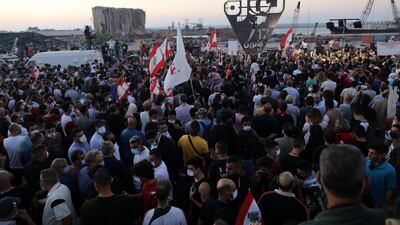
BEIRUT, LEBANON - OCTOBER 17: People wave Lebanese flags and chant to mark the one-year anniversary of anti-government protests with a background of the destroyed silos on the seaport on October 17, 2020 in Beirut, Lebanon. On the one year anniversary since the unprecedented mass protests of Lebanese demanding political change as the country buckled under social and economic devastation, Beirut remains in rubble after the August 4 port blast. (Photo by Marwan Tahtah/Getty Images) -
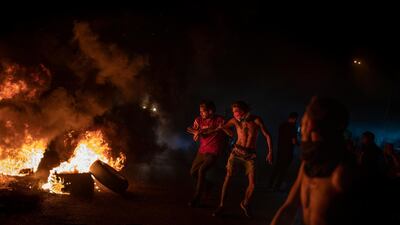
BEIRUT, LEBANON - JUNE 11: Protesters burn tires as large-scale protests resume on June 11, 2020 in Beirut, Lebanon. The Lebanese pound has lost 70% of its value since October when protests began. Although they abated during the coronavirus lockdown, the country's economic condition steadily worsened. (Photo by Diego Ibarra Sanchez/Getty Images) -
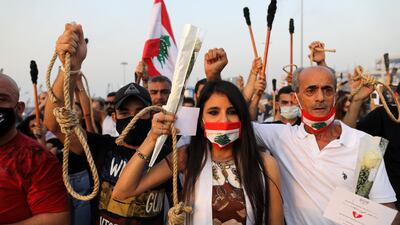
BEIRUT, LEBANON - SEPTEMBER 04: Protesters hold torches and nooses, which have become symbols of public anger against the Lebanese government, as they commemorate a month since the city's deadly explosion on September 4, 2020 in Beirut, Lebanon. On August 4th, a fire at Beirut's port ignited a stockpile of ammonium nitrate causing a massive explosion that killed more than 200 people, destroyed surrounding neighborhoods and upended countless lives. (Photo by Marwan Tahtah/Getty Images) -
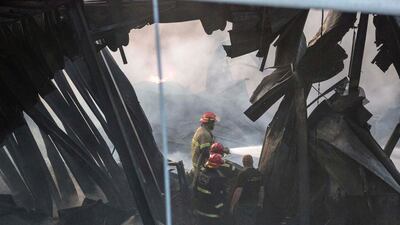
BEIRUT, LEBANON - SEPTEMBER 10: Firefighters walk through a burned out warehouse as they respond to a huge blaze at Beirut port on September 10, 2020 in Beirut, Lebanon. The fire broke out in a structure in the city's heavily damaged port facility, the site of last month's explosion that killed more than 190 people. (Photo by Sam Tarling/Getty Images) -
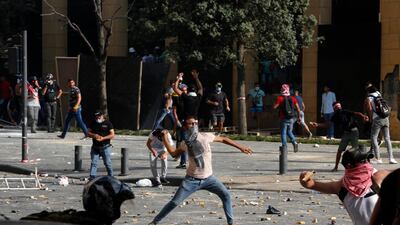
BEIRUT, LEBANON - AUGUST 08: Protesters throw stones during an anti-government demonstrations on August 8, 2020 in Beirut, Lebanon. The Lebanese capital is reeling from this week's massive explosion that killed at least 150 people, wounded thousands, and destroyed wide swaths of the city. Residents are demanding accountability for the blast, whose suspected cause was 2,700 tons of ammonium nitrate stored for years at the city's port. (Photo by Marwan Tahtah/Getty Images) -
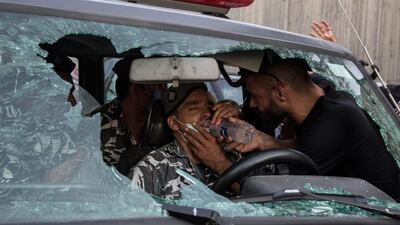
BEIRUT, LEBANON - SEPTEMBER 12: An anti-government protester gives water to a policeman after other protesters attacked his vehicle during a march toward the Presidential Palace, on September 12, 2020 in Baabda, Beirut, Lebanon. (Photo by Sam Tarling/Getty Images) -
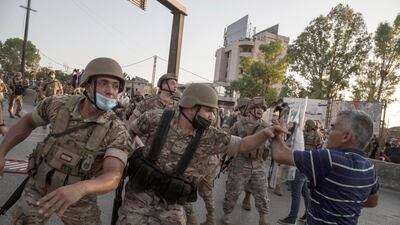
BEIRUT, LEBANON - SEPTEMBER 12: Anti-government protesters clash with security forces during a march toward the Presidential Palace, on September 12, 2020 in Baabda, Beirut, Lebanon. (Photo by Sam Tarling/Getty Images) -
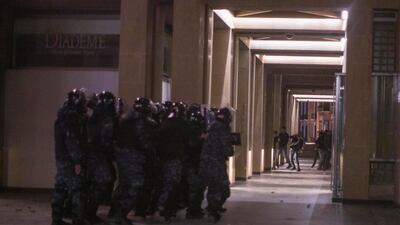
BEIRUT, LEBANON - JANUARY 22: Anti government protesters and riot police clash during a second day of violence, on January 22, 2020 in an upscale shopping district in Beirut, Lebanon. Weeks of bickering between the Hezbollah-allied political factions backing Lebanon's new Prime Minister Hassan Diab as to who gets which ministries has led protesters to decry his new government as partisan and political, and not the technocratic leadership they have been demanding since protests began on Oct 17th last year. (Photo by Sam Tarling/Getty Images) -
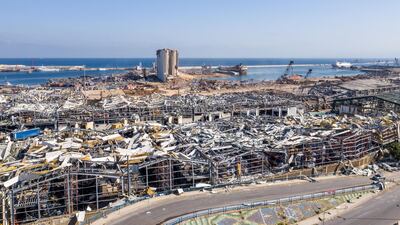
BEIRUT, LEBANON - AUGUST 07: An aerial view of ruined structures near the city's port, the site of Tuesday's explosion, on August 7, 2020 in Beirut, Lebanon. By Friday, the official death toll from Tuesday's blast stood at 145, with thousands injured. Public anger swelled over the possibility that government negligence over the storage of tons of ammonium nitrate was behind the catastrophe. (Photo by Haytham Al Achkar/Getty Images) -
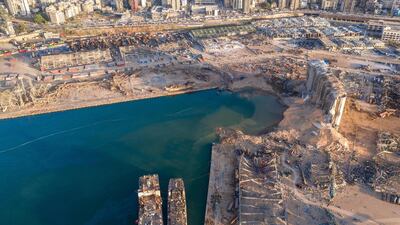
BEIRUT, LEBANON - AUGUST 05: An aerial view of ruined structures at the port, damaged by an explosion a day earlier, on August 5, 2020 in Beirut, Lebanon. As of Wednesday, more than 100 people were confirmed dead, with thousands injured, when an explosion rocked the Lebanese capital. Officials said a waterfront warehouse storing explosive materials, reportedly 2,700 tons of ammonium nitrate, was the cause of the blast. (Photo by Haytham Al Achkar/Getty Images) -

BEIRUT, LEBANON - FEBRUARY 11: Anti-government protesters are hit by a water cannon as they pull down a concrete barricade during a failed attempt to block politicians from accessing Parliament where they will vote whether to accept Lebanon's new government, on February 11, 2020 in Beirut, Lebanon. (Photo by Sam Tarling/Getty Images) -

BEIRUT, LEBANON - AUGUST 5: Destroyed buildings are visible a day after a massive explosion occurred at the port on Aug. 5, 2020 in Beirut, Lebanon. As of Wednesday morning, more than 100 people were confirmed dead, with thousands injured, when an explosion rocked the Lebanese capital. Officials said a waterfront warehouse storing explosive materials, reportedly 2,700 tons of ammonium nitrate, was the cause of the blast. (Photo by Daniel Carde/Getty Images) -
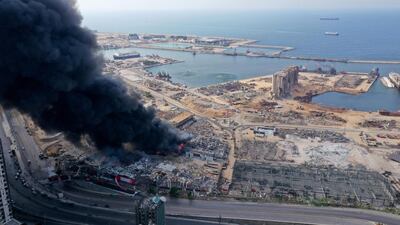
BEIRUT, LEBANON - SEPTEMBER 10: An aerial view of the black smoke following a fire that erupted in Beirut Ports Free Zone on September 10, 2020 in Beirut, Lebanon. The fire broke out in a structure in the city's heavily damaged port facility, the site of last month's explosion that killed more than 190 people. (Photo by Haytham Al Achkar/Getty Images) -
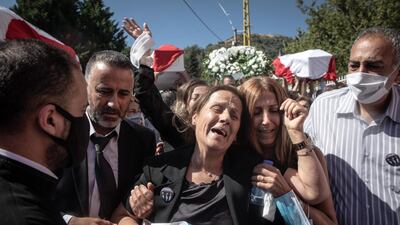
BEIRUT, LEBANON - AUGUST 17: Family members mourn as the coffins of firefighters Charbel Hetti, Najeeb Hetti and Charbel Karem who were killed in the August 4th, Beirut port explosion are carried to the church during their funeral service in their hometown of Qartaba on August 17, 2020 in Beirut, Lebanon. Najeeb Hetti, 27 his cousin Charbel Hetti, 22 and his sisters husband Charbel Karam, 37 were killed during the Beirut port explosion along with 7 other firefighters from the Karatina fire department, who were the first responders to the blaze. The remains of Najeeb and Charbel were found on August 13th, however the family refused to bury them until the body of Charbel Karam was found, his remains were recovered on August 15th. There has been little visible support from government agencies to help residents clear debris and help the displaced, although scores of volunteers from around Lebanon have descended on the city to help clean. (Photo by Chris McGrath/Getty Images) -

BEIRUT, LEBANON - AUGUST 07: A general view of buildings heavily damaged in Tuesday's explosion, on August 7, 2020 in Beirut, Lebanon. By Friday, the official death toll from Tuesday's blast stood at 145, with thousands injured. Public anger swelled over the possibility that government negligence over the storage of tons of ammonium nitrate was behind the catastrophe. (Photo by Haytham Al Achkar/Getty Images) -
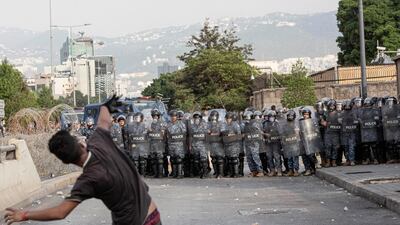
BEIRUT, LEBANON - OCTOBER 30: A demonstrator throws stones at police at an anti-France protest on October 30, 2020 in Beirut, Lebanon. Following a series of deadly attacks, France's President Macron declared a crackdown on Islamist extremism by shutting down mosques and other organisations accused of instigating violence. The comments sparked protests across the Muslim world and calls for a boycott of French goods. (Photo by Sam Tarling/Getty Images) -
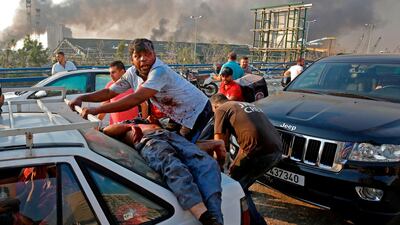
-- AFP PICTURES OF THE YEAR 2020 -- An injured man lies at the back of a car before being rushed away from the scene of a massive explosion at the port of Lebanon's capital Beirut on August 4, 2020. Two huge explosion rocked the Lebanese capital Beirut, wounding dozens of people, shaking buildings and sending huge plumes of smoke billowing into the sky. Lebanese media carried images of people trapped under rubble, some bloodied, after the massive explosions, the cause of which was not immediately known. - / AFP / Marwan TAHTAH -
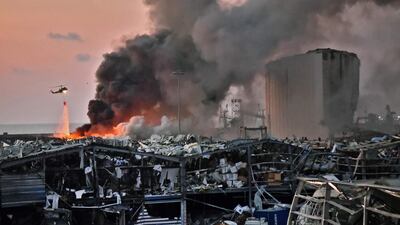
-- AFP PICTURES OF THE YEAR 2020 -- A helicopter puts out a fire at the scene of an explosion at the port of Lebanon's capital Beirut on August 4, 2020. AFP / STR


The current subsidy programme, he says is being literally burnt on cheap fuel.
"Filling up your car with gasoline today costs less than Saudi Arabia, and doesn’t distinguish between a rich Range Rover owner and a Kia owner,” Mr Azzi says.
“It’s not technically very difficult to identify truly needy families, through the analysis of certain variables, like the size of someone’s bank account, mobile phone bill, electricity bill, mortgage or rent payment, car loan payment, car brand, house square footage, etc.
"You can start out with a $100 payment for everyone, then an algorithm can be designed to subtract a certain percentage based on the above variables, such that a rich person, as defined by the weighted average of those variables, gets zero,” he says.
Restricting cash aid to families in need would further reduce the import bill, Mr Azzi adds, warning that if the current subsidies system remains in place, the Central Bank’s reserves would be consumed within 12-18 months.
“Not only would subsidies be removed then, but the electricity supply would be cut off when we run out of funds.”
The latter scenario seems likely if no agreement is reached over an alternative subsidy system to put in place, MP Selim Saade said in a recent televised interview.
“No one would dare eliminate subsidies completely before consuming it all unless an efficient alternative is found … I’m telling you, it [eliminating subsidies] is not happening,” he said.
Eliminating subsidies without providing social assistance to vulnerable households could prove disastrous for the country’s poor, UN agencies have warned.
The World Bank also warned that failure to enact reforms will plunge more than half of Lebanon’s population into poverty by 2021.
Reforms have been a long-time demand of the international community in exchange for providing Lebanon with much needed financial support to weather its crisis. But little progress has been made as political bickering intensified since the resignation of Mr Diab’s government after the deadly explosion that sent shock waves through Beirut in August.
The investigation into the explosion, which killed over 200 people and caused massive destruction at one of the region’s busiest ports and across large parts of the capital, has been marred by controversy with the country’s top officials trading accusations over who bears responsibility for the incident.
The political tensions surrounding the investigation and increased US sanctions on the Iran-backed Lebanese armed group Hezbollah and its key allies, including the president’s son-in-law and leader of the largest parliamentary bloc, have complicated efforts to form a new Cabinet tasked with implementing key reforms that the international community is demanding.
These include a stalled forensic audit of the Central Bank, which Lebanon has yet to undertake after consultancy firm Alvarez & Marsal, which was tasked by government to conduct the task, withdrew from the contract citing the “insufficient provision of information.”
A government source told The National that Lebanon has reinvited Alvarez and Marsal to undertake the audit after Parliament eased banking secrecy laws last month but has yet to receive a response from the consultancy firm.
Legal experts fear the ratification of the law is unlikely to pave the way for an audit any time soon since the appointment of a new auditor would necessitate a fully functioning government.
An audit of the central bank is a prerequisite for an IMF programme that Lebanon needs amid a deepening economic crisis that saw the country’s real GDP shrink by nearly 20 per cent in 2020, according to World Bank estimates.

