
Like most Lebanese expatriates who keep their life savings in their home country, Elias, a sales manager in Dubai, panicked when banks in Lebanon began enforcing capital controls on cash withdrawals last November.
Rumours were swirling that the cash-strapped government would resort to a haircut on deposits.
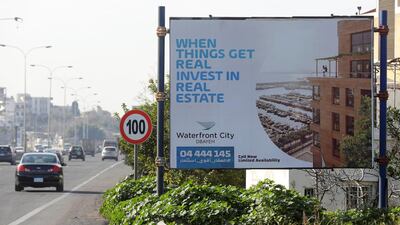
Desperate, many Lebanese wrote checks to transform their money stuck in the bank into tangible assets they did not need, triggering an artificial boom in the real estate sector, which had been sluggish for years.
First, Elias bought a Rolex watch. Then, he purchased land in his home village. Finally, early in June, he bought a bigger flat in the capital and sold his old one.
This allowed him to reduce the balance in his dollar bank account from more than a million dollars to just under $500,000 (Dh1.8 million). He had also been eyeing an off-road sports car, but importers had run out.
Government officials, who are negotiating with the IMF for a bailout deal, have hinted that should a haircut take place, only the biggest depositors would be affected. In reality, nobody knows what will happen as negotiations drag on.
-
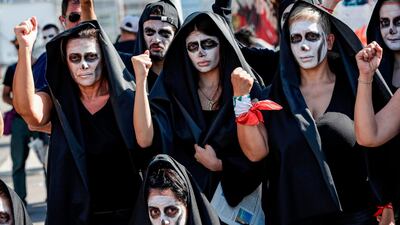
Lebanese anti-government protesters take part in a symbolic funeral for the country in the capital Beirut on June 13, 2020, the third consecutive day of demonstrations over a deepening economic crisis. AFP -
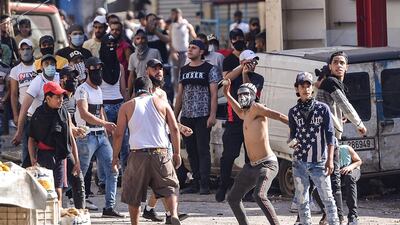
Lebanese anti-government protesters throw rocks at soldiers amid clashes in the Bab al-Tabbaneh neighbourhood in the northern port city of Tripoli on the third consecutive day of demonstrations against deepening economic crisis. AFP -
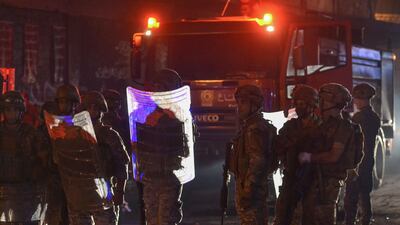
Lebanese soldiers deploy by a civil defence firefighting truck during clashes with anti-government protesters in the northern port city of Tripoli amid fresh demonstrations over a spiralling economic crisis. AFP -
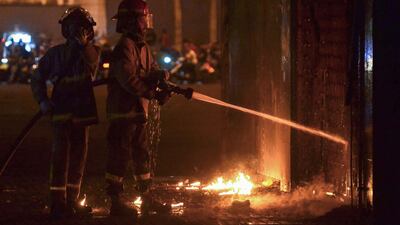
Lebanese civil defence firefighters extinguish flames in a shop as anti-government protesters and security forces clash in the northern port city of Tripoli amid fresh demonstrations over a spiralling economic crisis. AFP -
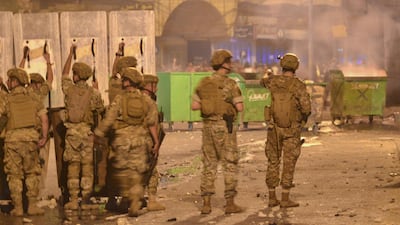
Lebanese soldiers with riot gear react during clashes with anti-government protesters in the northern port city of Tripoli amid fresh demonstrations over a spiralling economic crisis. AFP -
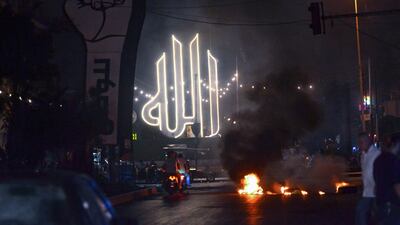
Lebanese anti-government protesters block a road with burning tyres in the northern port city of Tripoli amid fresh protests over a spiralling economic crisis. AFP -
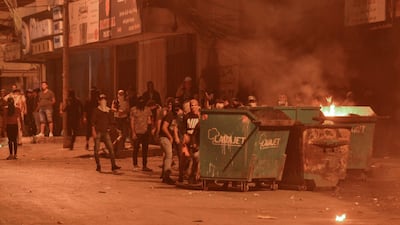
Lebanese anti-government protesters clash with security forces in the northern port city of Tripoli amid fresh protests over a spiralling economic crisis. AFP -
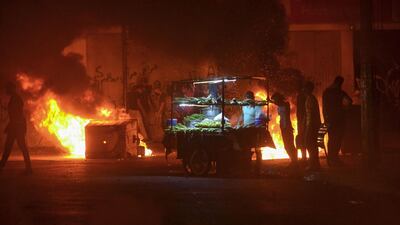
Lebanese anti-government protesters buy corn from a street vendor next to burning garbage bins during clashes with security forces in the northern port city of Tripoli amid fresh protests over a spiralling economic crisis. AFP -
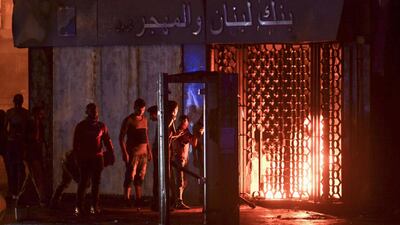
Lebanese anti-government protesters take shelter behind a public phone booth as a local bank's branch burns during clashes with security forces in the northern port city of Tripoli amid fresh protests over a spiralling economic crisis. AFP -
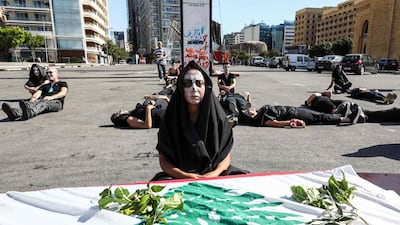
Lebanese anti-government protesters take part in a symbolic funeral for the country in the central area of the capital Beirut on the third consecutive day of demonstrations over a deepening economic crisis. AFP -
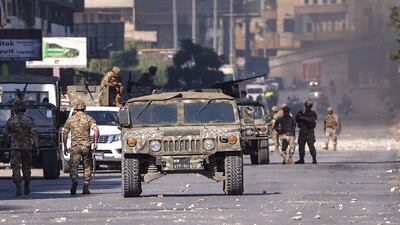
Lebanese soldiers deploy during an anti-government protest in the Bab al-Tabbaneh neighbourhood in the northern port city of Tripoli on the third day of demonstrations across the country over deepening economic crisis. AFP -
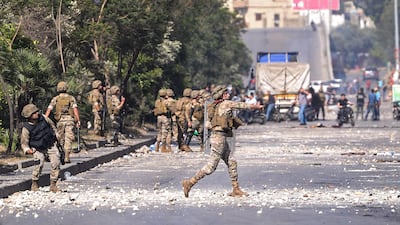
Lebanese soldiers clash with anti-government protesters in the Bab al-Tabbaneh neighbourhood in the northern port city of Tripoli on the third day of demonstrations across the country against deepening economic crisis. AFP


But for Lebanon's upper-middle class, real estate seems to be a secure investment. Buyers can pay with bank cheques and in some cases, sellers also ask for a small amount of cash dollars. Checks are then deposited in a Lebanese bank, though only a fraction of the amount can be withdrawn in cash.
Buying real estate has become so popular that prices went up 30 per cent since protests started and at the same time, the number of sales nearly tripled compared to the previous year, said Guillaume Boudisseau, from real estate consultancy Ramco in Beirut.
“The country is nearly bankrupt and in parallel, people are fighting over flats they don’t need,” he said. “It’s crazy.
“People are spending millions to buy a flat in downtown Beirut, just a few metres away from where protesters were vandalising property."
Solidere, a public-private partnership that manages downtown Beirut, told The National that they had sold $340m worth of property and plots, worth on average between $15m and $60m each, since early 2020.
This allowed Solidere to close its debts with local banks.
“We have some plots left but we are not going to sell them for the moment because we have no more loans [with banks] any more,” said Adib Al Nakib, division manager of sales and marketing at the company.
Most real estate developers’ debt had increased recently because of the slump in sales in previous years, as confidence in the Lebanese economy eroded because of regional tensions.
"Now, developers covered a big part of their debts, but it wasn't the deal of the century," Mireille Korab Abi Nasr, vice president of the association of real estate developers in Beirut, told The National. "They covered their losses of the past five years, when they were losing" money, she said.
This has been good for banks. Riad Obegi, the chairman and general manager of Lebanese Banque Bemo, told The National that debt owed to the bank went down by about 23 per cent over the past year, in part because of real estate purchases.
"Banks played the role of real estate brokers," said Christian Baz, a broker himself. "They knew which one of their clients was in debt. Instead of knocking on the door of a building asking who wants to sell, clients just asked the banks, which redirected them to indebted real estate developers."
But the rise in prices and in the number of property sales does not mean that their value has increased for a non-Lebanese market.
Quite the opposite: trust in the value of the local currency has eroded to such a point that prices can fall steeply if a client transfers money in euros or American dollars to a real estate owner's bank account abroad.
"Today, the real benchmark is the dollar," said property manager Zaher Boustany. "There is a discount of up to 60 per cent if a client pays with real dollars," he said, as opposed to dollars frozen in Lebanon's banks, locally called "lollars".
Mr Boustany said that the bubble was almost over because there was little available property left on the market. Additionally, once sellers have covered their debts, the incentive to sell dwindles. As Lebanon's economic crisis worsens, people are losing hope that they will ever be able to cash their money.
The value of the local currency has dropped by about 80 per cent on the black market since last October. The official peg of 1,507.5 Lebanese pounds remains in place, but it is rarely applied since the cash crunch started last summer.
Property prices will probably go down again next year, Mr Baz said.
“People sought refuge in real estate without any visibility on the long term because they had to get their dollars out of the bank,” he said. “But they don’t realise that property that is not lived in or not rented has a cost in taxes and ownership expenses. Next year, they’ll probably re-sell with a loss.”

