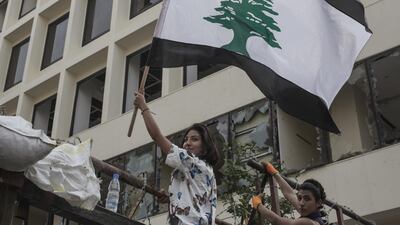
Lebanon's prime minister-designate was to begin talks on Wednesday on forming a crisis government within two weeks to start enacting desperately needed reforms in the disaster-hit country.
Government formation is usually a drawn-out process in multi-confessional Lebanon where a complex political system seeks to share power between different religious groups.
But a traumatic explosion at Beirut port last month has created intense pressure for swift reforms to lift the country out of its worst economic crisis in decades.
The last government, only in power since the start of the year, resigned in the wake of the August 4 explosion that killed at least 190, wounded thousands and laid waste to entire districts of the capital.
With the clock ticking, prime minister-designate Mustapha Adib was to meet the parliament speaker, former prime ministers and parliamentary bloc representatives.
Lebanese MPs rushed to approve the nomination of the little-known 48-year-old diplomat on Monday on the eve of a visit by French President Emmanuel Macron.
Visiting Lebanon to mark the centenary of the former French protectorate, Mr Macron on Tuesday said all sides had pledged to help Mr Adib form a cabinet within two weeks.
He promised to host two conferences in Paris in the second half of October – one to help drum up aid and the other to discuss political reform.
He said he would be back in Lebanon in December for a progress report.
US Assistant Secretary of State for Near Eastern Affairs, David Schenker, was due in Lebanon Wednesday to "urge Lebanese leaders to implement reforms that respond to the Lebanese people's desire for transparency, accountability, and a government free of corruption", the embassy said.
The Beirut explosion compounded Lebanon's worst economic crisis since the war, which has reached the point where the UN has warned that more than half of the population risk food shortages by the end of the year.
On August 9, international donors pledged more than 250 million euros ($300 million) in emergency aid, during a video conference jointly organised by France and the United Nations.
Mr Macron said he was ready to host a second Lebanon aid conference in the second half of October.
He said he had also invited the president, the prime minister and parliament speaker to a second political conference at the same time.
-

A journalist takes a selfie with French President Emmanuel Macron after a news conference at the Pine Residence, the official residence of the French ambassador to Lebanon, in Beirut, Lebanon. Reuters -
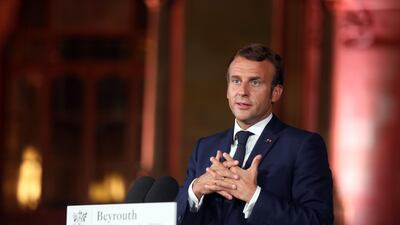
French President Emmanuel Macron speaks during a news conference in Beirut, Lebanon. Bloomberg -
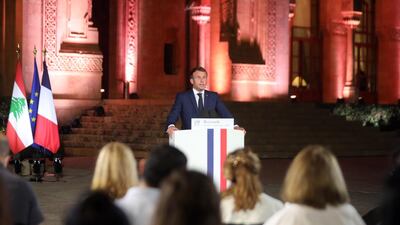
French President Emmanuel Macron speaks during a news conference in Beirut, Lebanon. Bloomberg -
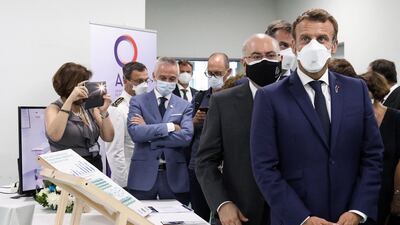
French President Emmanuel Macron visits the Rafik Hariri University Hospital in Beirut, Lebanon. EPA -
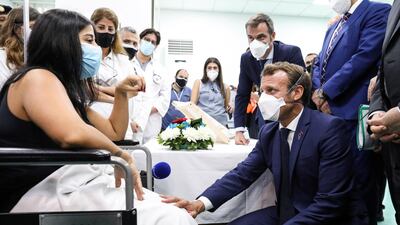
French President Emmanuel Macron, flanked by French Health Minister Olivier Veran visit the Rafik Hariri University Hospital in Beirut, Lebanon. EPA -

French President Emmanuel Macron meets members of the military mobilised for the reconstruction of the port of Beirut, in Beirut, Lebanon. Reuters -
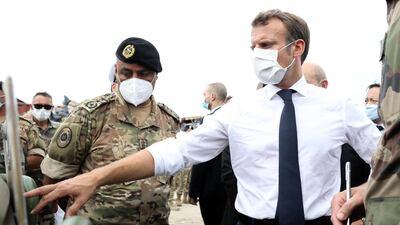
French President Emmanuel Macron meets members of the military mobilised for the reconstruction of the port of Beirut, in Beirut, Lebanon. Reuters -

French Foreign Minister Jean-Yves Le Drian and French President Emmanuel Macron meet members of the military mobilised for the reconstruction of the port, in Beirut, Lebanon. Reuters -
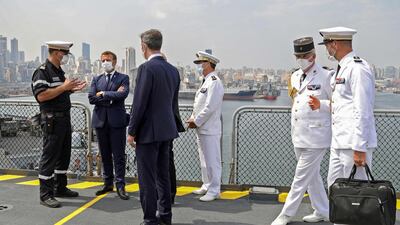
French President Emmanuel Macron flanked by French Health Minister Olivier Veran and French Foreign Minister Jean-Yves Le Drian listen to Arnaud Tranchant, commander of the Tonnerre helicopter carrier, off the port of Beirut. AFP -
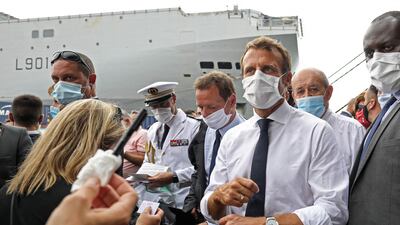
French President Emmanuel Macron and French Foreign Minister Jean-Yves Le Drian meet with UN representatives and NGOs mobilised for the reconstruction of Beirut port. AFP -
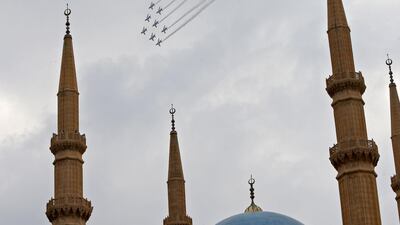
Alpha jets of the Patrouille de France release smoke in the colours of the Lebanese flag while flying over the Mohammad al-Amin mosque in the centre of Lebanon's capital Beirut, as the former French mandate marked its centenary while teetering on the brink of the abyss. AFP -
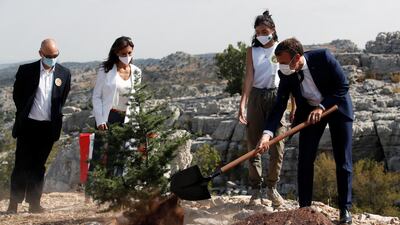
French President Emmanuel Macron plants a cedar next to members of the NGO Jouzour Loubnan in Jaj, Lebanon. EPA -
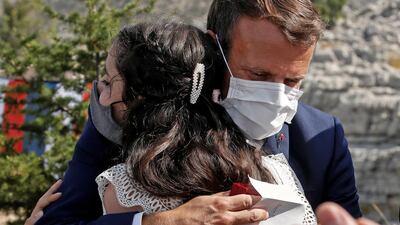
French President Emmanuel Macron hugs a blast victim, Tamara Tayah, while attending a ceremony to mark Lebanon's centenary in Jaj Cedars Reserve Forest, northeast of the capital Beirut. AFP -
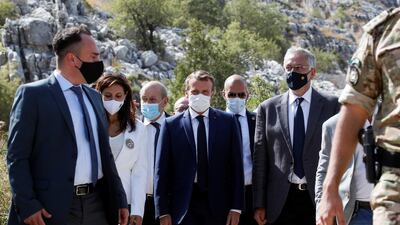
French President Emmanuel Macron speaks to victims of the blast as he arrives to a ceremony to plant a cedar next to members of the NGO Jouzour Loubnan in Jaj, near Beirut, Lebanon. EPA -
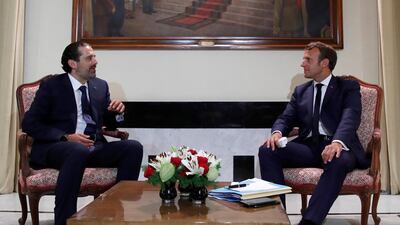
French President Emmanuel Macron meets former Lebanese prime minister Saad Hariri at the Pine Residence, the official residence of the French ambassador to Lebanon, in Beirut, Lebanon. EPA -
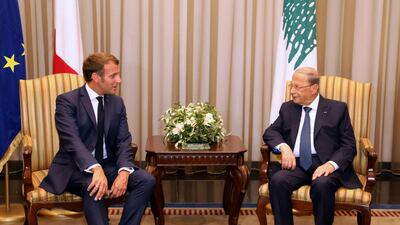
Lebanese President Michel Aoun and French President Emmanuel Macron during a welcome ceremony at Beirut airport. AFP -
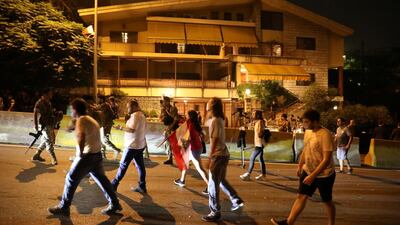
Protesters walk outside the home of Fairouz, one of Arab world's most famed singers, as French president Emmanuel Macron visits her, in Rabieh, Lebanon. Reuters -
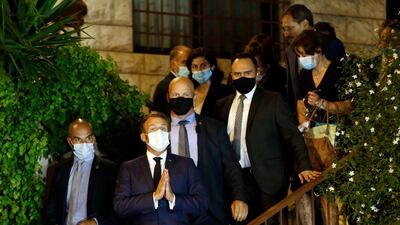
French President Emmanuel Macron, gives respect sign to anti government protesters as he leaves the house of Lebanon's diva Fairouz, one of the Arab world's most popular singers, in Rabieh, north Beirut, Lebanon. AP Photo -
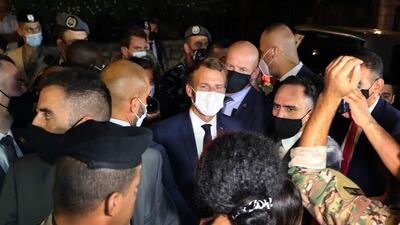
French President Emmanuel Macron, center, speaks with an anti government protester after his visit to the Lebanon's diva Fairouz, one of the Arab world's most popular singers, in Rabieh, north Beirut, Lebanon. AP Photo -
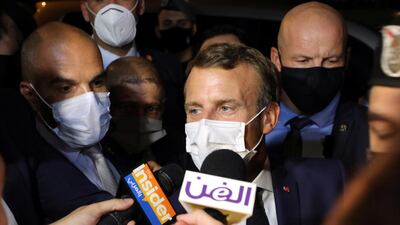
French President Emmanuel Macron talks to journalists as he leaves the home of Fairouz, one of the Arab world's most famed singers, after visiting her in Rabieh, Lebanon. Reuters -
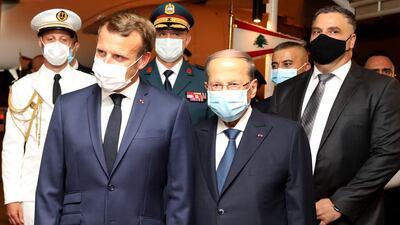
Lebanese President Michel Aoun and French President Emmanuel Macron, both wearing face masks, during a welcome ceremony at Beirut international airport. AFP -
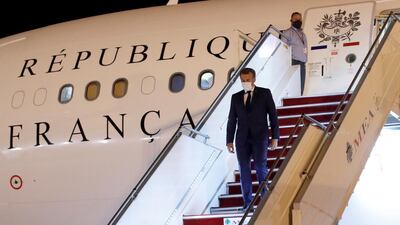
French President Emmanuel Macron arrives at Beirut international airport, Lebanon. EPA -
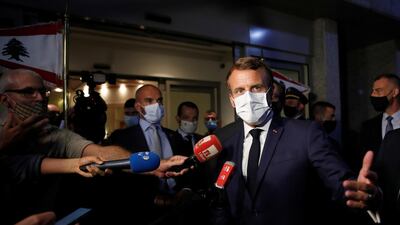
French President Emmanuel Macron speaks to reporters after his meeting with Lebanese President Michel Aoun at Beirut international airport. AP


Mr Macron had begun his trip not by visiting political leaders, but by spending more than an hour on Monday with veteran singer Fayrouz, who at 85 is a rare unifying figure in Lebanon.
On Tuesday, Mr Macron attended a series of events to mark 100 years since French mandate authorities proclaimed the creation of Greater Lebanon.
In the Jaj forest north-east of Beirut, he planted a cedar tree – Lebanon's national symbol – to express "confidence in the future of the country", his office said.
Mr Macron also returned for a second visit to Beirut port, ground zero of the colossal blast.
French air force jets flew overhead, leaving trails of red, white and green smoke, the colours of the Lebanese flag.
Some on social media criticised the aerial manoeuvre, saying it could trigger traumatic memories among people who experienced the port blast and the 1975-1990 civil war.

