
A confidant of Israeli Prime Minister Benjamin Netanyahu confirmed the Israeli leader's plan to annex parts of the occupied West Bank would not start on Wednesday, the original target date.
The delay comes after the British and French governments made extraordinary appeals for Israel to call off the plan.
It casts further uncertainty over whether Israel will follow through on the annexation, which has drawn international condemnation from some of Israel's closest allies.
Cabinet minister Ofir Akunis confirmed on Israel's Army Radio that the annexation process would not begin on Wednesday.
Mr Akunis said officials were still working out the final details with their American peers and he expected the annexation to take place later in July.
"Co-ordination with the American administration is not something that can be dismissed," he said.
In a show of Palestinian unity, about 3,000 people in the Gaza Strip, including members of the Fatah party and the rival Hamas group that runs the enclave, protested against annexation.
A Palestinian official told The National that Israel had realised it could not annex the occupied West Bank, which the Palestinians seek for a future state, on Wednesday because of condemnation across the Middle East and Europe.
-
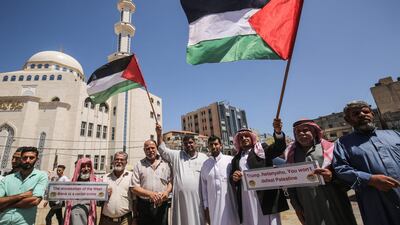
Palestinian protesters take part in a demonstration against Israel's plans to annex parts of the occupied West Bank, in Khan Yunis in the southern Gaza Strip. AFP -
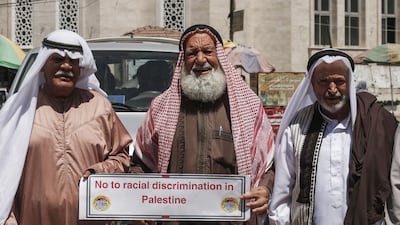
Palestinian protesters shout slogans as they take part in a demonstration against Israel's plans to annex parts of the occupied West Bank, in Khan Yunis in the southern Gaza Strip. AFP -

Palestinian protesters shout slogans as they take part in a demonstration against Israel's plans to annex parts of the occupied West Bank, in Khan Yunis in the southern Gaza Strip. AFP -
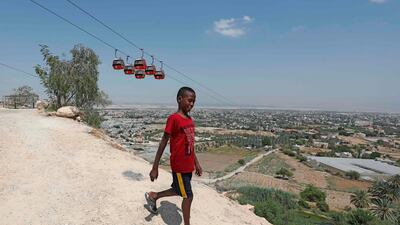
A Palestinian youth walks down a hillside overlooking the West Bank city of Jericho. When Israeli Prime Minister Benjamin Netanyahu unveiled a map of his plans in September, he pointed to a long blue zone to be annexed, leaving a brown speck in the middle: Jericho. Now the city's farmers in the occupied West Bank fear being marooned on a scrap of Palestinian land if Israel forges ahead with its plans to annex the Jordan Valley. AFP -
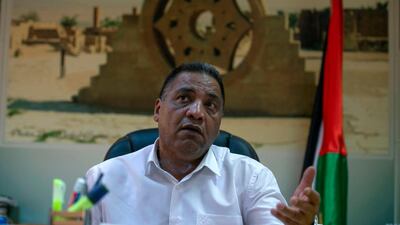
Palestinian mayor of Jericho Salem Ghrouf speaks during an interview at his office in the West Bank city. When Israeli Prime Minister Benjamin Netanyahu unveiled a map of his plans in September, he pointed to a long blue zone to be annexed, leaving a brown speck in the middle: Jericho. Now the city's farmers in the occupied West Bank fear being marooned on a scrap of Palestinian land if Israel forges ahead with its plans to annex the Jordan Valley. AFP -
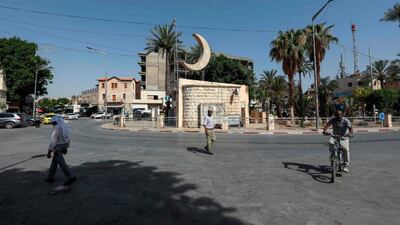
Palestinians pass by on a street of the West Bank city of Jericho. When Israeli Prime Minister Benjamin Netanyahu unveiled a map of his plans in September, he pointed to a long blue zone to be annexed, leaving a brown speck in the middle: Jericho. Now the city's farmers in the occupied West Bank fear being marooned on a scrap of Palestinian land if Israel forges ahead with its plans to annex the Jordan Valley. AFP -
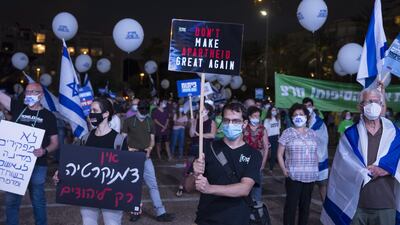
Israelis hold signs as they protest against the Israeli goverment's plan to annex parts of the West Bank in Tel Aviv, Israel. Getty Images -
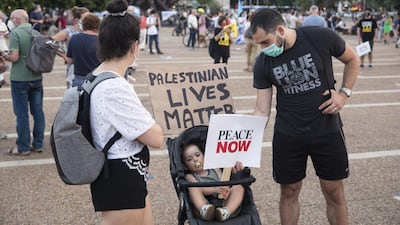
Israelis hold signs as they protest against Israel goverment's plan to annex parts of the West Bank in Tel Aviv, Israel. Getty Images -
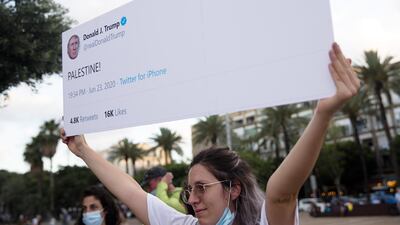
An Israeli woman holds a sign as she protests against Israel goverment's plan to annex parts of the West Bank in Tel Aviv, Israel. Getty Images -

Protesters, wearing masks of Israel's Prime Minister Benjamin Netanyahu and his coalition partner Defence Minister Benny Gantz, take part in a demonstration in Tel Aviv's Rabin Square to denounce Israel's plan to annex parts of the occupied West Bank. AFP -
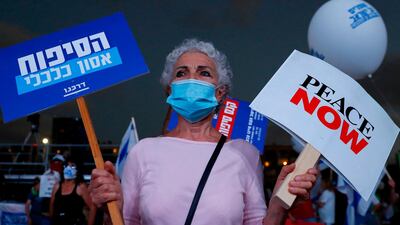
A protester, wearing a protective mask due to the COVID-19 pandemic, holds placards during a demonstration in Tel Aviv's Rabin Square to denounce Israel's plan to annex parts of the occupied West Bank. AFP -
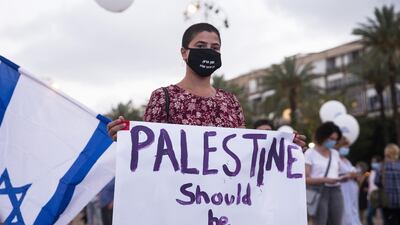
TEL AVIV, ISRAEL - JUNE 23: An Israeli woman holds a sign that reads "Palestine should be free" as she protest against Israel goverment's plan to annex parts of the West Bank in Tel Aviv, Israel. Getty Images


“I think they are in trouble,” the official said. “If they could annex it today, they would do it.
"So clearly, there were a number of miscalculations on their side with regards to annexation.
“I think they underestimated the response the international community would have on this.
“They are in a situation where they do whatever they want and no one says anything.
"They are risking this by taking a step that will basically consolidate a reality they already built, by announcing a formal statement of annexation."
Mr Netanyahu wanted to quickly start the process of annexing West Bank territory in line with US President Donald Trump's Middle East "peace plan".
The plan, unveiled in January, puts about 30 per cent of the territory under permanent Israeli control, while giving the Palestinians limited autonomy in carved-up pockets of the remaining land.
But the plan has come under international criticism. The UN, the EU and key Arab countries have said Israel's annexation would breach international.
They say it would undermine the already diminished prospects of establishing a viable independent Palestinian state alongside Israel. Even close allies, such as Britain, have opposed it.
In a front-page article in the Yedioth Ahronoth daily, British Prime Minister Boris Johnson wrote that as a "passionate defender of Israel," he was particularly troubled by its intentions.
Mr Johnson told of long links to Israel, going back to when volunteered on a kibbutz at the age of 18 and his "many visits" since then.
"As a lifelong friend, admirer and supporter of Israel, I am fearful that these proposals will fail in their objective of securing Israel's borders and will be contrary to Israel's own long-term interests," Mr Johnson wrote.
He said annexation "would put in jeopardy" the gains Israel has made in recent years in improving relations with the Arab world.
"I profoundly hope that annexation does not go ahead," Mr Johnson wrote.
"If it does, the UK will not recognise any changes to the 1967 lines, except those agreed between both parties."
Yousef Al Otaiba, UAE ambassador to the US and Minister of State, addressed the Israeli public in the same newspaper.
In his first direct address to the Israeli public, Mr Al Otaiba warned that a planned annexation of the occupied West Bank and Jordan Valley would be a major impediment to Israel’s hope of establishing ties with the Arab world.
The French government said on Wednesday that any Israeli annexation in the occupied West Bank would be in breach of international law and would have consequences.
"Annexation of Palestinian territories, whatever the perimeters, would seriously throw into question the parameters to resolve the conflict," French Foreign Minister Jean-Yves Le Drian told a parliamentary hearing.
"An annexation decision could not be left without consequences and we are examining different options at a national level and also in co-ordination with our main European partners."
Female political leaders called for the international community to stop the annexation, calling it an “existential threat” to the world order, in a joint statement released on Wednesday.
It was signed by more than 40 global female leaders, including former presidents of Finland, Sweden and Ireland.
“Such a move would unravel half a century of efforts for peace in the region and the vision of two sovereign states, Israel and Palestine, living side by side in peace and security, based on the pre-1967 borders," it said.

