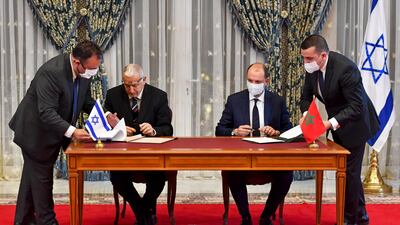
A US-Israeli delegation signed agreements with Morocco in Rabat, cementing a Washington-sponsored normalisation of relations between Israel and the North African country.
The visiting delegation, led by Jared Kushner – son-in-law and adviser to outgoing US President Donald Trump – and Israeli Prime Minister Benjamin Netanyahu’s security adviser, Meir Ben-Shabbat, arrived in Rabat from Tel Aviv on the first direct commercial flight between Israel and Morocco.
Less than two weeks ago, Morocco became the third Arab state this year, after the UAE and Bahrain, to normalise ties with Israel under US-brokered deals.
Sudan promised to follow sui to become the fourth. There is no word, yet, on which other state may follow to become the fifth.
Israeli Regional Co-operation Minister Ofir Akunis told Israel’s Ynet TV on Wednesday that the country was working on establishing ties with a fifth Arab state before Mr Trump leaves office.
“I believe ... there will be an American announcement about another country that is going public with the normalisation of relations with Israel and, in essence, with the infrastructure for an accord – a peace accord,” he said.
The US-Israeli delegation met King Mohammed VI at the royal palace on Tuesday, before the signing of a tripartite declaration lauding Mr Trump’s December 10 decision to recognise Morocco’s sovereignty over the Sahara region, widely read as a quid pro quo for Rabat’s simultaneous pledge to restore ties with Israel.
Kushner and Israeli delegation in Morocco
-

Unidentified Moroccan and Israeli officials sign memorandums of understanding during a visit by Israeli envoys to Rabat, Morocco. REUTERS -
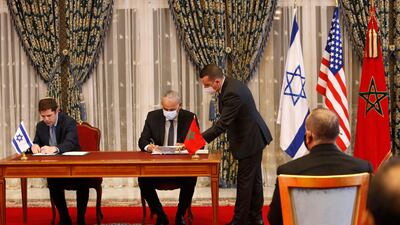
Morocco and Israel sign agreements on direct flights, financial cooperation, visa waivers for diplomats and water technology cooperation at the guest house next to the royal palace in Rabat, Morocco. Senior White House adviser Jared Kushner led a delegation from Israel to Morocco on Tuesday on the first known direct flight since the two countries agreed to establish full diplomatic ties earlier this month as part of a series of U.S.-brokered normalization accords with Arab countries. AP -
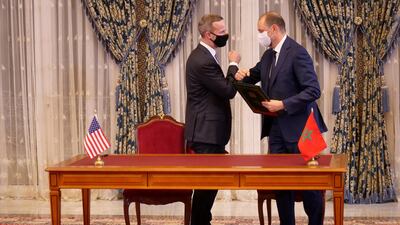
Unidentified officials greet each other at the signing of memorandums of understanding during a visit by Israeli envoys to Rabat, Morocco. REUTERS -
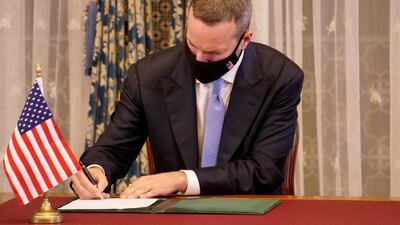
An unidentified official signs a memorandum of understanding during a visit by Israeli envoys to Rabat, Morocco. REUTERS -
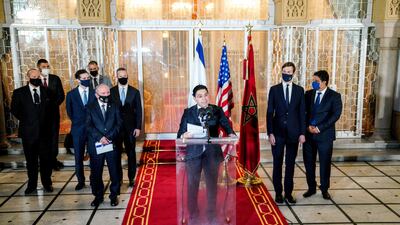
Moroccan Foreign Minister Nasser Bourita speaks during a visit by Israeli envoys to Rabat, Morocco. REUTERS -
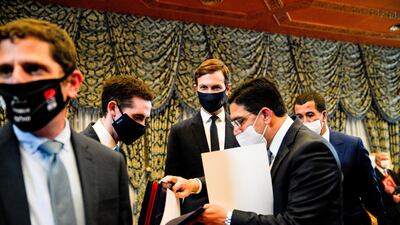
U.S. White House Senior Advisor Jared Kushner (C) looks on during a visit by Israeli envoys to Rabat, Morocco. REUTERS -
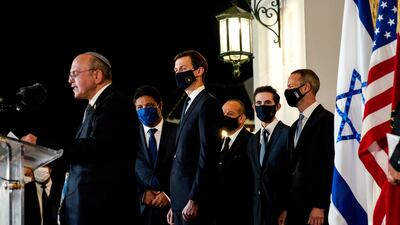
U.S. White House Senior Advisor Jared Kushner (C) looks on during a visit by Israeli envoys to Rabat, Morocco Embassy in Morocco. REUTERS -

U.S. White House Senior Adviser Jared Kushner, who accompanied an Israeli delegation, is seen during a visit to Rabat, Morocco. REUTERS -
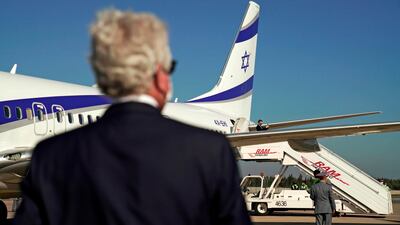
A handout picture released by the US Embassy in Morocco, shows US Ambassador David T. Fischer (L) waiting to welcome US Presidential advisor Jared Kushner in Morocco's capital Rabat, upon landing of the first Israel-Morocco direct commercial flight, marking the latest US-brokered diplomatic normalisation deal between the Jewish state and an Arab country. AFP -
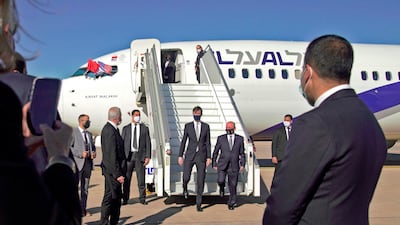
A handout picture released by the US Embassy in Morocco, shows US Presidential advisor Jared Kushner (L) and Israeli National Security Advisor Meir Ben Shabbat leaving the airplane in Morocco's capital Rabat, upon landing of the first Israel-Morocco direct commercial flight, marking the latest US-brokered diplomatic normalisation deal between the Jewish state and an Arab country. AFP -
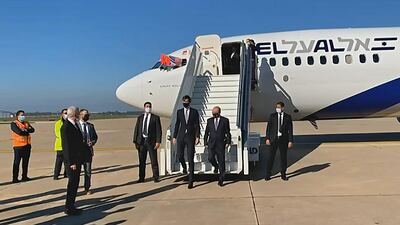
A screen grab from a handout video released by the US embassy in Morocco shows US President's advisor Jared Kushner (L) and Israeli National Security Advisor Meir Ben Shabbat leaving the plane upon landing, in Moroco's capital Rabat, on the first Israel-Morocco direct commercial flight, marking the latest US-brokered diplomatic normalisation deal between the Jewish state and an Arab country. AFP -
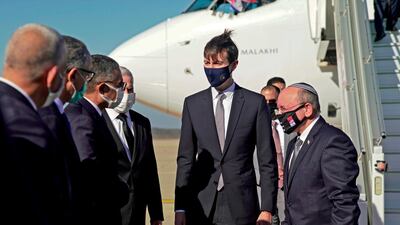
A handout picture released by the US Embassy in Morocco, shows US Presidential advisor Jared Kushner (C) and Israeli National Security Advisor Meir Ben Shabbat (R) greeting officials in Morocco's capital Rabat, upon landing of the first Israel-Morocco direct commercial flight, marking the latest US-brokered diplomatic normalisation deal between the Jewish state and an Arab country. AFP -
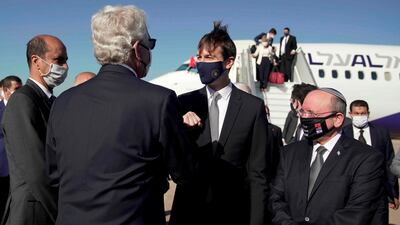
A handout picture released by the US Embassy in Morocco , shows US Ambassador David T. Fischer (2nd L) welcoming US Presidential advisor Jared Kushner and Israeli National Security Advisor Meir Ben Shabbat (R) in Moroco's capital Rabat, upon landing of the first Israel-Morocco direct commercial flight, marking the latest US-brokered diplomatic normalisation deal between the Jewish state and an Arab country. AFP -
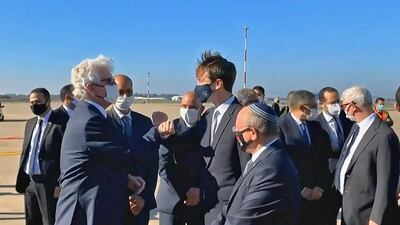
A screen grab from a handout video released by the US embassy in Morocco shows US Ambassador David T. Fischer (L) welcoming US President's advisor Jared Kushner (C) and Israeli National Security Advisor Meir Ben Shabbat (R) in Moroco's capital Rabat upon landing of the first Israel-Morocco direct commercial flight, marking the latest US-brokered diplomatic normalisation deal between the Jewish state and an Arab country. AFP -

A screen grab from a handout video released by the US embassy in Morocco shows US President's advisor Jared Kushner (3rd R) and Israeli National Security Advisor Meir Ben Shabbat (2nd R) arriving in Moroco's capital Rabat, on the first Israel-Morocco direct commercial flight, marking the latest US-brokered diplomatic normalisation deal between the Jewish state and an Arab country. AFP -
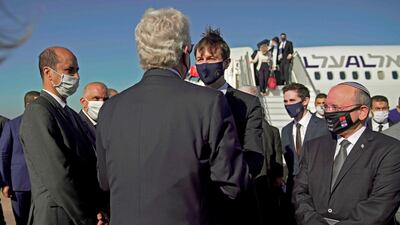
A handout picture released by the US Embassy in Morocco shows US Ambassador David T. Fischer (2nd L) welcoming US Presidential advisor Jared Kushner and Israeli National Security Advisor Meir Ben Shabbat (R) in Moroco's capital Rabat, upon landing of the first Israel-Morocco direct commercial flight, marking the latest US-brokered diplomatic normalisation deal between the Jewish state and an Arab country. AFP -
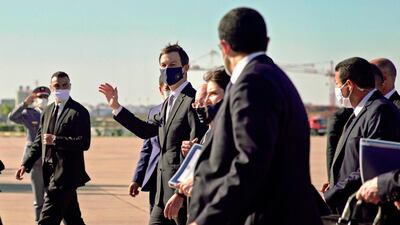
A handout picture released by the US Embassy in Morocco, shows US Presidential Adviser Jared Kushner waving his hand in greeting upon arrival to Morocco's capital Rabat on the first Israel-Morocco direct commercial flight, marking the latest US-brokered diplomatic normalisation deal between the Jewish state and an Arab country. AFP


Tuesday’s declaration included a commitment to “immediately resume full official contacts between Israeli and Moroccan counterparts”, with all parties agreeing to “fully implement” their sides of the bargain before the end of January.
Appearing alongside Morocco’s Foreign Minister Nasser Bourita, Mr Kushner said the visit had been “enormously productive so far”.
Mr Kushner and Mr Ben-Shabbat were received at the airport by Moroccan officials, albeit in a low-key welcome a far cry from the pomp of the delegation’s departure from Israel.
Alongside the tripartite declaration, four bilateral deals were signed on Tuesday between Israel and Morocco, centred on direct air links, water management, financial systems and a visa-waiver arrangement for diplomats.
Morocco has North Africa’s largest Jewish community, about 3,000 people, and Israel is home to 700,000 Jews with Moroccan ancestry.
Mr Kushner said on Tuesday that the US recognition of Moroccan sovereignty over the Sahara was “rejecting the failed status quo, which benefits no one”.
“Genuine autonomy is the only feasible option but it will take work. We urge all parties to constructively engage with the United Nations to move forward through the negotiations,” he said.
On Tuesday, King Mohammed congratulated Mr Kushner for his “substantial work ... which has led to the historic turning point in favour of Morocco’s territorial integrity and this promising development for peace in the Middle East”.
The US plans to open a consulate in Sahara region, and pledged investment that Moroccan media described as colossal.
Israel and Morocco plan to reopen diplomatic offices.
Morocco closed its liaison office in Tel Aviv in 2000, at the start of the second Palestinian intifada.
King Mohammed said Morocco will remain an advocate of the Palestinians.
Alongside the announcement of the resumption of relations with Israel, the king had earlier this month assured Palestinian President Mahmoud Abbas of Morocco’s “continued and sustained commitment to the just Palestinian cause”, based on the two-state solution to that conflict.
He restated his commitment in his statement on Tuesday.
But the Palestinians cried foul and condemned the normalisation announcement between Morocco and Israel.
Two pro-Palestinian demonstrations were banned last week in Rabat, and about 30 groups and far-left parties on Tuesday denounced the visit.
Morocco sought to temper the anger by insisting that relations with Israel are not new.
Morocco's Jewish community dates back to ancient times and grew with the arrival of Jews expelled from Spain by Roman Catholic kings from 1492.
It reached about 250,000 in the late 1940s, 10 per cent of the national population, but many Jews left after the creation of Israel in 1948.
About 70,000 Israeli tourists visit Morocco each year, but have to travel via third countries.
Mr Kushner said that while the UAE has become a popular destination for Israeli tourists since direct flights were recently opened between the states, “Morocco is going to give the UAE a run for its money very quickly”.
Under King Mohammed, several programmes were launched to conserve old Jewish districts, cemeteries and synagogues.

