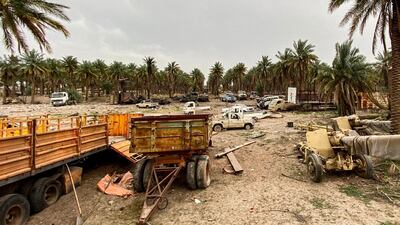
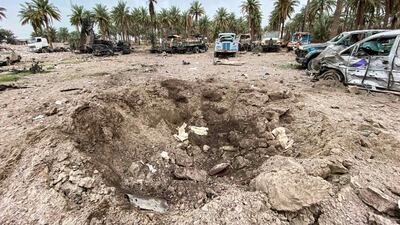
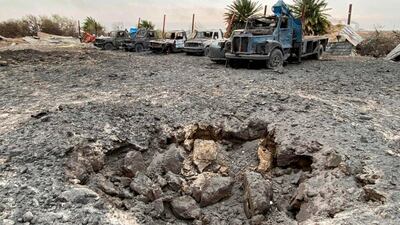
• ISIS blew up electricity pylons near Jurf Al Sakhar. Photo supplied by residents of the southern Iraqi governorate of Babel
    ISIS blew up electricity pylons near Jurf Al Sakhar. Photo supplied by residents of the southern Iraqi governorate of Babel
  • ISIS blew up electricity pylons near Jurf Al Sakhar. Photo supplied by residents of the southern Iraqi governorate of Babel
    ISIS blew up electricity pylons near Jurf Al Sakhar. Photo supplied by residents of the southern Iraqi governorate of Babel
  • ISIS blew up electricity pylons near Jurf Al Sakhar. Photo supplied by residents of the southern Iraqi governorate of Babel
    ISIS blew up electricity pylons near Jurf Al Sakhar. Photo supplied by residents of the southern Iraqi governorate of Babel
  • ISIS blew up electricity pylons near Jurf Al Sakhar. Photo supplied by residents of the southern Iraqi governorate of Babel
    ISIS blew up electricity pylons near Jurf Al Sakhar. Photo supplied by residents of the southern Iraqi governorate of Babel
  • ISIS blew up electricity pylons near Jurf Al Sakhar. Photo supplied by residents of the southern Iraqi governorate of Babel
    ISIS blew up electricity pylons near Jurf Al Sakhar. Photo supplied by residents of the southern Iraqi governorate of Babel
  • Remnants of explosive devices used by ISIS to blew up electricity pylons near Jurf Al Sakhar. Photo supplied by residents of the southern Iraqi governorate of Babel
    Remnants of explosive devices used by ISIS to blew up electricity pylons near Jurf Al Sakhar. Photo supplied by residents of the southern Iraqi governorate of Babel
  • ISIS blew up electricity pylons near Jurf Al Sakhar. Photo supplied by residents of the southern Iraqi governorate of Babel
    ISIS blew up electricity pylons near Jurf Al Sakhar. Photo supplied by residents of the southern Iraqi governorate of Babel
  • ISIS blew up electricity pylons near Jurf Al Sakhar. Photo supplied by residents of the southern Iraqi governorate of Babel
    ISIS blew up electricity pylons near Jurf Al Sakhar. Photo supplied by residents of the southern Iraqi governorate of Babel

ISIS bombed high-voltage power lines near Baghdad, Iraqi military claims


  • English
  • Arabic

An ISIS attack on electricity pylons in an area south of Baghdad held by Iran-backed hardline militia Kataib Hezbollah caused several explosions on Tuesday, official and militia sources told The National.

The incident in Jurf Al Sakhar, 65 kilometres south of Baghdad, was first reported as air strikes, but militias in the area, the Iraqi government and the US, which has troops in the country, denied this.

No deaths or injuries were reported.

"Several electric power transmission towers in the Bahbahani area, north of the Babil governorate, were attacked and sabotaged by ISIS gangs. This was initially interpreted as air strikes," the Iraqi military said.

A security operation was launched after the attack to find militants.

ISIS has not claimed responsibility for the attacks or commented on the accusation that they carried out the attack.

Despite the government announcing victory over ISIS in 2017, remnants and cells of the group still regularly stage hit-and-run attacks or plant explosives across the country.

Several reports stated that security forces in the governorate had come under attack, but military sources refuted the claim.

Air strikes on Iran-backed groups in Iraq – in pictures 

  • Damaged military vehicles in the aftermath of US air strikes at a militarised zone in the Jurf Al Sakhr area in Iraq's Babylon province controlled by Kataib Hezbollah. AFP
    Damaged military vehicles in the aftermath of US air strikes at a militarised zone in the Jurf Al Sakhr area in Iraq's Babylon province controlled by Kataib Hezbollah. AFP
  • US air strikes targeting pro-Iranian military factions in Iraq killed one civilian and five security personnel early on March 13, the Iraqi military said. AFP
    US air strikes targeting pro-Iranian military factions in Iraq killed one civilian and five security personnel early on March 13, the Iraqi military said. AFP
  • The Pentagon said the strikes were in retaliation for rocket fire against an Iraqi base the night of March 12 that killed one British and two US military personnel in the deadliest such attack in years. AFP
    The Pentagon said the strikes were in retaliation for rocket fire against an Iraqi base the night of March 12 that killed one British and two US military personnel in the deadliest such attack in years. AFP
  • An impact crater in the aftermath of US military air strikes at a militarized zone in the Jurf Al Sakhr area in Iraq's Babylon province. AFP
    An impact crater in the aftermath of US military air strikes at a militarized zone in the Jurf Al Sakhr area in Iraq's Babylon province. AFP
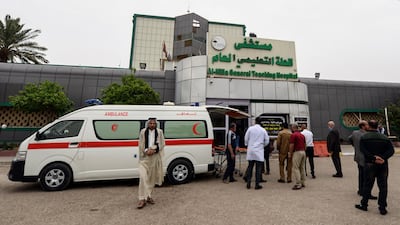
  • A member of the Hashed Al Shaabi paramilitaries injured in an area targeted by US military air strikes, receives treatment while lying on a bed at Hilla General Teaching Hospital in Iraq's central city of Hilla on March 13, 2020. AFP
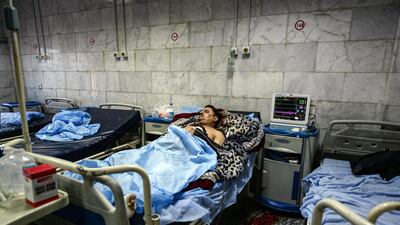
    A member of the Hashed Al Shaabi paramilitaries injured in an area targeted by US military air strikes, receives treatment while lying on a bed at Hilla General Teaching Hospital in Iraq's central city of Hilla on March 13, 2020. AFP
  • An ambulance that transported members of the Hashed Al Shaabi paramilitaries, injured in an area targeted by US military air strikes, arrives at Hilla General Teaching Hospital. AFP
    An ambulance that transported members of the Hashed Al Shaabi paramilitaries, injured in an area targeted by US military air strikes, arrives at Hilla General Teaching Hospital. AFP
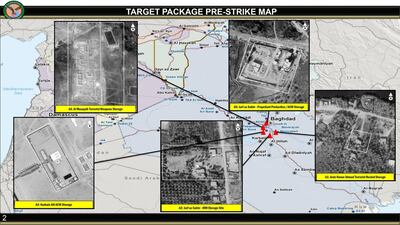
  • This annotated image provided by the US Department of Defense showing aerial images of sites targeted in airstrikes on Friday, March 13, 2020. US Department of Defense via AP
    This annotated image provided by the US Department of Defense showing aerial images of sites targeted in airstrikes on Friday, March 13, 2020. US Department of Defense via AP
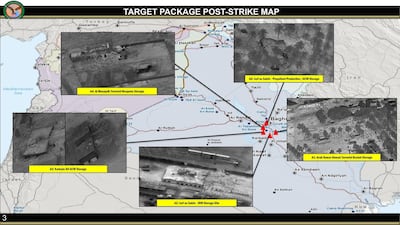
  • This annotated image provided by the US Department of Defense showing aerial images of sites targeted in airstrikes on Friday, March 13, 2020. US Department of Defense via AP
    This annotated image provided by the US Department of Defense showing aerial images of sites targeted in airstrikes on Friday, March 13, 2020. US Department of Defense via AP
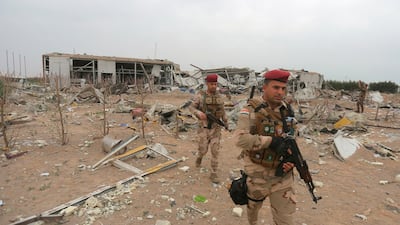
  • Iraqi army soldiers inspect the destruction at an airport complex under construction in Karbala. AP
    Iraqi army soldiers inspect the destruction at an airport complex under construction in Karbala. AP
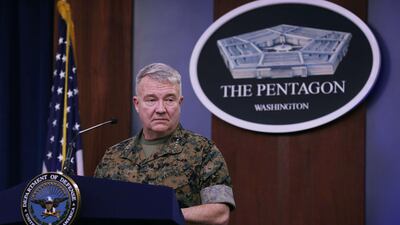
  • Marine Corps Gen Kenneth F McKenzie, commander of US Central Command, talks to journalists about the military response to rocket attacks that killed two US and one UK service members in Iraq. Getty Images via AFP
    Marine Corps Gen Kenneth F McKenzie, commander of US Central Command, talks to journalists about the military response to rocket attacks that killed two US and one UK service members in Iraq. Getty Images via AFP
  • Marine Corps Gen Kenneth F McKenzie, commander of US Central Command, talks to journalists about the military response to rocket attacks that killed two US and one UK service members in Iraq. Getty Images via AFP
    Marine Corps Gen Kenneth F McKenzie, commander of US Central Command, talks to journalists about the military response to rocket attacks that killed two US and one UK service members in Iraq. Getty Images via AFP

Reports initially suggested that the US had conducted air strikes on the area, targeting Iranian backed militia groups. However, Capt Bill Urban, a spokesman for US Central Command, told The National that Washington was not involved.

The explosions "are not and were not the results of any US military action", he said.

"I have seen reports of the explosion but have no independent knowledge of it," Capt Urban said.

Yehya Rasool, a spokesman for the Iraqi military, also said the reports of attacks on Iraqi security forces were wrong.

Jurf Al Sakhar was one of the main strongholds for Sunni militant groups such as Al Qaeda in Iraq following the US-led invasion of 2003.

It came under the control of the insurgents in June 2014, but they were driven out a few months later by security forces.

Thousands of Sunnis who fled the town have been unable to return as it is under the control of powerful Iran-backed Shiite militias, including Kataib Hezbollah. There are few government forces in the area.

Sunni politicians have repeatedly called for their community to return.

The attack is the latest by ISIS against Iraq's electricity infrastructure in remote areas as it seeks to destabilise the government.

High voltage power lines in remote areas such as the eastern province of Diyala and the northern provinces of Kirkuk and Salahuddin have been blown up, causing massive power outages, according to security forces.

US Secretary of State Mike Pompeo tweeted his recollection of an attempted storming of the US embassy by Iran-backed militias and their supporters in December 2019 as news emerged of the explosions.

“When violent protesters attacked the US Embassy on New Year’s Eve 2019, US State Department special agents defended the compound against the mob for more than 40 hours, with no loss of life or serious injuries,” Mr Pompeo said.

The US and Iran came close to war after the US targeted Iran-backed militia groups in late 2019 in response to attacks on US forces.

Washington launched an air strike just outside Baghdad's airport that killed Iranian general Qassem Suleimani and top Iraqi militia leader Abu Mahdi Al Muhandis on January 3 last year.

In retaliation, Tehran fired rockets at Iraqi bases hosting American forces, causing brain injuries to dozens of soldiers.

Over the past year, Iranian allies in Iraq have attacked and killed US and international troops, and attacked the Baghdad embassy. The US has retaliated by launching air strikes against militia groups.

Baghdad accuses "outlaw groups" of launching the attacks, but Washington blames Iran-backed militias. The attacks have often been claimed by fringe and formerly little heard of groups that experts say are a smokescreen for the Popular Mobilisation Forces, an umbrella grouping of militias sanctioned by the government but often supported and funded by Iran.


'Nope'
%3Cp%3E%3Cstrong%3EDirector%3A%3C%2Fstrong%3E%20Jordan%20Peele%0D%3Cbr%3E%3Cstrong%3EStars%3A%3C%2Fstrong%3E%20Daniel%20Kaluuya%2C%20Keke%20Palmer%2C%20Brandon%20Perea%2C%20Steven%20Yeun%0D%3Cbr%3E%3Cstrong%3ERating%3A%3C%2Fstrong%3E%203.5%2F5%3C%2Fp%3E%0A

Mercer, the investment consulting arm of US services company Marsh & McLennan, expects its wealth division to at least double its assets under management (AUM) in the Middle East as wealth in the region continues to grow despite economic headwinds, a company official said.

Mercer Wealth, which globally has $160 billion in AUM, plans to boost its AUM in the region to $2-$3bn in the next 2-3 years from the present $1bn, said Yasir AbuShaban, a Dubai-based principal with Mercer Wealth.

Within the next two to three years, we are looking at reaching $2 to $3 billion as a conservative estimate and we do see an opportunity to do so,” said Mr AbuShaban.

Mercer does not directly make investments, but allocates clients’ money they have discretion to, to professional asset managers. They also provide advice to clients.

“We have buying power. We can negotiate on their (client’s) behalf with asset managers to provide them lower fees than they otherwise would have to get on their own,” he added.

Mercer Wealth’s clients include sovereign wealth funds, family offices, and insurance companies among others.

From its office in Dubai, Mercer also looks after Africa, India and Turkey, where they also see opportunity for growth.

Wealth creation in Middle East and Africa (MEA) grew 8.5 per cent to $8.1 trillion last year from $7.5tn in 2015, higher than last year’s global average of 6 per cent and the second-highest growth in a region after Asia-Pacific which grew 9.9 per cent, according to consultancy Boston Consulting Group (BCG). In the region, where wealth grew just 1.9 per cent in 2015 compared with 2014, a pickup in oil prices has helped in wealth generation.

BCG is forecasting MEA wealth will rise to $12tn by 2021, growing at an annual average of 8 per cent.

Drivers of wealth generation in the region will be split evenly between new wealth creation and growth of performance of existing assets, according to BCG.

Another general trend in the region is clients’ looking for a comprehensive approach to investing, according to Mr AbuShaban.

“Institutional investors or some of the families are seeing a slowdown in the available capital they have to invest and in that sense they are looking at optimizing the way they manage their portfolios and making sure they are not investing haphazardly and different parts of their investment are working together,” said Mr AbuShaban.

Some clients also have a higher appetite for risk, given the low interest-rate environment that does not provide enough yield for some institutional investors. These clients are keen to invest in illiquid assets, such as private equity and infrastructure.

“What we have seen is a desire for higher returns in what has been a low-return environment specifically in various fixed income or bonds,” he said.

“In this environment, we have seen a de facto increase in the risk that clients are taking in things like illiquid investments, private equity investments, infrastructure and private debt, those kind of investments were higher illiquidity results in incrementally higher returns.”

The Abu Dhabi Investment Authority, one of the largest sovereign wealth funds, said in its 2016 report that has gradually increased its exposure in direct private equity and private credit transactions, mainly in Asian markets and especially in China and India. The authority’s private equity department focused on structured equities owing to “their defensive characteristics.”

Top 10 most polluted cities
  1. Bhiwadi, India
  2. Ghaziabad, India
  3. Hotan, China
  4. Delhi, India
  5. Jaunpur, India
  6. Faisalabad, Pakistan
  7. Noida, India
  8. Bahawalpur, Pakistan
  9. Peshawar, Pakistan
  10. Bagpat, India
General%20Classification
%3Cp%3E1.%20Elisa%20Longo%20Borghini%20(ITA)%20Trek-Segafredo%3Cbr%3E2.%20Gaia%20Realini%20(ITA)%20Trek-Segafredo%207%20secs%3Cbr%3E3.%20Silvia%20Persico%20(ITA)%20UAE%20Team%20ADQ%201%20min%2018%20secs%3C%2Fp%3E%0A
The smuggler

Eldarir had arrived at JFK in January 2020 with three suitcases, containing goods he valued at $300, when he was directed to a search area.
Officers found 41 gold artefacts among the bags, including amulets from a funerary set which prepared the deceased for the afterlife.
Also found was a cartouche of a Ptolemaic king on a relief that was originally part of a royal building or temple. 
The largest single group of items found in Eldarir’s cases were 400 shabtis, or figurines.

Khouli conviction

Khouli smuggled items into the US by making false declarations to customs about the country of origin and value of the items.
According to Immigration and Customs Enforcement, he provided “false provenances which stated that [two] Egyptian antiquities were part of a collection assembled by Khouli's father in Israel in the 1960s” when in fact “Khouli acquired the Egyptian antiquities from other dealers”.
He was sentenced to one year of probation, six months of home confinement and 200 hours of community service in 2012 after admitting buying and smuggling Egyptian antiquities, including coffins, funerary boats and limestone figures.

For sale

A number of other items said to come from the collection of Ezeldeen Taha Eldarir are currently or recently for sale.
Their provenance is described in near identical terms as the British Museum shabti: bought from Salahaddin Sirmali, "authenticated and appraised" by Hossen Rashed, then imported to the US in 1948.

- An Egyptian Mummy mask dating from 700BC-30BC, is on offer for £11,807 ($15,275) online by a seller in Mexico

- A coffin lid dating back to 664BC-332BC was offered for sale by a Colorado-based art dealer, with a starting price of $65,000

- A shabti that was on sale through a Chicago-based coin dealer, dating from 1567BC-1085BC, is up for $1,950

Ovo's tips to find extra heat
  • Open your curtains when it’s sunny 
  • Keep your oven open after cooking  
  • Have a cuddle with pets and loved ones to help stay cosy 
  • Eat ginger but avoid chilli as it makes you sweat 
  • Put on extra layers  
  • Do a few star jumps  
  • Avoid alcohol   
GIANT REVIEW

Starring: Amir El-Masry, Pierce Brosnan

Director: Athale

Rating: 4/5

Infiniti QX80 specs

Engine: twin-turbocharged 3.5-liter V6

Power: 450hp

Torque: 700Nm

Price: From Dh450,000, Autograph model from Dh510,000

Available: Now

RESULT

Arsenal 0 Chelsea 3
Chelsea: Willian (40'), Batshuayi (42', 49')