
A fire that broke out at Iran's Natanz nuclear facility on Thursday caused significant damage, the country's atomic agency admitted on Sunday.
Behrouz Kamalvandi, spokesman for the Atomic Energy Organisation of Iran, said the fire could slow down Tehran's development and production of advanced centrifuges in the medium term.
Mr Kamalvandi said Iran would replace the damaged building with a larger one containing more advanced equipment.
-

Iranian President Hassan Rouhani, right, and the head of Atomic Energy Organization of Iran Ali Akbar Salehi inspect the nuclear technology on the occasion of Iran National Nuclear Technology Day in Tehran in 2019. EPA -
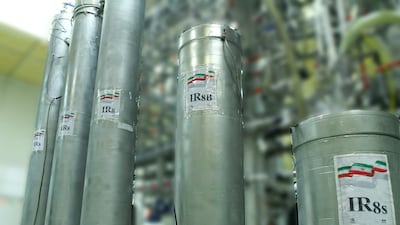
IR-8 centrifuges at Natanz nuclear power plant, some 300 kilometres south of capital Tehran. AFP -
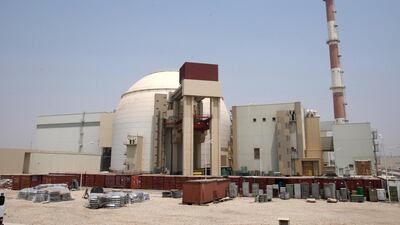
The Iranian nuclear power plant in Bushehr in 2010. EPA -

Salehi speaks with media while visiting Natanz enrichment facility, in central Iran in 2019. Atomic Energy Organization of Iran via AP -
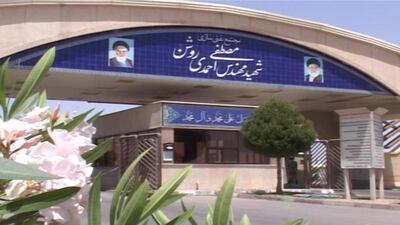
The gate of Natanz nuclear power plant in Natanz , Isfahan province, in 2019. EPA -
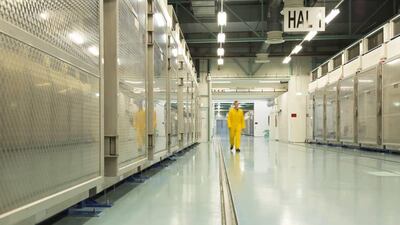
Inside of the Iran's Fordow nuclear facility, in Fordow, Qom province in 2019. EPA -
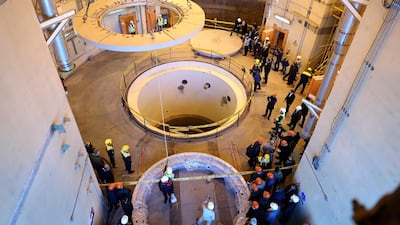
Technicians work at the Arak heavy water reactor's secondary circuit, as officials and media visit the site, near Arak, Iran in 2019. Atomic Energy Organization of Iran via AP -
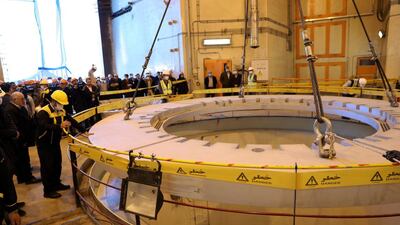
Members of the media and officials tour the water nuclear reactor at Arak in 2019. WANA via Reuters -
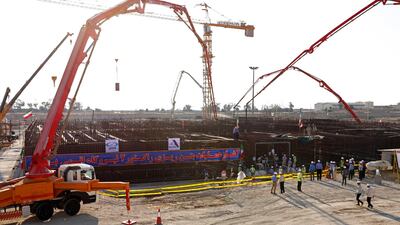
Concrete is poured for the base of the second nuclear power reactor at Bushehr plant in 2019. Atomic Energy Organization of Iran via AP


The agency initially reported only that an "incident" had occurred early on Thursday at Natanz, in the desert of the central province of Isfahan.
It later published a photo of a one-storey brick building with its roof and walls partly burnt.
A door hanging off its hinges showed that there had been an explosion inside the building.
Iranian officials later suggested the fire might have been the result of a cyber attack but refused to make the cause public because of "security reasons".
Iran's nuclear chief, Ali Salehi, told the Iranian News Agency on Sunday that "various scenarios" about the incident were under investigation and the results would be announced soon.
The agency quoted Mr Kamalvandi as saying uranium enrichment was continuing far from the site of the fire.
The Natanz uranium-enrichment site, much of which is underground, is one of several Iranian complexes monitored by inspectors of the International Atomic Energy Agency, the UN nuclear watchdog.
The agency said on Friday that the fire did not ignite near nuclear materials, and that none of its inspectors was present at the time.
Less than a week earlier, there was mysterious blast at a suspected missile development centre at Parchin, east of Tehran.
Iranian officials said the explosion, which was felt in the capital about 20 kilometres away, was caused by a gas leak.

