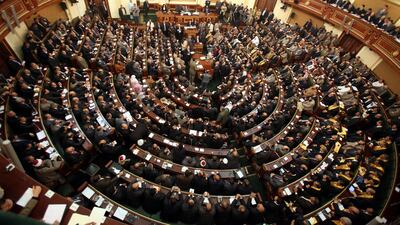
Egyptian MPs voted to amend a 1968 law governing the formation of 'popular forces' to aid the military at times of war. EPA

Egyptian Parliament extends military's power in provinces


Hamza Hendawi
  • English
  • Arabic

Egypt’s Parliament on Monday voted to extend the military’s influence in the provinces, further cementing the armed forces’ status as the chief source of power.

Constitutional amendments adopted last year enshrined the military as the guarantor of Egypt’s constitution and democracy, effectively giving it final say on policies and the political system.

On Monday, legislators voted to amend a 1968 law governing the formation of “popular forces” to aid the military at times of war.

A new clause empowers the Defence Minister, Mohamed Zaki, to name a military adviser and appoint a “sufficient” number of aides to each of Egypt’s 27 provinces.

President Abdel Fattah El Sisi is a career army officer, continuing the hold by the military on the country's highest post since young officers seized power, toppling the monarchy in the early 1950s. He won the presidency in a landslide election in 2014.

As defence minister, Mr El Sisi in 2013 led the military’s removal of president Mohammed Morsi, a member of the now-banned Muslim Brotherhood.

Morsi's one year in power proved divisive and sparked mass protests.

Last year, the constitution was amended to allow Mr El Sisi to remain in power until 2030 if he chooses to seek re-election at the end of his six-year term in 2024.

The military, by far Egypt’s most powerful institution, has assumed a commanding role in a wide range of fields since Mr El Sisi took office.

It has significantly built on the economic influence it assumed in the late 1970s and early 1980s.

With direct supervision from Mr El Sisi, the military now oversees mega projects including the construction of a new capital, a nationwide network of roads and about a dozen new cities.

It has also made large strides in industry, retail, food production and imports.

On Monday, the 596-seat chamber, packed with Mr El Sisi’s supporters, added one more layer to the vast power already wielded by the military.

Legislators celebrated the vote, lavishing praise on the army as the nation’s saviour, protector and main force behind development.

Under the new powers, advisers appointed by Mr Zaki will be charged with following up on services provided to residents and the progress of development projects.

Reporting to the defence minister, they will work to “avoid any grave danger that may undermine the safety and the security of the state”, the amendment's text read.

They and their aides will also co-ordinate with provincial authorities to take “necessary measures” to meet the nation’s economic, social and cultural development goals.

The amendment does not make clear how the advisers, giving their vast authority, would operate alongside provincial governors, many of whom are retired army officers.

The new mandate adds to the core task of the armed forces, whose men are fighting militants in the northern region of the Sinai Peninsula and protecting the porous desert border with Libya, home to militias backing rival administrations in the west and east of the vast energy-rich nation.

Mr El Sisi recently said Egypt was prepared to directly intervene in Libya to protect its national security.


COMPANY%20PROFILE
%3Cp%3E%0D%3Cbr%3E%3Cstrong%3ECompany%20name%3A%20%3C%2Fstrong%3EClara%0D%3Cbr%3E%3Cstrong%3EStarted%3A%20%3C%2Fstrong%3E2019%0D%3Cbr%3E%3Cstrong%3EFounders%3A%20%3C%2Fstrong%3EPatrick%20Rogers%2C%20Lee%20McMahon%2C%20Arthur%20Guest%2C%20Ahmed%20Arif%0D%3Cbr%3E%3Cstrong%3EBased%3A%20%3C%2Fstrong%3EDubai%0D%3Cbr%3E%3Cstrong%3EIndustry%3A%20%3C%2Fstrong%3ELegalTech%0D%3Cbr%3E%3Cstrong%3EFunding%20size%3A%3C%2Fstrong%3E%20%244%20million%20of%20seed%20financing%0D%3Cbr%3E%3Cstrong%3EInvestors%3A%20%3C%2Fstrong%3EWamda%20Capital%2C%20Shorooq%20Partners%2C%20Techstars%2C%20500%20Global%2C%20OTF%2C%20Venture%20Souq%2C%20Knuru%20Capital%2C%20Plug%20and%20Play%20and%20The%20LegalTech%20Fund%3C%2Fp%3E%0A
The%20specs
%3Cp%3E%3Cstrong%3EEngine%3A%20%3C%2Fstrong%3E2.9-litre%20twin-turbo%20V6%0D%3Cbr%3E%3Cstrong%3ETransmission%3A%20%3C%2Fstrong%3E8-speed%20auto%0D%3Cbr%3E%3Cstrong%3EPower%3A%20%3C%2Fstrong%3E536hp%20(including%20138hp%20e-motor)%0D%3Cbr%3E%3Cstrong%3ETorque%3A%20%3C%2Fstrong%3E750Nm%20(including%20400Nm%20e-motor)%0D%3Cbr%3E%3Cstrong%3EPrice%3A%20%3C%2Fstrong%3EFrom%20Dh1%2C380%2C000%0D%3Cbr%3E%3Cstrong%3EOn%20sale%3A%20%3C%2Fstrong%3Enow%3C%2Fp%3E%0A
Teenage%20Mutant%20Ninja%20Turtles%3A%20Shredder's%20Revenge
%3Cp%3E%3Cstrong%3EDeveloper%3A%20%3C%2Fstrong%3ETribute%20Games%3Cbr%3E%3Cstrong%3EPublisher%3A%3C%2Fstrong%3E%20Dotemu%3Cbr%3E%3Cstrong%3EConsoles%3A%20%3C%2Fstrong%3ENintendo%20Switch%2C%20PlayStation%204%26amp%3B5%2C%20PC%20and%20Xbox%20One%3Cbr%3E%3Cstrong%3ERating%3A%3C%2Fstrong%3E%204%2F5%3C%2Fp%3E%0A
ARM%20IPO%20DETAILS
%3Cp%3E%3Cstrong%3EShare%20price%3A%3C%2Fstrong%3E%20Undisclosed%3C%2Fp%3E%0A%3Cp%3E%3Cstrong%3ETarget%20raise%3A%3C%2Fstrong%3E%20%248%20billion%20to%20%2410%20billion%3C%2Fp%3E%0A%3Cp%3E%3Cstrong%3EProjected%20valuation%3A%3C%2Fstrong%3E%20%2460%20billion%20to%20%2470%20billion%20(Source%3A%20Bloomberg)%3C%2Fp%3E%0A%3Cp%3E%3Cstrong%3ELead%20underwriters%3A%3C%2Fstrong%3E%20Barclays%2C%20Goldman%20Sachs%20Group%2C%20JPMorgan%20Chase%20and%20Mizuho%20Financial%20Group%3C%2Fp%3E%0A
The burning issue

The internal combustion engine is facing a watershed moment – major manufacturer Volvo is to stop producing petroleum-powered vehicles by 2021 and countries in Europe, including the UK, have vowed to ban their sale before 2040. The National takes a look at the story of one of the most successful technologies of the last 100 years and how it has impacted life in the UAE. 

Read part four: an affection for classic cars lives on

Read part three: the age of the electric vehicle begins

Read part two: how climate change drove the race for an alternative 

Company%20Profile
%3Cp%3E%3Cstrong%3ECompany%20name%3A%20%3C%2Fstrong%3ENamara%0D%3Cbr%3E%3Cstrong%3EStarted%3A%20%3C%2Fstrong%3EJune%202022%0D%3Cbr%3E%3Cstrong%3EFounder%3A%20%3C%2Fstrong%3EMohammed%20Alnamara%0D%3Cbr%3E%3Cstrong%3EBased%3A%20%3C%2Fstrong%3EDubai%20%0D%3Cbr%3E%3Cstrong%3ESector%3A%20%3C%2Fstrong%3EMicrofinance%0D%3Cbr%3E%3Cstrong%3ECurrent%20number%20of%20staff%3A%20%3C%2Fstrong%3E16%0D%3Cbr%3E%3Cstrong%3EInvestment%20stage%3A%20%3C%2Fstrong%3ESeries%20A%0D%3Cbr%3E%3Cstrong%3EInvestors%3A%20%3C%2Fstrong%3EFamily%20offices%0D%3Cbr%3E%3C%2Fp%3E%0A
Some of Darwish's last words

"They see their tomorrows slipping out of their reach. And though it seems to them that everything outside this reality is heaven, yet they do not want to go to that heaven. They stay, because they are afflicted with hope." - Mahmoud Darwish, to attendees of the Palestine Festival of Literature, 2008

His life in brief: Born in a village near Galilee, he lived in exile for most of his life and started writing poetry after high school. He was arrested several times by Israel for what were deemed to be inciteful poems. Most of his work focused on the love and yearning for his homeland, and he was regarded the Palestinian poet of resistance. Over the course of his life, he published more than 30 poetry collections and books of prose, with his work translated into more than 20 languages. Many of his poems were set to music by Arab composers, most significantly Marcel Khalife. Darwish died on August 9, 2008 after undergoing heart surgery in the United States. He was later buried in Ramallah where a shrine was erected in his honour.


Company: Instabug

Founded: 2013

Based: Egypt, Cairo

Sector: IT

Employees: 100

Stage: Series A

Investors: Flat6Labs, Accel, Y Combinator and angel investors

Indoor cricket World Cup:
Insportz, Dubai, September 16-23

UAE fixtures:
Men

Saturday, September 16 – 1.45pm, v New Zealand
Sunday, September 17 – 10.30am, v Australia; 3.45pm, v South Africa
Monday, September 18 – 2pm, v England; 7.15pm, v India
Tuesday, September 19 – 12.15pm, v Singapore; 5.30pm, v Sri Lanka
Thursday, September 21 – 2pm v Malaysia
Friday, September 22 – 3.30pm, semi-final
Saturday, September 23 – 3pm, grand final

Women
Saturday, September 16 – 5.15pm, v Australia
Sunday, September 17 – 2pm, v South Africa; 7.15pm, v New Zealand
Monday, September 18 – 5.30pm, v England
Tuesday, September 19 – 10.30am, v New Zealand; 3.45pm, v South Africa
Thursday, September 21 – 12.15pm, v Australia
Friday, September 22 – 1.30pm, semi-final
Saturday, September 23 – 1pm, grand final

Roll of honour 2019-2020

Dubai Rugby Sevens

Winners: Dubai Hurricanes

Runners up: Bahrain


West Asia Premiership

Winners: Bahrain

Runners up: UAE Premiership


UAE Premiership

Winners: Dubai Exiles

Runners up: Dubai Hurricanes


UAE Division One

Winners: Abu Dhabi Saracens

Runners up: Dubai Hurricanes II


UAE Division Two

Winners: Barrelhouse

Runners up: RAK Rugby

Need to know

Unlike other mobile wallets and payment apps, a unique feature of eWallet is that there is no need to have a bank account, credit or debit card to do digital payments.

Customers only need a valid Emirates ID and a working UAE mobile number to register for eWallet account.

Mercer, the investment consulting arm of US services company Marsh & McLennan, expects its wealth division to at least double its assets under management (AUM) in the Middle East as wealth in the region continues to grow despite economic headwinds, a company official said.

Mercer Wealth, which globally has $160 billion in AUM, plans to boost its AUM in the region to $2-$3bn in the next 2-3 years from the present $1bn, said Yasir AbuShaban, a Dubai-based principal with Mercer Wealth.

Within the next two to three years, we are looking at reaching $2 to $3 billion as a conservative estimate and we do see an opportunity to do so,” said Mr AbuShaban.

Mercer does not directly make investments, but allocates clients’ money they have discretion to, to professional asset managers. They also provide advice to clients.

“We have buying power. We can negotiate on their (client’s) behalf with asset managers to provide them lower fees than they otherwise would have to get on their own,” he added.

Mercer Wealth’s clients include sovereign wealth funds, family offices, and insurance companies among others.

From its office in Dubai, Mercer also looks after Africa, India and Turkey, where they also see opportunity for growth.

Wealth creation in Middle East and Africa (MEA) grew 8.5 per cent to $8.1 trillion last year from $7.5tn in 2015, higher than last year’s global average of 6 per cent and the second-highest growth in a region after Asia-Pacific which grew 9.9 per cent, according to consultancy Boston Consulting Group (BCG). In the region, where wealth grew just 1.9 per cent in 2015 compared with 2014, a pickup in oil prices has helped in wealth generation.

BCG is forecasting MEA wealth will rise to $12tn by 2021, growing at an annual average of 8 per cent.

Drivers of wealth generation in the region will be split evenly between new wealth creation and growth of performance of existing assets, according to BCG.

Another general trend in the region is clients’ looking for a comprehensive approach to investing, according to Mr AbuShaban.

“Institutional investors or some of the families are seeing a slowdown in the available capital they have to invest and in that sense they are looking at optimizing the way they manage their portfolios and making sure they are not investing haphazardly and different parts of their investment are working together,” said Mr AbuShaban.

Some clients also have a higher appetite for risk, given the low interest-rate environment that does not provide enough yield for some institutional investors. These clients are keen to invest in illiquid assets, such as private equity and infrastructure.

“What we have seen is a desire for higher returns in what has been a low-return environment specifically in various fixed income or bonds,” he said.

“In this environment, we have seen a de facto increase in the risk that clients are taking in things like illiquid investments, private equity investments, infrastructure and private debt, those kind of investments were higher illiquidity results in incrementally higher returns.”

The Abu Dhabi Investment Authority, one of the largest sovereign wealth funds, said in its 2016 report that has gradually increased its exposure in direct private equity and private credit transactions, mainly in Asian markets and especially in China and India. The authority’s private equity department focused on structured equities owing to “their defensive characteristics.”

THE BIO

Favourite holiday destination: Whenever I have any free time I always go back to see my family in Caltra, Galway, it’s the only place I can properly relax.

Favourite film: The Way, starring Martin Sheen. It’s about the Camino de Santiago walk from France to Spain.

Personal motto: If something’s meant for you it won’t pass you by.