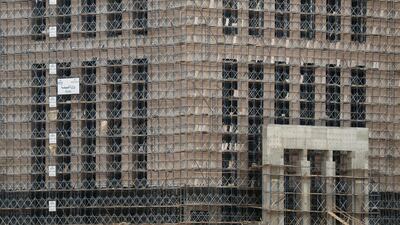

Construction work has resumed on Egypt’s mega projects as the country tries to achieve a balance between protecting its people from a coronavirus outbreak and keeping the economy afloat.
The outbreak has to date infected 1,173 people and killed at least 78 in Egypt.
The decision to resume work in the building sector, which employs an estimated 4 million people, came after the country’s business tycoons pressured the government to ease measures introduced to prevent the spread of the virus.
One businessman went as far as to question the principle of saving lives at the expense of the economy.
The government is facing the difficult task of balancing the need to prevent the economy from tanking while keeping the number of coronavirus-related infections and deaths among 100 million residents to a minimum.
To prevent a recession, it has introduced a stimulus package that included lowering interest rates by 300 points, suspending taxes on stock market transactions and bailing out struggling exporters.
It also increased unemployment benefits for informal workers and added thousands of households to a cash assistance programme for the poor.
At stake are the hard-won gains made by Egypt after a harsh austerity programme that began in 2016 and hit the poor and middle class the hardest.
As part of the programme, the value of the local currency to the dollar was slashed by half, value added tax was introduced and state subsidies on fuel and utilities were removed.
Workers returned to sites in the new desert capital outside Cairo and a city on the coast of the Mediterranean this week.
-
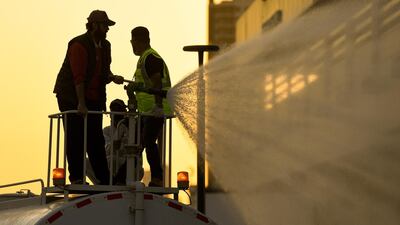
Municipality workers spray disinfectant as a precaution against the spread of coronavirus at the Kuwait Salmiya market. EPA -
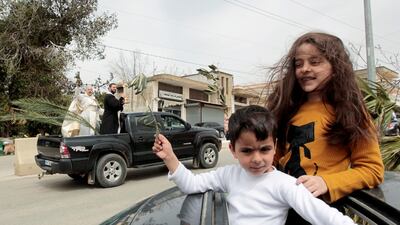
Children hold olive branches as they look out from the sunroof of a car to be blessed by priests to celebrate Palm Sunday, amid the lockdown to contain the coronavirus in Marjayoun, southern Lebanon. Reuters -
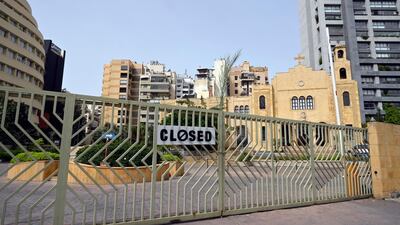
An empty Greek Catholic Church during a Mass on Palm Sunday in Beirut, Lebanon. EPA -
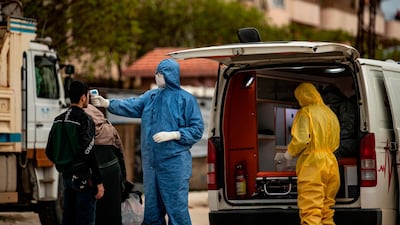
Members of the Kurdish Red Crescent check passengers who were stranded in Damascus upon their arrival at the Qamishli airport in Syria's north-eastern Hasakeh province. AFP -

Coptic girls reacting while watching hymns performed on telelvision at home at Shubra Al Khema district in Cairo, Egypt. EPA -
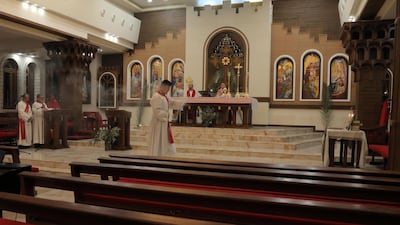
Iraqi priests celebrate the Palm Sunday Mass at the empty Saint Joseph Church in Erbil, the capital of the autonomous Kurdish region of northern Iraq. AFP -
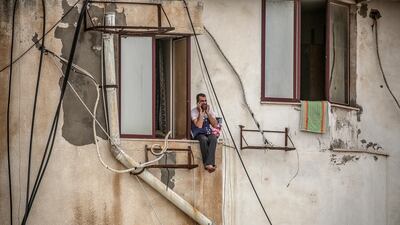
A Palestinian man, who was quarantined, talks on his phone on a hotel window in Gaza City. EPA -
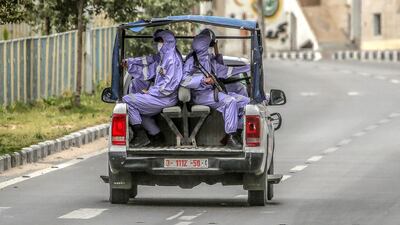
Palestinian security policemen wearing protective gear, patrol on the street of Gaza city. EPA -

A street vendor wearing protective face mask stands between lines of cars during a sandstorm in Cairo, Egypt. EPA -
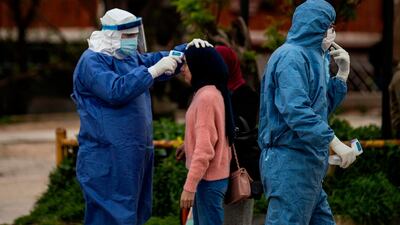
Members of the Kurdish Red Crescent check passengers who were stranded in Damascus upon their arrival at the Qamishli airport in Syria's north-eastern Hasakeh province. AFP -
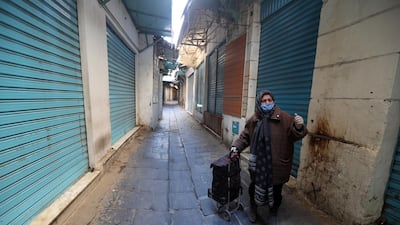
A view of an empty street during the coronavirus pandemic in Tunis, Tunisia. EPA -
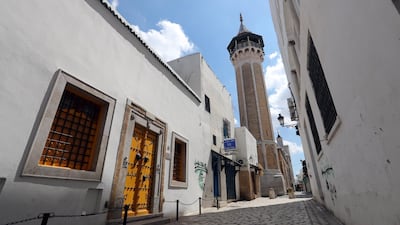
A view of an empty street during the coronavirus pandemic in Tunis, Tunisia. EPA -
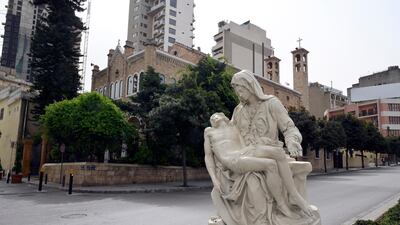
A statue representing the Virgin Mary and Jesus is seen in front of the closed St Maroun Maronite Catholic Church during Mass on Palm Sunday in downtown Beirut, Lebanon. EPA -

Municipality workers spray disinfectant as a precaution against the spread of coronavirus at the Kuwait Salmiya market following the outbreak of coronavirus in Kuwait. EPA -
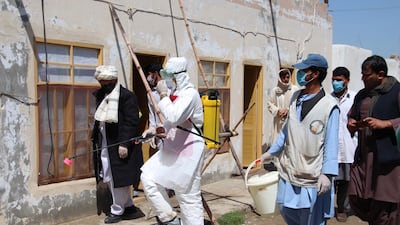
Afghan health workers spray disinfectants at public places in Helmand, Afghanistan. EPA


President Abdel Fattah El Sisi on Saturday ordered the “highest possible preventive measures” on construction sites, with the enforcement of social distancing and provision of health care.
Information Minister Osama Heikal later on Saturday said older workers and those with pre-existing conditions would not be allowed to return to work given their vulnerability to Covid-19.
Mr Heikal denied that the government's decision to allow building clashed with its call for people to stay at home.
“There is no contradiction,” he said. “We need the cycle of the economy to run. If the economy comes to a halt, we will regress a great deal.”
The same point was emphatically made last week by Egypt’s best known businessman, billionaire Naguib Sawiris.
“If this goes on for too long, it’s possible the country will be bankrupt and we’ll have hunger, famine and chaos,” Mr Sawiris wrote in a tweet that sparked a debate on social media.
Some said he was lacking the spirit of social corporate responsibility.
“People will die but at least we won’t be bankrupt,” building tycoon Hussein Sabbour said in comments that drew ire from the public.
"What do we want, a populace that’s standing on its feet, albeit a smaller one, or a people who are totally penniless and cannot find food for the next day?”
But with or without the construction workers returning to sites, the economy has already taken a blow from coronavirus.
The tourism sector has been flattened during a year that had been expected to register its highest number of visitors.
Revenues in 2020 had been expected to surpass last year’s $12.5 billion (Dh45.91bn).
The slump was expected to spill over into at least part of 2021, with tourism executives reporting significant drops in new bookings.
Remittances from the country’s expatriate workforce, primarily in the Gulf region, were also expected to be down this year from $26.4bn in 2019.
Global energy demand is also weakening because of the coronavirus crisis, just as Egypt was establishing itself as a major gas exporter and a regional energy centre.
Through all of this, the government has been at pains not to be perceived as indifferent to the welfare of the workers it wants back on the job.
It also doesn not want to seem oblivious to the impact of the anti-coronavirus measures on the millions of other workers eking out a life on meagre daily wages in the services sector.
Just how badly business has been hit was recounted by an executive of a major motor vehicles business in Egypt.
“Normally, we have 90 to 120 potential buyers walking daily into our showrooms nationwide," he said.
"Now we have between five and six, including perhaps one or two who wanted to enjoy our air conditioning."
He said that the government’s decision to close its vehicle registration department until mid-April meant that buying a new car was a meaningless task.
“If this goes on, we will consider laying off the least-performing employees and renegotiate showroom rents with landlords."

