
US President Donald Trump said all US sanctions on Turkey will be lifted after Ankara said the ceasefire in its Syrian offensive would be permanent.
Mr Trump said sanctions would be lifted "unless something happens that I'm not happy with".
He said he welcomed other countries' help in the Syria conflict, acknowledging Russia's agreement with Turkish President Recep Tayyip Erdogan to hold joint patrols.
The deal, reached in Tuesday and hailed as a "big success" by Mr Trump, requires Kurdish troops to pull back to a line 30 kilometres from the border along its entire length.
That has forced them to surrender some of their main towns and crushed their dreams of autonomy.
"Earlier this morning, the government of Turkey informed my administration that they would be stopping combat and their offensive in Syria and making the ceasefire permanent," he said in a televised address from the White House.
"I have, therefore, instructed the Secretary of the Treasury to lift all sanctions imposed on October 14 in response to Turkey's original offensive moves against the Kurds in Syria's north-east border region."
Mr Trump said he was committed to pursuing a different course in the Middle East. He said America should only commit troops to battle when a clear national interest was at stake.
He said a small number of US troops would remain at Syria's oilfields despite a broader American withdrawal from the country.
"We have secured the oil and, therefore, a small number of US troops will remain in the area where they have the oil," Mr Trump said.
Turkey launched a military operation in Syria after he agreed to pull US troops who were allied with the Syrian Democratic Forces, the Kurdish-led group that bore the brunt of the fight against ISIS.
-
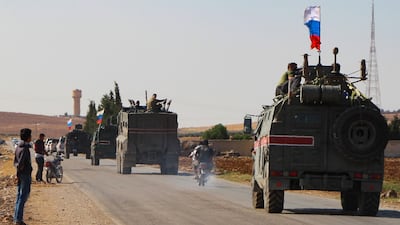
A convoy of Russian military vehicles drives toward the northeastern city of Kobani. Russian forces in Syria headed for the border with Turkey today to ensure Kurdish fighters pull back after a deal between Moscow and Ankara wrested control of the Kurds' entire heartland. AFP -
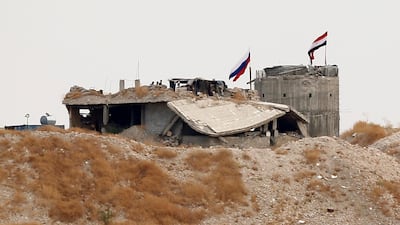
Russian and Syrian national flags are pictured near the northern Syrian village of Zor Magar, as seen from the Turkish border town of Karkamis in Gaziantep province, Turkey. REUTERS -
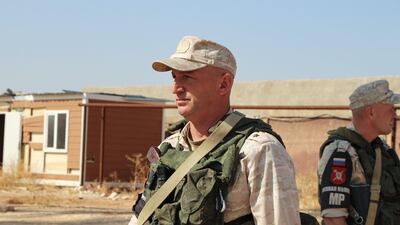
Members of the Russian military police patrol in the the northeastern Syrian city of Kobane. AFP -
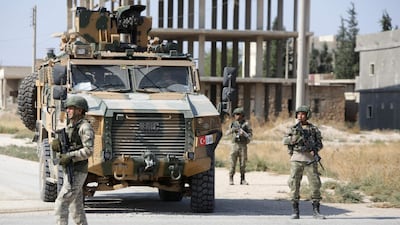
Turkish soldiers patrol the northern Syrian Kurdish town of Tal Abyad, on the border between Syria and Turkey. AFP -
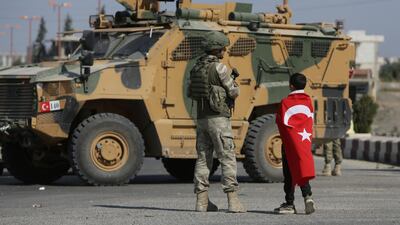
Turkish soldiers patrol the northern Syrian Kurdish town of Tal Abyad, on the border between Syria and Turkey. AFP -
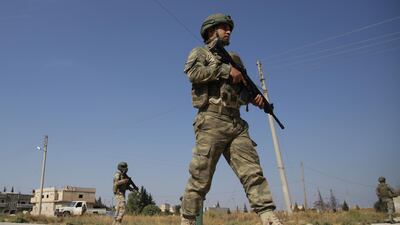
Turkish soldiers patrol the northern Syrian Kurdish town of Tal Abyad, on the border between Syria and Turkey. AFP


Also on Wednesday, Russian forces in Syria moved towards the Turkish border to ensure Kurdish fighters withdrew.
Russian military police started to gather on Syria's north-east border, marking Moscow's deepening influence in the region two weeks after the US pulled out troops.
Joint Russian-Turkish patrols are due to start next week.
Having previously controlled nearly a third of Syria, the Kurds lost almost everything under the deal, in which Turkey remain stationed an Arab-majority area that was the main target of its two-week offensive.
Mr Trump's special envoy for Syria said that US forces had received evidence of war crimes by Turkish forces during the offensive against the Kurds.
"We haven't seen widespread evidence of ethnic cleansing," James Jeffrey told a House of Representatives hearing.
But Mr Jeffrey said there had been reports of "several incidents of what we consider war crimes".

