
The economy of Iraq’s Najaf province, the main centre of Shiism, will collapse in the next few weeks as a result of travel restrictions imposed to contain the country's coronavirus outbreak, the governor said on Thursday.
Louay Al Yasiri told the state news agency he expected “a big economic collapse” because of declining religious tourism and a sharp drop in the price of oil, Iraq's main source of revenue.
He said more than 2,000 Iranian visitors have been stuck in Najaf since the central government restricted travel last month, although the airport in Najaf city remains open.
The province reported 10 more coronavirus infections on Thursday.
Mr Al Yasiri said Najaf was facing a shortage of essential medical supplies but the coronavirus “is still under control".
But Iraq’s health minister on Thursday expected the coronavirus to be contained by next month if quarantine is observed, ignoring massive lack of observance of lockdown measures.
“Most likely the end May will be the end of the coronavirus danger if there is commitment to the quarantine,” Jaafar Allawi told state television.
Iraqi officials and residents reported major breaches of curfews in Baghdad and other cities in the last few weeks. The country’s borders with Iran and Syria are also porous.
The shrine of Imam Ali, the Prophet’s cousin and son-in law, is at the heart of Najaf. Ali is a central figure in Islam with special importance for Shiites, who regard him as the first of the Twelver imams.The Shiite religious authorities, known as the Hawza, and seminaries they supervise are also in Najaf.
The “Sea of Najaf”, a huge cemetery where many Shiites wish to be buried, is on the outskirts of the city.
_____________________________________
Coronavirus in the Middle East
-
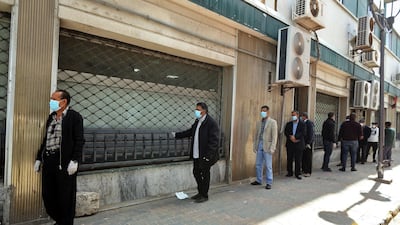
Libyans wearing protective face masks queue in front of a bank in the centre of the capital Tripoli amid the coronavirus pandemic. AFP -

A medical staffer wearing protective gear stands in a hallway at Basra University Hospital, where Covid-19 patients are treated, in the southern Iraqi city. AFP -
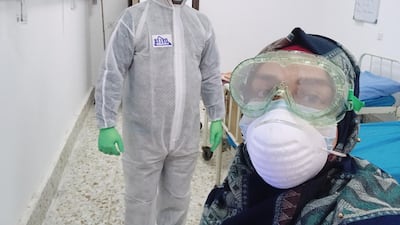
Farah Al-Awadi, a 28-year-old Iraqi woman who has contracted coronavirus disease, takes selfies with a member of the medical team during quarantine in the holy city of Najaf, Iraq. Reuters -

Palestinian fitness trainer and bodybuilding Ahmed Sawi uses alternative tools as a weight as he trains at his home in Gaza City. AFP -
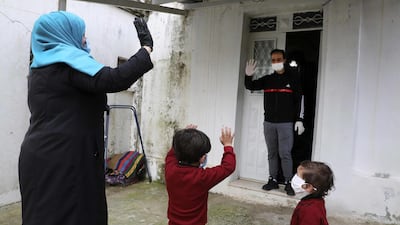
Islam Bseileh, a 29-year-old Palestinian who used to work in Israel, waves to his wife and two kids (all wearing masks) as he receives food they delivered to him while in quarantine in his home in the city of Hebron in the occupied West Bank. AFP -
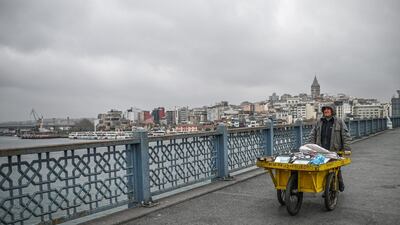
A garbage collector pushes a wheelbarrow across the empty Galata bridge in Istanbul, after Turkish officials have repeatedly urged citizens to stay home and respect social distancing rules. AFP -
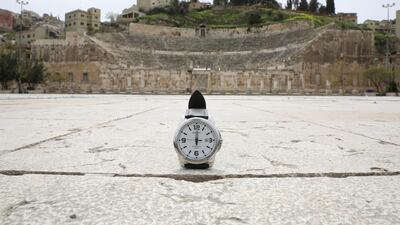
A watch showing the time at noon, is displayed for a photo in front of the Roman amphitheatre, which is empty during the coronavirus disease outbreak, in Amman, Jordan. Reuters -
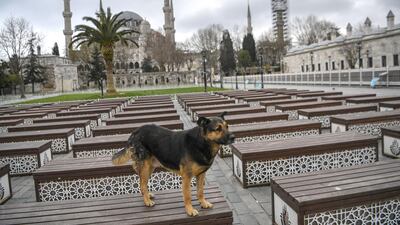
A stray dog during a animal food distribution near Sultanahmet mosque (blue mosque) in Istanbul after Turkish officials have repeatedly urged citizens to stay home amid the spread of the coronavirus. AFP -
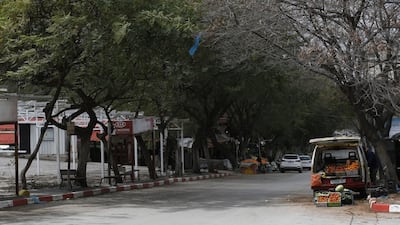
A Palestinian vendor waits to sell vegetables in the West Bank city of Nablus. EPA -
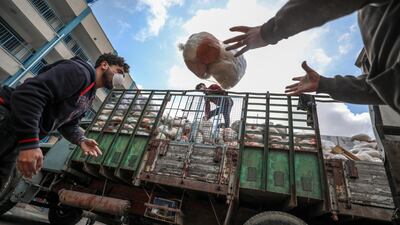
Palestinian workers at the United Nation Relief and Works Agency (UNRWA) wearing protective masks upload food aid rations for poor refugee families, at a UN school in Gaza City. EPA -
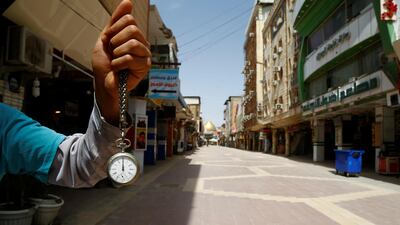
A man holds a pocket watch at noon, as he shows the time while posing for photo at an almost empty market near the Imam Ali shrine, during the coronavirus disease outbreak, in Najaf, Iraq. Reuters -
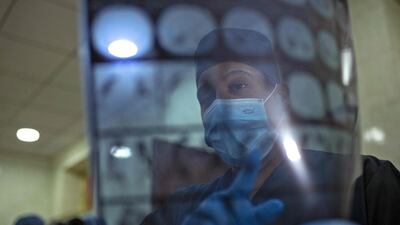
A medical staffer wearing protective gear inspects chest X-ray scans at Basra University Hospital, where Covid-19 coronavirus patients are treated, in the southern Iraqi city. AFP -
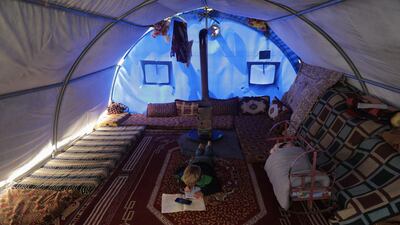
Internally displaced boy, Mahmoud Abdel Hadi, 8, does his homework received on mobile, inside his tent after his tented school was shut due to the threat of coronavirus disease in Atmeh camp, near the Turkish border, Syria. Reuters -
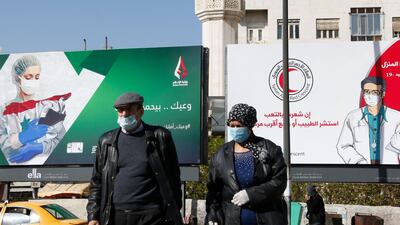
Syrians wearing face masks walk in front of posters informing about the novel coronavirus, in the capital Damascus. AFP -
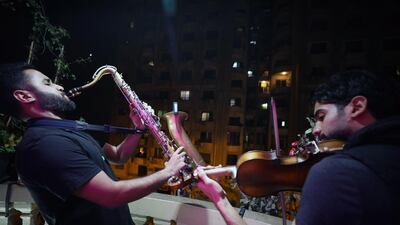
Egyptians Mahmoud Saad (left) plays saxophone and Mohamed Adel (right) violin on their balcony during curfew in Giza, Egypt. EPA -
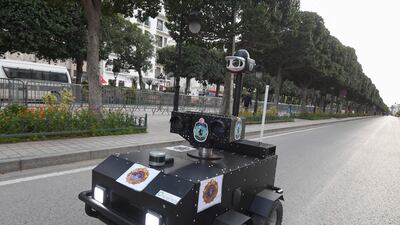
A Tunisian police robot patrols along Avenue Habib Bourguiba in the centre of the capital Tunis, as a means of enforcing a nationwide lockdown to combat the coronavirus pandemic. AFP



