

Egypt’s Coptic Orthodox Church, an ancient sect whose traditions have historically been slow to change with time, is showing surprising flexibility to enforce the social distancing strongly recommended as an effective way to contain an outbreak of the coronavirus that has to date killed at least 40.
After a brief, albeit spirited, resistance by its clergy and followers, the church’s spiritual leader, Pope Tawadros II, last week ordered all churches closed. On Sunday, he said some churches had already started allowing the faithful to confess by telephone. In the meantime, young members of congregations across the country have taken to video conferencing applications to hold prayers, Sunday school and choir meetings.
Smaller denominations in Egypt’s 10 million-strong Christian community have followed suit.
“It was a difficult but necessary decision to safeguard people’s health,” said the Egyptian pontiff about closing the churches.
“Let us endure a little for the sake of safety and prevention,” he said in his weekly sermon on Sunday, delivered in an empty chapel but televised on church-linked networks.
No one knows exactly when churches in Egypt were last closed. Pope Tawadros said it was hundreds of years ago, but he was not more specific. Priests and monks are said to have fled en masse to the deserts of Egypt to escape the heavy-handed policies of the country’s Byzantine rulers during what is known as the Age of Persecution.
Many Coptic Orthodox Christians in Egypt stayed away from churches late in the 11-year rule of the late president Anwar Sadat to protest his 1981 decision to strip the late Pope Shenouda of his temporal powers and banish him to a desert monastery for his alleged meddling in politics. He was released in 1985, four years after Sadat was gunned down by Islamic extremists.
Although many churches around the world have closed their doors to contain the spread of the deadly virus, the significance of closing them in Egypt is rooted in the traditionally rigid and fatalistic ways of the Coptic Orthodox Church. Churches in Egypt remained open Even after a series of deadly attacks over the past four years that targeted them and pilgrims on their way to desert monasteries. The attacks were claimed by ISIS.

Making the decision more difficult to stomach is that, as members of a minority in a Muslim majority country, Christians in Egypt have traditionally maintained close ties to their churches. Those ties go beyond attending mass to cover social, sports and cultural activities. Adding to their disappointment is that closure came during the holiest period of the Christian calendar: the lent fast in the run-up to Easter with all the prayers and rituals involved.
“The church has over the years shown some flexibility, but it has been a slow process,” said Shady Lewis Botros, an Egyptian novelist and a political analyst who lives in London. “Mass used to be on Sunday as it is customary, now it’s on Friday because Sunday is the start of the business week in Egypt. It also used to be completely in Coptic, then it became a mix of Coptic and Arabic and now it is mostly Arabic.”
“It is not completely out of character for the church to close its places of worship because of the virus. It’s an emergency that required an emergency measure.”
That measure, however, also saddened many. But it gave young Christians the opportunity to show solidarity and tenacity to keep their normal activities going.
“My mother is in a very bad way. She is very upset,” said a Coptic Orthodox woman whose 65-year-old mother is a lifetime churchgoer who regularly took communion.
-
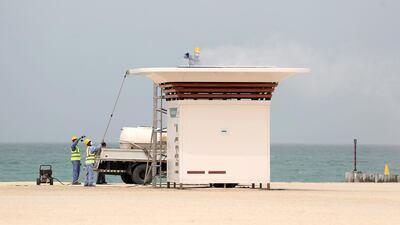
People clean the buildings on the public beach, Dubai. Chris Whiteoak / The National -

A sign says 'Thank you for practicing social distancing' at a supermarket in Dubai Investment Park (DIP), Dubai. Chris Whiteoak / The National -

Two gentlemen clean the Careem bikes on Kite beach, Dubai. Chris Whiteoak / The National -

A Life pharmacy worker makes his deliveries in Al Barsha, Dubai. Chris Whiteoak / The National -

A Palestinian man sprays disinfectant as a precaution against the spread of Covid-19 disease, in the streets of Gaza City. EPA -

The statue of Our Lady of Lebanon is pictured empty of people during a lockdown implemented to stem the spread of the ongoing coronavirus pandemic in the town of Harissa north of Beirut. EPA -

Jordanian soldiers hand flowers to people amongst the first group of people who were on a two-week quarantine in resorts and hotels at the Dead Sea, 60km south of Amman. EPA -

A man wearing a protective mask amid the coronavirus pandemic rides a bicycle in front of the Arbil citadel, in the eponymous capital of the northern Iraqi Kurdish autonomous region. AFP -
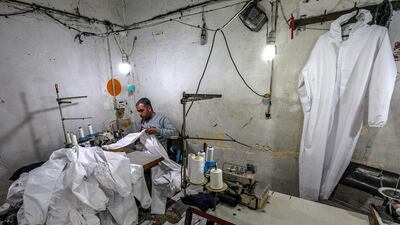
Palestinians manufacture protective coverall suits in a small sewing factory in Gaza City. EPA -

People take pictures of the Great pyramid of Kheops where a laser projection writes "Stay home, thanks to those keeping us safe". AFP -

Palestinian workers fill barrels with cement to be used to block roads as part of measures to limit movement in the West Bank city of Hebron. EPA -

Benches stand with tape placed by authorities, to prevent them being used, on a pavement of Sakarya Street in Ankara. AFP -
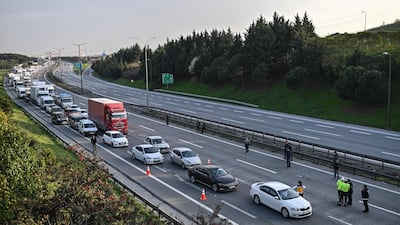
A Turkish health official checks the temperature of a driver at a check point, on the Asian side entrance of Istanbul. AFP -
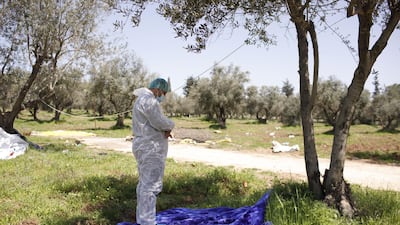
A municipal worker wearing a hazmat overall prays during a break in disinfecting duties for Palestinian workers at the Tarqumya checkpoint in Hebron, West Bank. Bloomberg -

A Palestinian baker finishes a cake, that portrays a woman wearing a facemask, at his shop in Khan Yunis in the southern Gaza Strip. AFP -

Palestinian workers manufacture protective coverall suits and maks at a workshop in Gaza City amid the coronavirus pandemic. AFP -
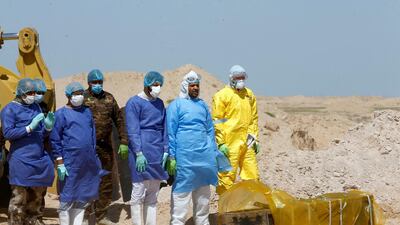
Iraqi Shiite volunteers from Hashid Shaabi (Popular Mobilization Forces) and members of a medical team wearing protective suits, pray near the coffin of a man who passed away due to coronavirus on the outskirt of Najaf, Iraq. Reuters


“She desperately wanted to take my daughter to church to take communion when she felt that churches might be closed. She was very sad that she could not.”
Christine Raafat, 31, said she personally would not confess on the telephone, preferring instead the church’s traditional face-to-face sit-down with a priest. But she has turned to Zoom, the video conferencing application, to resume teaching Sunday school as she has been doing at her church in Heliopolis, a leafy suburb east of Cairo.
She had 50 in her first session.
“We sang church hymns and we read from the Bible. But we could not all sing together because of the application’s limitations that cause voice delay,” she said. “Two sisters sang for all of us.”
Kirolos Milad, a 27-year-old engineer by training who teaches mathematics at a Cairo school, is a senior scouts leader at his church who has been determined to keep church friends of roughly the same age as him busy and on a learning curve at a time when much of life has come to a complete halt because of the virus outbreak.
“We need to fill our time by going on Zoom. We sang hymns, discussed creativity, listened to a tutorial on Excel and a lecture on general etiquette,” he said. “We have three sessions a day, the last of which is at 10 pm when we offer the day’s final prayer.”
The Catholic church in Egypt has taken the use of social media a step further, with priests using it to lead Mass live on their Facebook page.
Eileen, who is in her 30s, joined the last one on Sunday.
“A friend of mine bathed her children and dressed them in their Sunday best to join her on the sofa at home while watching Mass live,” she said. “I was in jeans and a t-shirt.”
Easter Sunday falls on April 19 this year and many like Eileen are hoping and praying that churches will reopen before that.
“The irony is that churches have always been open for us to go to and pray if we wanted to. Now that they’re closed we miss them so much.”

