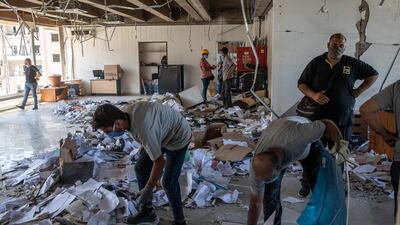

Beirut's haphazard clean-up of residential neighbourhoods affected by the deadly blast that killed at least 181 people three weeks ago may have life-threatening long-term health effects, experts told The National.
Some 40,000 buildings were damaged in what has been described as one of the largest non-nuclear explosions in recent history. Modern high-rise apartments, historic palaces and modest flats were destroyed in equal measure.
For weeks after the blast, thousands of volunteers and workers came together to clean the debris in neighbourhoods close to the port as the cash-strapped Lebanese state struggled to respond to the disaster.
As debris is moved around, fine particles of glass and asbestos remain suspended in the air. If inhaled, asbestos fibres, once prised for their thermal isolating qualities, can cause lung cancer to develop several years after exposure.
“The risk is that people will develop cancer,” said Charbel Afif, associate professor in air pollution and chairperson of the chemistry department at Universite Saint Joseph in Beirut.
-
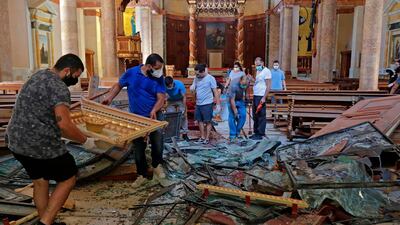
Destruction inside a church in the aftermath of the massive explosion. AFP -
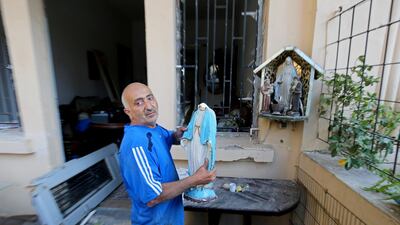
A man holds a damaged sculpture depicting Mary in his house near the site of Tuesday's blast in Beirut's port area. Reuters -
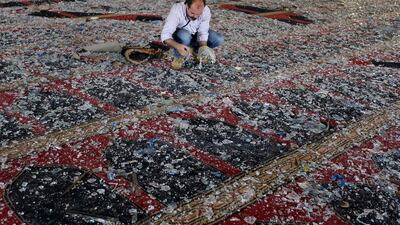
A man removes broken glass scattered on the carpet of a mosque damaged in Tuesday's blast in Beirut. Reuters -
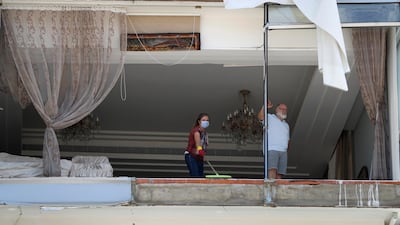
A woman cleans debris from her damaged apartment a day after an explosion hit the seaport of Beirut. AP Photo -
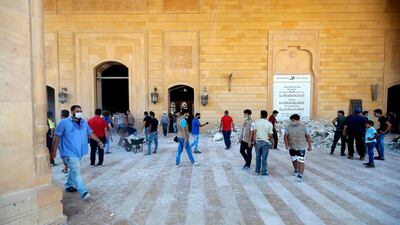
People clean debris at Mohammed Al Amin mosque in the centre of Beirut. AFP -
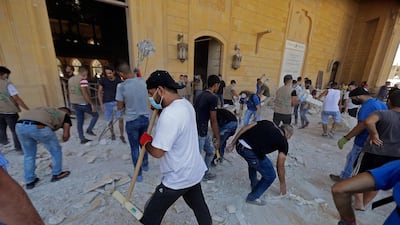
People clean debris at Mohammed Al Amin mosque in the centre of Beirut. AFP -
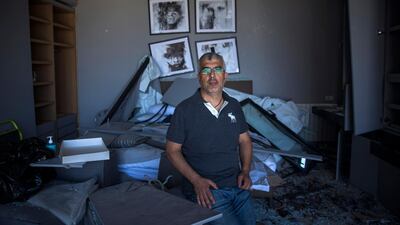
Karim Corbani, 45, poses for a portrait inside his bedroom in Beirut. Getty Images -
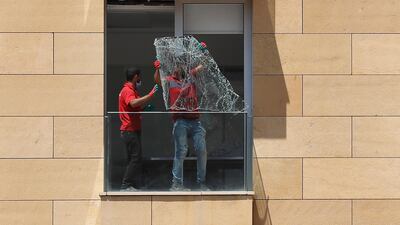
Workers throw a broken window from a damaged apartment a day after an explosion hit the seaport of Beirut. AP Photo -
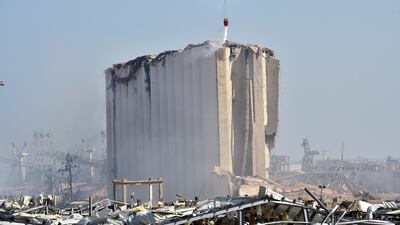
A helicopter trying to put out the fire a day after the explosion rocked Beirut. EPA -
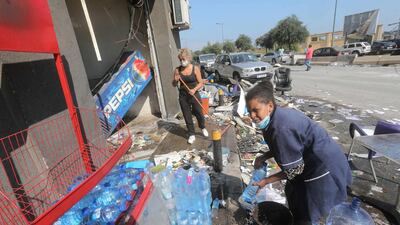
Women clear the damage outside a sideroad kiosk in Beirut. AFP -

People help clear rubble and debris from the driveway of a residential building in Beirut. Bloomberg -
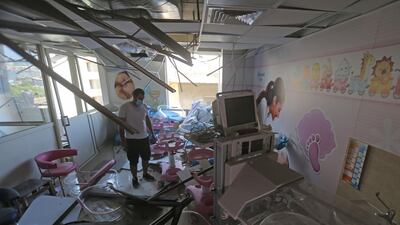
The damaged Wardieh hospital is pictured in the aftermath of the blast that tore through Lebanon's capital. AFP -
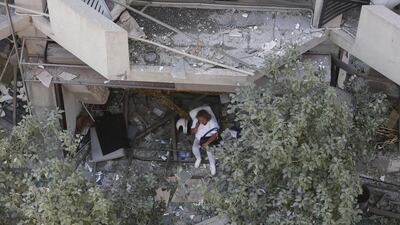
A woman sits in front of a building, damaged by the explosion a day earlier. Getty Images -
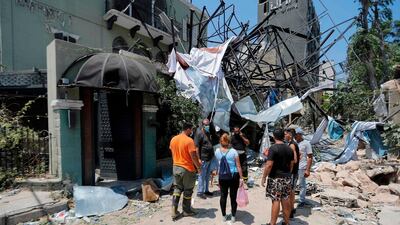
Lebanese inspect the damage in the aftermath of yesterday's blast that tore through Lebanon's capital. AFP -

A woman looks out of the collapsed facade of an apartment. Getty Images -

A woman looks down from a balcony. Getty Images -
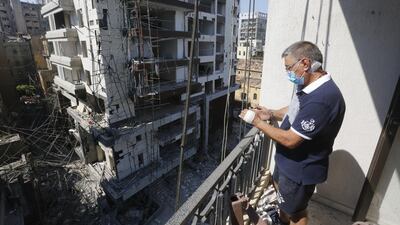
A man looks from the balcony of a building. Getty Images -
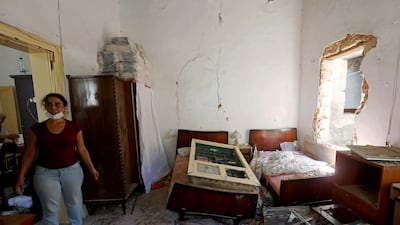
A woman stands inside her damaged home. Reuters


In co-operation with the Lebanese government, several international organisations and universities, including USJ, conducted an awareness campaign to tell people how to protect themselves during debris removal via leaflets and messages on social media.
“NGOs self-checked that their volunteers were abiding by the rules, but no governmental body enforced them,” said Professor Afif.
Most residents wore surgical masks that also help to protect against Covid-19 as they cleaned their damaged flats, shops, and houses. Some also sported helmets, but none wore special masks to remove asbestos simply because they are scarce in Lebanon, said Professor Afif.
“We recommended that they use at least an N95 mask, though even they are becoming hard to find because of the coronavirus pandemic,” he said.
N95 masks are named so as they filter out 95 per cent of airborne particulates, including dusts, mists and fumes.
“Asbestos inhalation is the most dangerous route of exposure because it leads to several health consequences related to the respiratory organs. These include fibrosis, lung cancer and malignant mesothelioma. Malignant mesothelioma, a rare form of cancer, is directly related to the exposure to asbestos fibres,” said Jina Talj, director of environmental NGO Diaries of the Ocean.
But cancer can take several decades to develop detectable symptoms, which means that understanding when the patient was exposed is very difficult.
“It’s impossible to tell what the effects of this blast will be on the population in and surrounding the affected area,” said Ms Talj.
Some buildings built in Lebanon in the second half of the twentieth century contain asbestos, particularly in suspended ceilings, corrugated cement roofs, and irrigation pipes.
But their number is not known. Asbestos was never professionally removed in Lebanon despite its known health dangers. A majority Swiss-held company, Eternit, produced asbestos locally for five decades until it closed in 2002.
“There should be a clear management plan for debris removal, including asbestos. But to my knowledge there has not been one,” said Adib Kfoury, assistant professor at the department of environmental sciences at the University of Balamand.
“I see a lot of people doing things on their own in unco-ordinated efforts.” The Beirut municipality did not respond in time to a request for comment.
Imports of certain types of asbestos were banned in 1998, but others remain permitted for import and use, including chrysotile asbestos, which is considered a human carcinogen, said Professor Kfoury.
“There is no complete ban on the import and use of asbestos in Lebanon, and no clear follow up on the level of enforcement of any related regulations,” he said.
“My concern is to avoid a repeat of health issues like the ones developed after the twin towers attack,” he said.
The destruction caused by the Beirut explosion shares common elements with the September 11 terror attacks on the World Trade Centre in the US in 2001, said Michael Crane, professor at the department of environmental medicine and public health at Mount Sinai hospital in New York and a leading expert on the physical and mental health consequences of 9/11.
The collapse of the twin towers released a dust cloud of toxic materials, including asbestos and other carcinogens, pulverised concrete and other toxins, he told The National.
Like in Beirut, rescue workers and residents were repeatedly exposed to those materials during the clean-up process.
In addition to suffering from a profound mental health impact, exposed populations contracted multiple physical illnesses.
Studies in which Dr Crane participated over a decade after the attacks found that there were statistically higher risks of prostate and thyroid cancers and leukaemia among first responders compared to the general US population.
Lebanon does not have the capacity to assess risks of asbestos or other hazardous material located in debris from damaged buildings. Several local universities and UN agencies have sent samples abroad for testing but the results are not known yet.
“It will take a few weeks before we get some answers, and until then we cannot really do anything,” said Ms Talj.

