

The pattern is now sadly familiar.
The regime of Bashar Al Assad launches a major assault on a besieged and embattled haven of the rebellion against its rule. Backed by its Russian and Iranian allies, atrocity after another are committed – the flagrant bombardment of hospitals and schools and vital civilian infrastructure, coupled with the denial of humanitarian aid to desperate people.
Sometimes, though, the regime’s impunity compels it to go beyond the pale in its murderous modus operandi, by poisoning the very air of its victims.
The spectre of chemical weapons use in Syria and the dimmer prospect of Western intervention appeared once again this week with the US State Department’s announcement that it was looking into an alleged chlorine attack on Sunday in Idlib, and vowing a quick and appropriate response if the claims are proven.
The senior US envoy for Syria, James Jeffrey, said Washington had not yet found any evidence for the attack.
Idlib is the scene of a looming showdown between the Assad regime and extremist militants. The province is one of the last areas outside of government control in Syria. After eight years of war, the regime has reclaimed much of the country – save for Idlib, parts of the north under the control of Turkish-backed rebels and the areas liberated from ISIS by US-backed Kurdish militias.
An offensive appears in the offing with at least 18 medical facilities bombed since April, more than 200 dead, and more than 300,000 displaced.
-
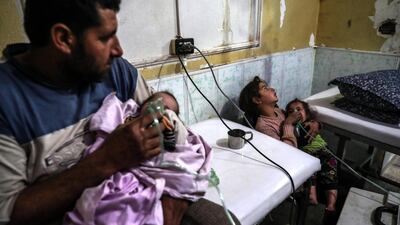
An affected man puts the aerosol mask on his child while his other daughter gives treatment to her other sister after a shelling attack on rebels-held Eastern Ghouta. EPA -
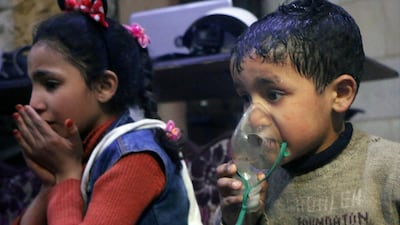
A child receiving oxygen through respirators following an alleged poison gas attack in the rebel-held town of Douma on Sunday, April 8, 2018. Syrian Civil Defense White Helmets via AP -
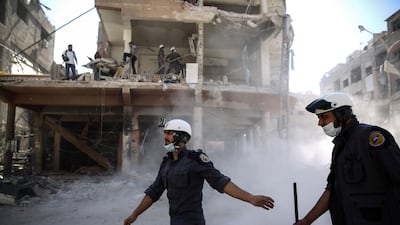
Syrian civil defence volunteers, known as the White Helmets, work around destroyed buildings following reported air strikes on the rebel-held town of Douma. AFP, file -

A Syrian child who was injured in shelling on the town of Misraba receives treatment at a make-shift hospital in the besieged rebel-held town of Douma. AFP -
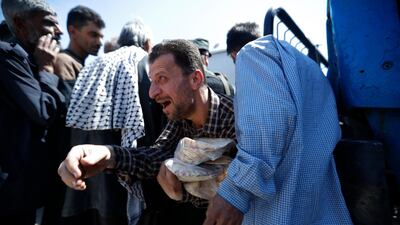
A Syrian man pushes out of a crowd after Syrian authorities distributed bread, vegetables and pasta to hungry Douma residents. AP -
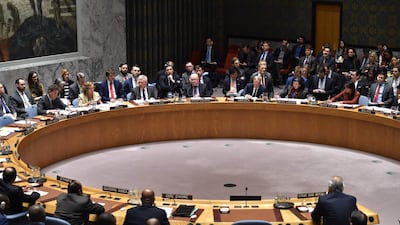
Russia vetoes a UN Security Council resolution that would have set up an investigation into chemical weapons use in Syria on April 10, 2018. AFP -
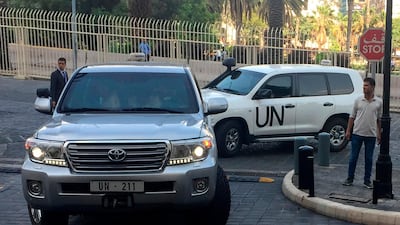
UN vehicles carrying the team of the Organization for the Prohibition of Chemical Weapons (OPCW). AP, File -
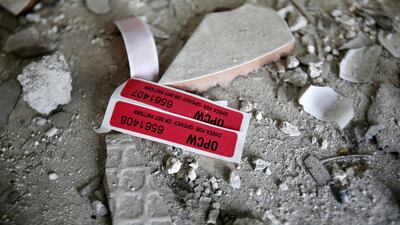
Labels of the Organisation for the Prohibition of Chemical Weapons (OPCW) are seen inside a damaged house in Douma in Damascus, Syria April 23, 2018. Reuters -
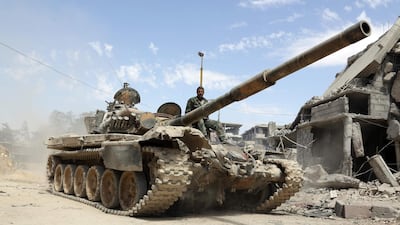
The Syrian government unleashed a ferocious assault on the then-rebel stronghold of Eastern Ghouta on February 18, 2018 aiming to crush militant groups on the doorstep of the capital. Civilans were trapped and many died. AFP -
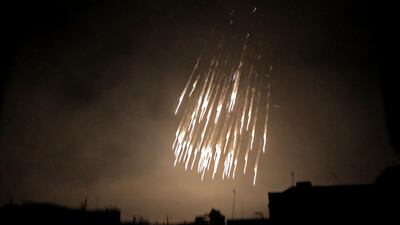
What appears to be white phosphorus incendiaries over Douma during regime bombardment of what was one of the few remaining rebel-held pockets in Eastern Ghouta. AFP, file -

A Syrian man helps evacuate an injured victim following Syrian government air strikes on the Eastern Ghouta rebel-held enclave of Douma, on the outskirts of the capital Damascus on March 20, 2018. AFP -
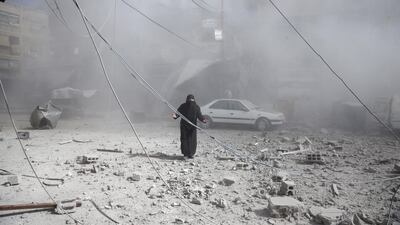
A woman gestures as she walks on rubble of damaged buildings after an airstrike in the besieged in eastern Ghouta. Reuters -
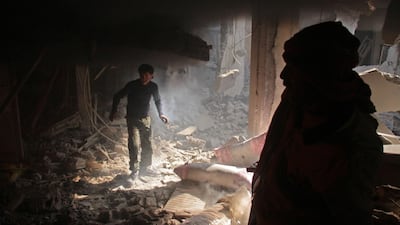
Syrians search for survivors following regime air strikes on the rebel-held besieged town of Douma in the eastern Ghouta region. AFP -
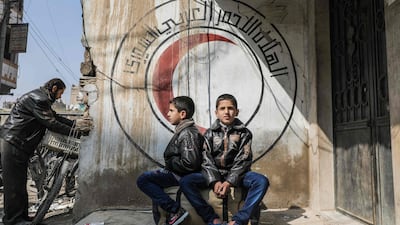
Syrian children sit before a mural on a wall bearing the logo of the Syrian Red Crescent in the Syrian town of Douma in the rebel-held enclave of Eastern Ghouta on the eastern outskirts of the capital Damascus on March 13, 2018. AFP -
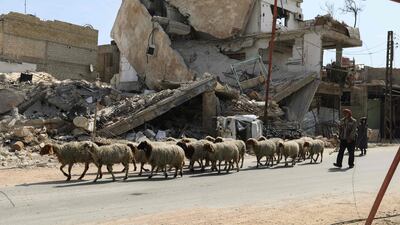
A shepherd leads his flock away from Douma to safer areas in the rebel-held enclave of Eastern Ghouta, on the outskirts of Damascus, on March 7, 2018. AFP -

People ride a horse along a damaged street at the city of Douma in Damascus. Reuters -
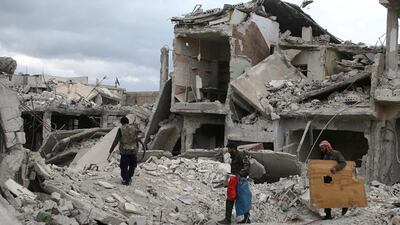
People walk on rubble of damaged buildings in the besieged town of Douma, Eastern Ghouta. Reuters, file


The threat of action comes at a sensitive time, with heightened regional tensions between Iran and the US. The latter has drawn up plans to send thousands of troops to the Middle East after unspecified threats, and Gulf oil tankers have been sabotaged and pro-Iranian militias in the region placed at the ready to prepare for confrontation.
But, like past cases, whatever tepid Western response to the latest chemical attack in Syria will do little to alter the course of the war or deter future abuses.
The use of chemical weapons in the conflict came to the fore when then US President Barack Obama said in 2012 that their use would change his “calculus” about intervention in the conflict, at a time when the Assad regime seemed to be teetering.
The distinction still strikes many Syrians as odd, because vastly more civilians have been killed by conventional weapons in the conflict that chemical attacks.
A year after Mr Obama’s warning, the regime carried out the war’s worst single atrocity, killing over 1,300 people on August 21, 2013, with rockets laced with the nerve agent sarin. The pictures of children in white shrouds, the worst such attack since the 1980s, provoked horror in Western capitals and nearly prompted an American intervention in the war.
But the West blinked.
In Westminster, the UK’s parliament voted against intervention and in Washington, Mr Obama deferred the decision to launch airstrikes to Congress. The plan was scuttled after Russia, Assad’s main backer, brokered a deal to have Damascus sign on to the Chemical Weapons Convention and turn over its arsenal.
Despite the deal, the Syrian regime has continued to carry out chemical attacks with impunity, either not declaring its full stockpiles or developing new ones in the interim.
The most well-known are inevitably the ones that sparked international outrage and killed dozens of civilians. However, those attacks belied a much broader campaign that deployed chlorine gas, in particular, to cow opposition communities into submission through terror.
There was the attack in Khan Sheikhun in April 2017, a town that is situated strategically at the intersection of the borders of Idlib and neighbouring Hama. More than 80 people were killed in the dawn toxic gas attack, prompting much condemnation and the decision by President Donald Trump to launch dozens of cruise missiles at the airfield in Homs where the chemical attack originated. It was a slap on the wrist, but not one whose impact lasted for very long.
Almost exactly a year to the day, on April 7, 2018, a chemical attack on the city of Douma near Damascus killed more than 70 people, during negotiations with local rebels and opposition communities who were resisting a complete surrender deal. They capitulated soon afterwards.
The US, UK and France responded with a series of missile strikes on military installations whose effects were so minuscule that the Assad regime claimed it had withstood an attack comparable to the tripartite aggression against Egypt during the Suez crisis in 1956.
Sarin, the deadliest agent deployed in the war, was only used in a minority of chemical attacks in Syria. The UN’s independent commission of inquiry in 2018 said it had documented 34 separate chemical attacks since 2013, 28 of which had been carried out by the government. ISIS also carried out attacks using sulphur mustard, a chemical agent likely obtained from abandoned government stockpiles. The number of attacks is likely to be higher, but various issues such as limited access at times of heavy fighting prevented the UN teams from confirming other reports.
Chlorine is not a controlled substance like sarin because it has commercial and industrial uses, though its use as a weapon is banned under the Chemical Weapons Convention. Dozens of cases of chlorine use have been documented in Idlib in particular in 2015, but they caused little outrage because, compared to sarin, they left much fewer casualties.

