

Israel’s president tasked centrist leader Benny Gantz with forming a government on Monday, sidelining the incumbent Benjamin Netanyahu after a tumultuous few days in politics overshadowed by the coronavirus pandemic.
President Reuven Rivlin urged politicians to act "in this hour of crisis" as he formally nominated Mr Gantz for the premiership, during a ceremony at the presidential residence in Jerusalem.
“The enormity of this moment and the dimensions of the challenges we face require forming a government,” the president said, following the country’s third election in less than a year.
Tasking Mr Gantz with forming a government follows the recommendation of 61 MPs, as various factions united against the prime minister whose right-wing and religious bloc secured 58.
The Blue and White chairman vowed to "do everything to form a government" which will "serve all of Israel's citizens".
"I will lead the government in healing Israeli society from the effects of the coronavirus epidemic, as well as from the epidemic of divisiveness and hate," Mr Gantz said at the ceremony.
Mr Gantz’s nomination to form an administration marks a dramatic turnaround since the March 2 election, in which Mr Netanyahu appeared the frontrunner after his Likud party won 36 seats compared to the 33 picked up by his rival’s Blue and White party.
-
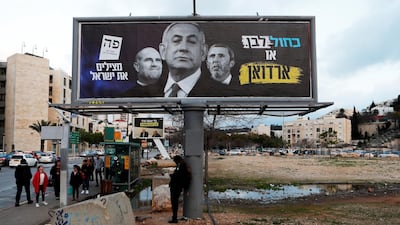
A Blue and White party election campaign banner depicting Israeli Prime Minister Benjamin Netanyahu, Justice Minister Amir Ohana and Education Minister Rafi Peretz with Hebrew writing reading: "Blue and White or Erdogan" and "Saving Israel", is seen in Modiin, Israel. REUTERS -

A boy watches his father as he stands behind a booth at a polling station and votes in Israel's national election, in the Israeli settlement of Nokdim, in the occupied West Bank. Reuters -

Paramedics take part in a coronavirus response training at a special polling station for quarantined Israelis in Tel Aviv. AFP -

Israeli demonstrators lift placards against Prime Minister Benjamin Netenyahu as an election campaign van for the Arab Joint List passes by, on the main road leading to the bedouin village of Tal al-Sabaa, near the southern Israeli city of Beersheva. AFP -

Israeli employees present and demonstrate a special polling station for Israeli voters in home quarantine because of the coronavirus, in Tel Aviv, Israel. EPA -

A man stands behind a booth at a polling station in Nokdim, in the occupied West Bank. Reuters -

A boy puts his father's ballot in the box. Reuters -

A man prepares to cast his ballot in the Israeli settlement of Nokdim, in the occupied West Bank. REUTERS -

Staff from Israel's Central Election Commission prepare a special polling station for quarantined Israelis. AFP -

Staff from Israel's Central Election Commission prepare a special polling station for quarantined Israelis. AFP


Key to Mr Gantz gaining the necessary 61 seats was the unanimous support of the Arab-led Joint List, whose 15 elected members backed the former army chief despite Blue and White saying they would not be included in the cabinet.
The Joint List would in theory vote in favour of a minority government led by Mr Gantz in exchange for enacting legislation to improve the lives of Arab Israelis, who make up about 20 per cent of the population.
Such an arrangement would be unprecedented in Israeli politics as Arab MPs have largely been excluded from the upper echelons of decision-making, but significant hurdles remain.
The Joint List legislators stand in an unhappy alliance with the seven MPs from Avigdor Lieberman’s far-right Yisrael Beiteinu party, sharing almost no common ground beyond their desire to oust Mr Netanyahu.
Two Blue and White members, Zvi Hauser and Yoaz Hendel, have already voiced their opposition to a minority government supported by the Joint List.
Mr Gantz now has 28 days to bring them into line while cobbling together a cabinet from his array of backers, including a handful of left-wing politicians, all while the country grapples with coronavirus.
-

A municipal policeman orders people to evacuate the corniche, or waterfront promenade, along the Mediterranean Sea, as the country's top security council and the government were meeting over the spread of coronavirus, in Beirut, Lebanon. AP Photo -

A bus driver wearing a mask as a means of protection against the cononavirus Covid-19, speaks to passengers in the northeastern Syrian Kurdish-majority city of Qamishli. AFP -

A medical staff member in protective gear prepares to check the temperature of a cleric man amid concerns over the coronavirus (COVID-19) spread, at Najaf airport in the holy city of Najaf upon his arrival from Iran, Iraq. REUTERS -

A picture shows extra beds set up in tents in the yard of a Red Crescent Society building hosting a hospital opened by the governor of Hebron and equipped with modern appliances, to receive patients affected by the coronavirus Covid-19 in the village of Halhul, near the city of Hebron in the occupied West Bank. AFP -

A Palestinian student follows through his mobile telephone from his home, a lesson broadcast by a teacher from an educational radio station, during his isolation period in a bid to prevent the spread of the novel coronavirus, in Gaza City. AFP -

A pedestrian wears a protective face mask while walking in central Tehran, Iran. Bloomberg -

A municipal policeman, left, orders fishermen to leave the corniche, or waterfront promenade, along the Mediterranean Sea, as the country's top security council and the government were meeting over the spread of coronavirus, in Beirut, Lebanon. AP Photo -

Turkish citizens wearing protective face masks sit in a bus as they are repatriated from the "umrah" pilgrimage in Saudi Arabia, prior to being placed in quarantine as part of measures to limit the spread of COVID-19, caused by the novel coronavirus in Ankara. AFP -

Buses carry Turkish citizens who returned from Saudi Arabia for Umrah pilgrimage, to place in dormitories to prevent the spread of the novel coronavirus COVID-19, as part of quarantine measures, in Ankara, Turkey. EPA -

A Palestinian teacer broadcasts a lessen from an educational radio station, in order for students to follow through their mobile telephones at home, during their isolation period in a bid to prevent the spread of the novel coronavirus, in Gaza City. AFP -

A medical staff member in protective gear checks the temperature of a girl amid concerns over the coronavirus (COVID-19) spread, at Najaf airport in the holy city of Najaf upon his arrival from Iran, Iraq. REUTERS -

A woman wearing a mask as a means of protection against the cononavirus Covid-19, gazes out of a car window in the northeastern Syrian Kurdish-majority city of Qamishli. AFP -

A worker arranges goods on an empty shelve in a mall amid concerns over the coronavirus (COVID-19) spread, in Amman Jordan. REUTERS -

A cashier wearing a face mask amid concerns over the coronavirus (COVID-19) spread works at a mall in Amman, Jordan.REUTERS -

Egyptian Coptic priest Sawirs Marcos Saiwirs reads government instructions on preventing the spread of coronavirus during Sunday mass at Archangel Michael Church in Cairo, Egypt. REUTERS -

Pedestrians walk in front of a closed sidewalk cafe in the centre of the Tunisian capital Tunis after the government's decision to shut down bars, cafes and restaurants in a bid to limit the spread of the coronavirus Covid-19. AFP -

Shops remain closed in the centre of the Tunisian capital Tunis after the government's decision to shut down bars, cafes and restaurants in a bid to limit the spread of the coronavirus Covid-19. AFP -

A man with a motorcycle helmet covers his face with a mask, as he watches municipal policemen order people to leave the corniche, or waterfront promenade, along the Mediterranean Sea, as the country's top security council and the government were meeting over the spread of coronavirus, in Beirut, Lebanon. AP Photo


Like other countries in the region, Israel has imposed stringent measures at its borders and within the country to contain the virus, including closing all schools and many businesses while limiting gatherings to 10 people.
Emergency steps taken by the courts have seen Mr Netanyahu’s corruption trial, due to start on Tuesday, postponed until 24 May.
The outbreak of coronavirus also led the Likud leader to push for a six-month emergency government with himself at the helm, dividing ministerial posts equally between Likud and Blue and White.
While initially open to discussing an emergency administration, Mr Gantz on Sunday accused Mr Netanyahu of trying to “manipulate the public” and speaking to the media rather than send a negotiating team to discuss the proposal.
“When you get serious, we can talk,” he said.
The president, however, suggested the proposal should remain on the table as Israel’s coronavirus cases topped 250. “It is possible that forming a government quickly will require interim arrangements for the coming months,” he said on Monday.
While Mr Gantz and Mr Netanyahu have agreed their negotiating teams would meet, opposition politicians are seeking a path through parliament to end the sitting prime minister’s career.
The Blue and White bloc has said it will table legislation prohibiting a politician who is under indictment from forming a government, barring Mr Netanyahu from the premiership.
But it is unclear how quickly they can get a draft law into parliament, as a Knesset spokesman told The National officials have not yet decided how to convene parliament with the coronavirus restrictions in place.
MPs were being sworn in before the president on Monday just three at a time, speaking briefly inside an echoing chamber, in line with the restrictions imposed on gatherings.
People in white protective suits and masks had roamed through parliament on Sunday spraying disinfectant, readying the Knesset for politics under a pandemic.

