Beirut: fire breaks out at Zaha Hadid building


  • English
  • Arabic

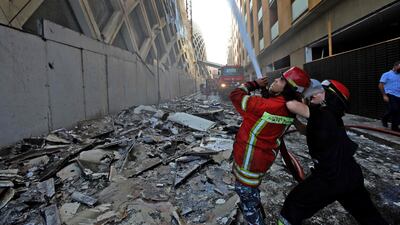
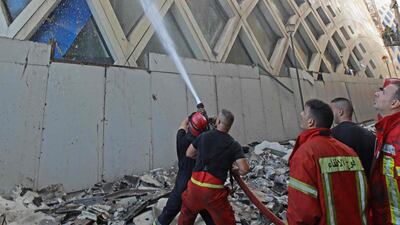
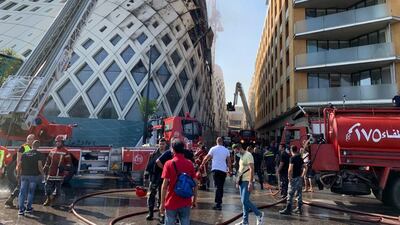
A fire broke out on Tuesday morning at the Zaha Hadid building in central Beirut. Videos on social media showed firefighters attempting to extinguish the flames as smoke billowed from the building and over the Hilton hotel next door.

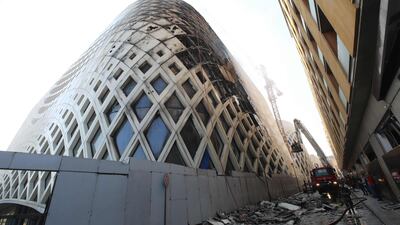
Crowds gathered around the famous building, designed by celebrated architect Dame Zaha Hadid, as parts of the external wall fell away in the flames.

The Lebanese Civil Defence has announced that the flames are now under control. There have been no injuries reported so far.

It was not immediately clear what caused the fire at the futuristic seafront building, which sits on the main road that runs past the port.

  • Lebanese firefighters douse the flames of a blaze that engulfed the Zaha Hadid building in central Beirut. AFP
    Lebanese firefighters douse the flames of a blaze that engulfed the Zaha Hadid building in central Beirut. AFP
  • Videos on social media showed firefighters attempting to extinguish the flames as smoke billowed from the building and over the Hilton hotel next door. AP Photo
    Videos on social media showed firefighters attempting to extinguish the flames as smoke billowed from the building and over the Hilton hotel next door. AP Photo
  • Crowds gathered around the famous building, designed by celebrated architect Dame Zaha Hadid, as parts of the external wall fell away in the flames. AFP
    Crowds gathered around the famous building, designed by celebrated architect Dame Zaha Hadid, as parts of the external wall fell away in the flames. AFP
  • The Lebanese Civil Defence has announced that the flames are now under control. There have been no injuries reported so far. AFP
    The Lebanese Civil Defence has announced that the flames are now under control. There have been no injuries reported so far. AFP
  • It was not immediately clear what caused the fire at the futuristic seafront building, which sits on the main road that runs past the port. AFP
    It was not immediately clear what caused the fire at the futuristic seafront building, which sits on the main road that runs past the port. AFP
  • This is the second time in less than a week that the city has suffered a major fire. AFP
    This is the second time in less than a week that the city has suffered a major fire. AFP
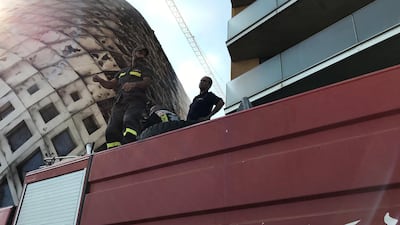
  • Civil defence tackle the blaze. Reuters
    Civil defence tackle the blaze. Reuters
  • Civil defence tackle the blaze. Reuters
    Civil defence tackle the blaze. Reuters
  • Crowds gathered around the famous building as civil defence tackles the blaze. Reuters
    Crowds gathered around the famous building as civil defence tackles the blaze. Reuters
  • Civil defence tackle the blaze. Reuters
    Civil defence tackle the blaze. Reuters

This is the second time in less than a week that the city has suffered a major fire. Last Thursday, a blaze broke out at Beirut port, destroying a warehouse storing aid and sending a thick plume of smoke over the city.

The latest fire appears to have engulfed part of the historic souk area in the centre of Beirut. The Zaha Hadid building, a new commercial complex designed by the late British-Iraqi architect, has been under construction for years and was nearing completion when the fire broke out.

The Lebanese capital is still reeling from the huge explosion that killed almost 200 people and injured more than 6,000 on August 4. The blast, which laid waste to swathes of the city and left around 300,000 homeless, prompted the government to resign six days later.

The country is facing an unprecedented economic crisis and financial collapse, blamed on decades of mismanagement and corruption by an entrenched political class.

Last month’s blast – caused by nearly 3,000 tonnes of ammonium nitrate being improperly stored at the port for years – is seen as the culmination of leaders unable to manage the country’s affairs or protect its people.

So far, authorities have been unable to provide answers about the explosion, and there has been no accountability for it.

Last week's fire prompted terrified residents to open their windows and take refuge in corridors fearing a repeat of the August 4 explosion.

It's unclear what sparked the flames last week, which reignited on Saturday before being fully extinguished.


The%20Super%20Mario%20Bros%20Movie
%3Cp%3E%3Cstrong%3EDirectors%3A%3C%2Fstrong%3E%20Aaron%20Horvath%20and%20Michael%20Jelenic%0D%3Cbr%3E%3Cstrong%3EStars%3A%3C%2Fstrong%3E%20Chris%20Pratt%2C%20Anya%20Taylor-Joy%2C%20Charlie%20Day%2C%20Jack%20Black%2C%20Seth%20Rogen%20and%20Keegan-Michael%20Key%0D%3Cbr%3E%3Cstrong%3ERating%3A%3C%2Fstrong%3E%201%2F5%3C%2Fp%3E%0A

Mercer, the investment consulting arm of US services company Marsh & McLennan, expects its wealth division to at least double its assets under management (AUM) in the Middle East as wealth in the region continues to grow despite economic headwinds, a company official said.

Mercer Wealth, which globally has $160 billion in AUM, plans to boost its AUM in the region to $2-$3bn in the next 2-3 years from the present $1bn, said Yasir AbuShaban, a Dubai-based principal with Mercer Wealth.

Within the next two to three years, we are looking at reaching $2 to $3 billion as a conservative estimate and we do see an opportunity to do so,” said Mr AbuShaban.

Mercer does not directly make investments, but allocates clients’ money they have discretion to, to professional asset managers. They also provide advice to clients.

“We have buying power. We can negotiate on their (client’s) behalf with asset managers to provide them lower fees than they otherwise would have to get on their own,” he added.

Mercer Wealth’s clients include sovereign wealth funds, family offices, and insurance companies among others.

From its office in Dubai, Mercer also looks after Africa, India and Turkey, where they also see opportunity for growth.

Wealth creation in Middle East and Africa (MEA) grew 8.5 per cent to $8.1 trillion last year from $7.5tn in 2015, higher than last year’s global average of 6 per cent and the second-highest growth in a region after Asia-Pacific which grew 9.9 per cent, according to consultancy Boston Consulting Group (BCG). In the region, where wealth grew just 1.9 per cent in 2015 compared with 2014, a pickup in oil prices has helped in wealth generation.

BCG is forecasting MEA wealth will rise to $12tn by 2021, growing at an annual average of 8 per cent.

Drivers of wealth generation in the region will be split evenly between new wealth creation and growth of performance of existing assets, according to BCG.

Another general trend in the region is clients’ looking for a comprehensive approach to investing, according to Mr AbuShaban.

“Institutional investors or some of the families are seeing a slowdown in the available capital they have to invest and in that sense they are looking at optimizing the way they manage their portfolios and making sure they are not investing haphazardly and different parts of their investment are working together,” said Mr AbuShaban.

Some clients also have a higher appetite for risk, given the low interest-rate environment that does not provide enough yield for some institutional investors. These clients are keen to invest in illiquid assets, such as private equity and infrastructure.

“What we have seen is a desire for higher returns in what has been a low-return environment specifically in various fixed income or bonds,” he said.

“In this environment, we have seen a de facto increase in the risk that clients are taking in things like illiquid investments, private equity investments, infrastructure and private debt, those kind of investments were higher illiquidity results in incrementally higher returns.”

The Abu Dhabi Investment Authority, one of the largest sovereign wealth funds, said in its 2016 report that has gradually increased its exposure in direct private equity and private credit transactions, mainly in Asian markets and especially in China and India. The authority’s private equity department focused on structured equities owing to “their defensive characteristics.”

MAIN CARD

Bantamweight 56.4kg
Abrorbek Madiminbekov v Mehdi El Jamari

Super heavyweight 94 kg
Adnan Mohammad v Mohammed Ajaraam

Lightweight 60kg
Zakaria Eljamari v Faridoon Alik Zai

Light heavyweight 81.4kg
Mahmood Amin v Taha Marrouni

Light welterweight 64.5kg
Siyovush Gulmamadov v Nouredine Samir

Light heavyweight 81.4kg
Ilyass Habibali v Haroun Baka

Stats at a glance:

Cost: 1.05 billion pounds (Dh 4.8 billion)

Number in service: 6

Complement 191 (space for up to 285)

Top speed: over 32 knots

Range: Over 7,000 nautical miles

Length 152.4 m

Displacement: 8,700 tonnes

Beam:   21.2 m

Draught: 7.4 m