

The Beirut port disaster provoked international sympathy for Lebanon but not enough to revive chances of an economic bailout, European diplomats and Middle East bankers said on Thursday.
"There is a big awareness that any penny in cash will go to enrich the coffers of a corrupt state and to engorge the fortunes of the kleptomaniac political class," a senior international banker in Dubai told The National.
At least 2,750 tonnes of ammonium nitrate blew up just east of the city centre on Tuesday, killing at least 145 people and destroying parts of the capital.
Arab and western nations were quick to send medical aid and other basic assistance.
Before the tragedy, most of the Lebanese political class was seeking “a bailout for a failed state”, the banker said, without serious changes to a system in which the currency was devalued and the economy crushed.
He expected the international assistance would go much beyond aid for the thousands of Lebanese wounded or left homeless, and possibly some rebuilding aid for damaged districts in Beirut.
French President Emmanuel Macron was in Beirut on Thursday to show support.
Mr Macron floated a vague initiative to bridge decades of division and reduce corruption, a hallmark of Lebanon’s Second Republic after the end of the civil war in 1990.
A man told him in the Christian Gemayzeh district of East Beirut that the Lebanese “don't want the money to go to our government".
"You can trust me so that the help comes to you directly," Mr Macron replied.
He has taken special interest in Lebanon beyond France’s traditionally close ties to its former colonial territory.
Mr Macron personally intervened three years ago to mend ties between former Lebanese prime minister Saad Al Hariri and Saudi Arabia.
-

A Lebanese youth hugs French President Emmanuel Macron during a visit to the Gemmayzeh neighbourhood, which has suffered extensive damage due to a massive explosion in the Lebanese capital. AFP -
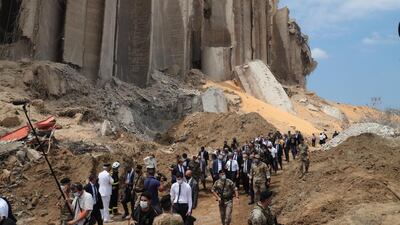
French President Emmanuel Macron (C) visiting the devastated site of the explosion at the port of Beirut, Lebanon. Macron arrived to Lebanon to show support after a massive explosion on 04 August -
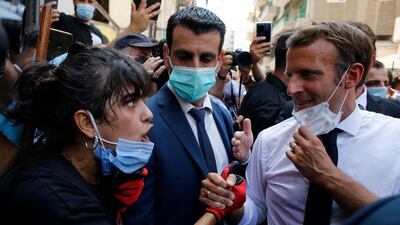
French President Emmanuel Macron listens to a resident as he visits a devastated street of Beirut. AP Photo -
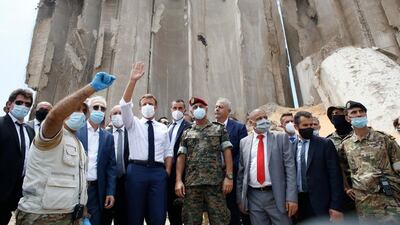
French President Emmanuel Macron gestures as he visits the devastated site of the explosion at the port of Beirut. EPA -
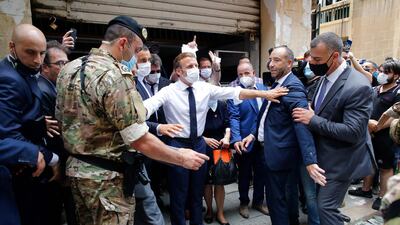
French President Emmanuel Macron gestures as he visits a devastated street of Beirut. AFP -
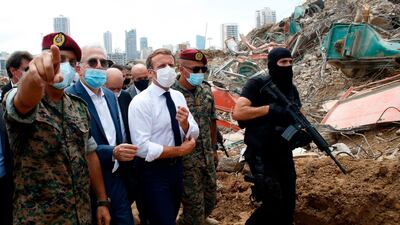
French President Emmanuel Macron surrounded by Lebanese servicemen, visits the devastated site of the explosion at the port of Beirut. AFP -

French President Emmanuel Macron, speaks with a woman as he visits the Gemayzeh neighborhood, which suffered extensive damage from an explosion on Tuesday. AP Photo -
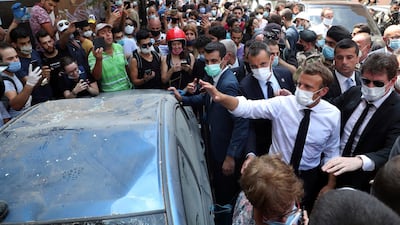
French President Emmanuel Macron visits the Gemayzeh neighborhood, which suffered extensive damage from an explosion on Tuesday that hit the seaport of Beirut. AP Photo -
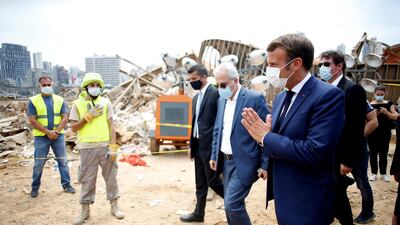
French President Emmanuel Macron gestures as he arrives at the devastated site of the explosion at the port of Beirut. REUTERS -
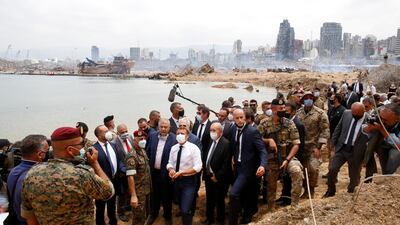
French President Emmanuel Macron visits the devastated site of the explosion at the port of Beirut. REUTERS -
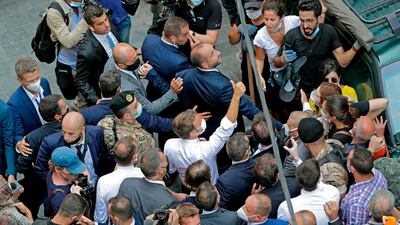
French President Emmanuel Macron greets people during a visit to the Gemmayzeh neighbourhood, which has suffered extensive damage due to a massive explosion in the Lebanese capital. AFP -
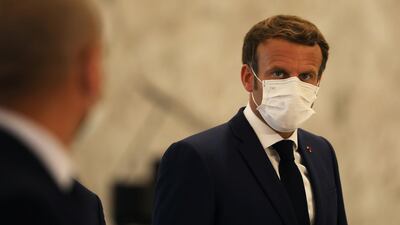
French President Emmanuel Macron wears a protective face mask as he meets Lebanon's President Michel Aoun following Tuesday's blast in Beirut's port area, at the presidential palace in Baabda, Lebanon. Reuters -
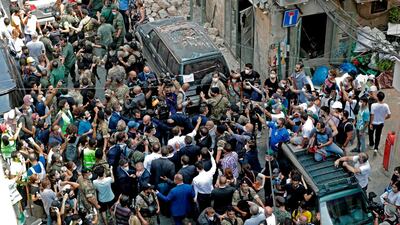
French President Emmanuel Macron greets people during a visit to the Gemmayzeh neighbourhood, which has suffered extensive damage due to a massive explosion in the Lebanese capital, on August 6, 2020. French President Emmanuel Macron visited shell-shocked Beirut, pledging support and urging change after a massive explosion devastated the Lebanese capital in a disaster that has sparked grief and fury. / AFP / ANWAR AMRO -
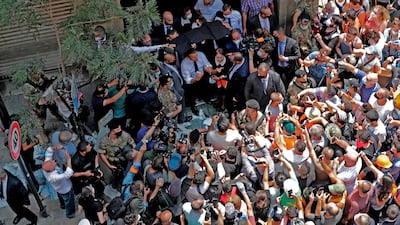
French President Emmanuel Macron speaks to the crowd during a visit to the Gemmayzeh neighbourhood, which has suffered extensive damage due to a massive explosion in the Lebanese capital, on August 6, 2020. French President Emmanuel Macron visited shell-shocked Beirut, pledging support and urging change after a massive explosion devastated the Lebanese capital in a disaster that has sparked grief and fury. / AFP / ANWAR AMRO -
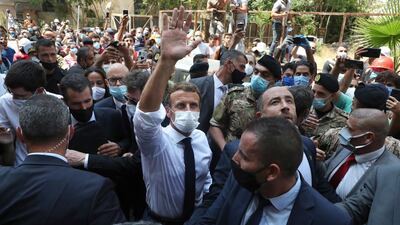
French President Emmanuel Macron, center, gestures as he visits the Gemayzeh neighborhood, which suffered extensive damage from an explosion on Tuesday that hit the seaport of Beirut, Lebanon, Thursday, Aug. 6, 2020. (AP Photo/Bilal Hussein) -

French President Emmanuel Macron gestures as he visits a devastated street of Beirut, Lebanon, on August 6, 2020 a day after a massive explosion devastated the Lebanese capital in a disaster that has sparked grief and fury. French President Emmanuel Macron visited shell-shocked Beirut Thursday, pledging support and urging change after a massive explosion devastated the Lebanese capital in a disaster that has sparked grief and fury. / AFP / POOL / Thibault Camus -
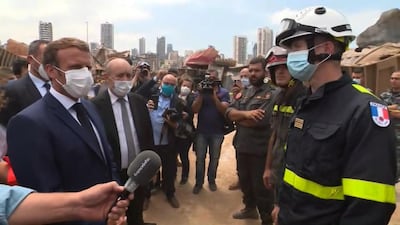
A video grab shows French President Emmmanuel Macron, left, speaking with a member of a French rescue team which arrived overnight to support relief efforts at the port of Lebanon's capital Beirut. AFP -
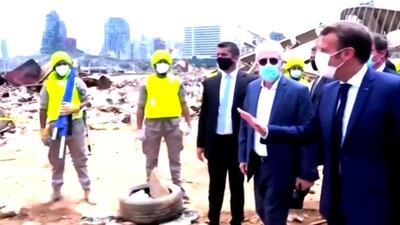
French President Emmanuel Macron visits the site of Tuesday's blast in Beirut. Tele Liban / Reuters -
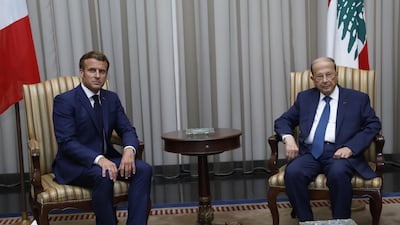
Lebanon's President Michel Aoun meets French President Emmanuel Macron on his arrival at the airport in Beirut. Dalati Nohra/Reuters -
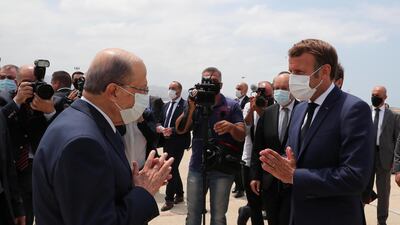
Lebanon's President Michel Aoun welcomes French President Emmanuel Macron on his arrival at the airport in Beirut. Dalati Nohra/Reuters -
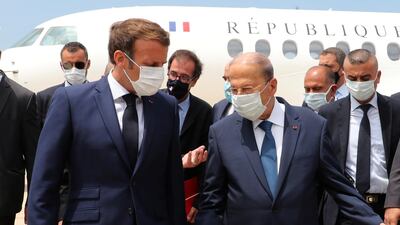
"Lebanon is not alone," Mr Macron tweeted shortly after landing. Dalati Nohra/Reuters -
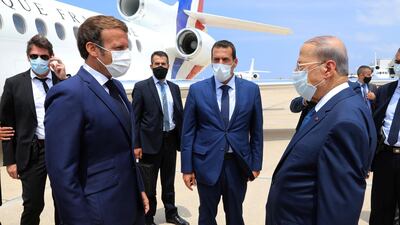
The French president is the first foreign leader to visit the Lebanese capital since an explosion on Tuesday killed at least 137 people. Dalati Nohra / Reuters -
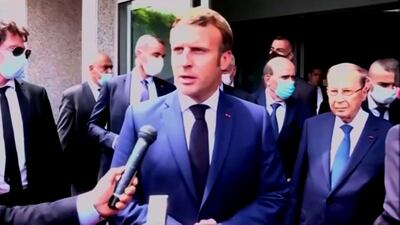
Mr Macron said Lebanon was facing a political and economic crisis, and that it would continue to suffer unless it enacted reforms. Reuters


But two French political sources expected any long-term rescue to rely on reforms that the Hezbollah-aligned government has not enacted.
They referred to comments two weeks ago by French Foreign Minister Jean-Yves Le Drian in Beirut, in which he chided the Lebanese political class for failing to act on sparing the country from financial ruin.
One of the sources said that although Mr Macron sometimes ignores the advice of his Foreign Ministry, “ultimately he cannot appear as rescuing a government beholden to Hezbollah” and deviating from the US stance.
The explosion occurred weeks after talks ended between the government and the International Monetary Fund for an emergency financial package.
The government defaulted in March on its public debt, after bans on dollar deposits were imposed to halt a run on the banks.
A German diplomat said the Lebanese government was succeeding in “employing the disaster politically” and would probably receive a visit to Beirut by a higher-ranking official from Berlin.
He said it was standard procedure in such disasters for the German Development Ministry to divert funds temporarily from existing aid projects in Lebanon towards a “rapid response” to help the country cope.
“Germany may end up financing a special reconstruction project in the aftermath of the disaster but I do not think there will be cash flow transfers to the government,” the diplomat said.
Another European diplomat said the explosion, and the corruption and incompetence behind it, presented EU policymakers with a quandary.
He said the disaster showed the need “to stabilise this corrupt system” while “there is rampant evidence that this system is deeply corrupt and simply not able and willing to reform".

