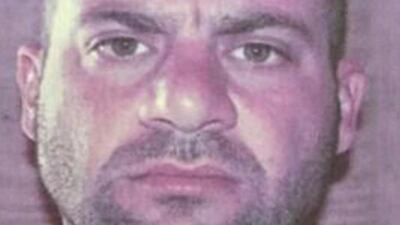
ISIS leader Mohammed Al Mawla now has a $10m bounty on his head.

Al Mawla: new ISIS leader has a reputation for brutality


  • English
  • Arabic

With monikers as divergent as the "Professor" and the "Destroyer", ISIS's new head has a reputation for brutality, but otherwise remains largely an enigma.

Amir Mohammed Said Abd Al Rahman Al Mawla replaced Abu Bakr Al Baghdadi after his death in a raid by US special forces last October.

Al Mawla was initially presented to the world by ISIS as Abu Ibrahim Al Hashimi Al Qurashi – a man about whom America and Iraq had little intelligence.

US officials later came to believe that Al Qurashi was Al Mawla's nom de guerre, recognising him in March as the new head of ISIS.

The State Department immediately placed him on its Specially Designated Global Terrorist list, sparking a quest to learn more about a most-wanted man who now has a $10 million bounty on his head.

One thing everyone seems to agree on is Al Mawla's brutal nature.

He is probably best known for playing "a major role in the campaign of liquidation of the Yazidi minority (of Iraq) through massacres, expulsion and sexual slavery," according to Jean-Pierre Filiu, an extremism analyst at the Sciences Po university in Paris.

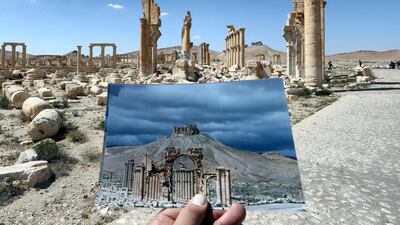
  • A photographer holding his picture of the Arc du Triomphe (Triumph's Arch) taken on March 14, 2014 in front of the remains of the historic monument after it was destroyed by ISIS in October 2015 in the ancient Syrian city of Palmyra. AFP
    A photographer holding his picture of the Arc du Triomphe (Triumph's Arch) taken on March 14, 2014 in front of the remains of the historic monument after it was destroyed by ISIS in October 2015 in the ancient Syrian city of Palmyra. AFP
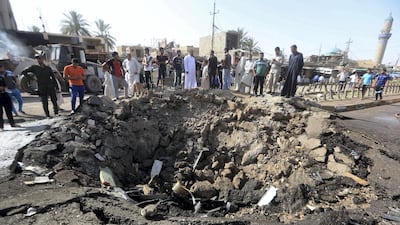
  • Iraqi men look at a crater left by a massive suicide car bomb attack carried out the previous day by ISIS in the predominantly Shiite town of Khan Bani Saad, 20km north of Baghdad, on July 18, 2015. AFP
    Iraqi men look at a crater left by a massive suicide car bomb attack carried out the previous day by ISIS in the predominantly Shiite town of Khan Bani Saad, 20km north of Baghdad, on July 18, 2015. AFP
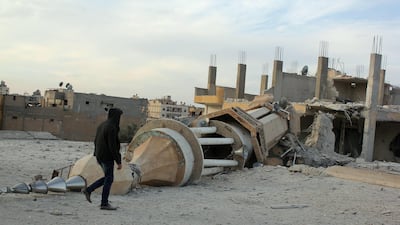
  • A Syrian man walks past a minaret destroyed following an alleged air strikes by Syrian government forces in the ISIS controlled Syrian city of Raqqa, on November 25, 2014. AFP
    A Syrian man walks past a minaret destroyed following an alleged air strikes by Syrian government forces in the ISIS controlled Syrian city of Raqqa, on November 25, 2014. AFP
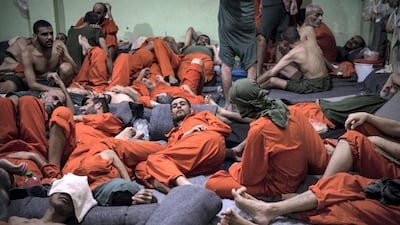
  • Men, suspected of being affiliated with ISIS, gather in a prison cell in the northeastern Syrian city of Hasakeh on October 26, 2019. AFP
    Men, suspected of being affiliated with ISIS, gather in a prison cell in the northeastern Syrian city of Hasakeh on October 26, 2019. AFP
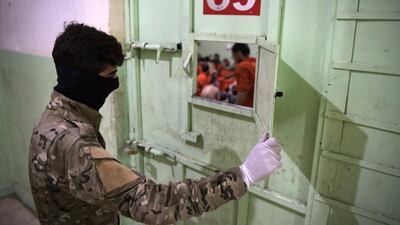
  • A member of the Syrian Democratic Forces (SDF) stands guard in a prison where men suspected to be affiliated with ISIS are jailed in northeast Syria in the city of Hasakeh on October 26, 2019. AFP
    A member of the Syrian Democratic Forces (SDF) stands guard in a prison where men suspected to be affiliated with ISIS are jailed in northeast Syria in the city of Hasakeh on October 26, 2019. AFP
  • A woman stands in front of a bullet riddled facade in the northern Syrian city of Raqqa, the former Syrian capital of ISIS, on August 21, 2019. AFP
    A woman stands in front of a bullet riddled facade in the northern Syrian city of Raqqa, the former Syrian capital of ISIS, on August 21, 2019. AFP
  • A fighter with the Syrian Democratic Forces (SDF) monitors on Surveillance screens, prisoners who are accused of being affiliated with ISIS, at a prison in the northeastern Syrian city of Hasakeh on October 26, 2019. AFP
    A fighter with the Syrian Democratic Forces (SDF) monitors on Surveillance screens, prisoners who are accused of being affiliated with ISIS, at a prison in the northeastern Syrian city of Hasakeh on October 26, 2019. AFP
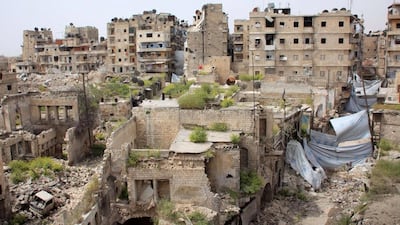
  • A general view shows blankets hanging across the road for protection from sniper fire in the Hamidiyeh neighbourhood of the northern Syrian city of Aleppo as local popular committee fighters, who support the Syrian government forces, try to defend the traditionally Christian district on the third day of intense battles with ISIS on April 9, 2015. AFP
    A general view shows blankets hanging across the road for protection from sniper fire in the Hamidiyeh neighbourhood of the northern Syrian city of Aleppo as local popular committee fighters, who support the Syrian government forces, try to defend the traditionally Christian district on the third day of intense battles with ISIS on April 9, 2015. AFP
  • An undated image, which appears to be a screenshot from a video and which was published by ISIS in the Homs province (Welayat Homs) on August 25, 2015, allegedly shows smoke billowing from the Baal Shamin temple in Syria's ancient city of Palmyra. AFP
    An undated image, which appears to be a screenshot from a video and which was published by ISIS in the Homs province (Welayat Homs) on August 25, 2015, allegedly shows smoke billowing from the Baal Shamin temple in Syria's ancient city of Palmyra. AFP
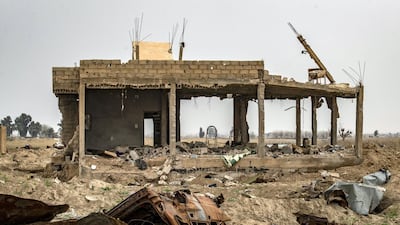
  • The house of local farmer Hamad al-Ibrahim is seen destroyed in the eastern Syrian village of Baghouz on March 13, 2020, a year after the fall of ISIS. AFP
    The house of local farmer Hamad al-Ibrahim is seen destroyed in the eastern Syrian village of Baghouz on March 13, 2020, a year after the fall of ISIS. AFP
  • A picture taken on January 13, 2020 during a press tour organised by the US-led coalition fighting the remnants of ISIS, shows a view of the damage at Ain al-Asad military airbase housing US and other foreign troops in the western Iraqi province of Anbar. AFP
    A picture taken on January 13, 2020 during a press tour organised by the US-led coalition fighting the remnants of ISIS, shows a view of the damage at Ain al-Asad military airbase housing US and other foreign troops in the western Iraqi province of Anbar. AFP
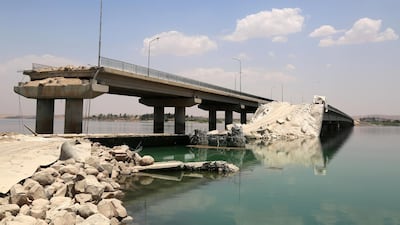
  • A bridge that was destroyed by ISIS after they took control of the river crossing and rebuilt the bridge as US-backed Kurdish and Arab fighters advance into ISIS's bastion of Manbij, in northern Syria, on June 23, 2016. AFP
    A bridge that was destroyed by ISIS after they took control of the river crossing and rebuilt the bridge as US-backed Kurdish and Arab fighters advance into ISIS's bastion of Manbij, in northern Syria, on June 23, 2016. AFP
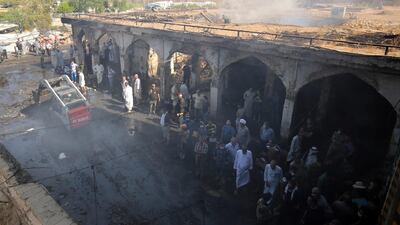
  • Iraqis look at the damage at aftermath scene of a mortar and bombing attack on the Sayyid Mohammed shrine in the Balad area, located 70km (around 45 miles) north of Baghdad, on July 8, 2016. AFP
    Iraqis look at the damage at aftermath scene of a mortar and bombing attack on the Sayyid Mohammed shrine in the Balad area, located 70km (around 45 miles) north of Baghdad, on July 8, 2016. AFP
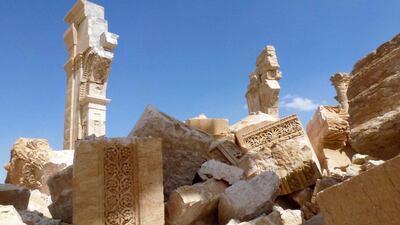
  • Part of the remains of Arch of Triumph, also called the Monumental Arch of Palmyra, that was destroyed by ISIS in October 2015 in the ancient Syrian city of Palmyra, after government troops recaptured the UNESCO world heritage site. AFP
    Part of the remains of Arch of Triumph, also called the Monumental Arch of Palmyra, that was destroyed by ISIS in October 2015 in the ancient Syrian city of Palmyra, after government troops recaptured the UNESCO world heritage site. AFP
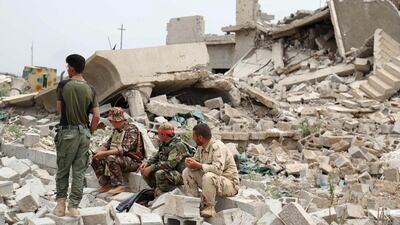
  • Iraqi Kurdish and Turkmen Shiite forces sit in the northern Iraqi town of Bashir after they recaptured the town from ISIS on May 1, 2016. AFP
    Iraqi Kurdish and Turkmen Shiite forces sit in the northern Iraqi town of Bashir after they recaptured the town from ISIS on May 1, 2016. AFP

The new ISIS leader was born, likely in 1976, in the town of Tal Afar, some 70 kilometres from Mosul.

He was born into a Turkmen family, making him a rare non-Arab to ascend the ranks of ISIS, which at its height ruled vast parts of Iraq and Syria and drew volunteers from the West.

His ethnic origins prompted the United Nations to predict in a January report that he might be a "temporary choice until the group finds a more legitimate 'emir', a direct descendant from the Quraysh Hashemite tribe who could therefore command the full support of the remote provinces."

Al Mawla graduated from the Islamic Sciences College in Mosul.

A former officer in the army of Saddam Hussein, he joined the ranks of Al Qaeda after the US invasion of Iraq and Hussein's capture in 2003, according to the Counter Extremism Project think-tank.

He took on the role of religious commissary and a general Sharia jurist for Al Qaeda.

In 2004, Al Mawla was detained by US forces at the Camp Bucca prison in southern Iraq, where he met Al Baghdadi.

Both men were later freed, and Al Mawla remained at Al Baghdadi's side as he took the reins of the Iraqi branch of Al Qaeda in 2010, then defected to create ISIS.

In 2014, according to the CEP, Al Mawla welcomed Al Baghdadi to Mosul "before leaving Al Qaeda and pledging allegiance and full support to the radical's mission, providing ISIS the support to quickly take control of the city".

A profile drawn up by the CEP said that Al Mawla "quickly established himself among the insurgency's senior ranks, and was nicknamed the 'Professor' and the 'Destroyer'".

He was well respected among ISIS members as a "brutal policymaker" and was responsible for "eliminating those who opposed Al Baghdadi's leadership", it said.

Analysts believe Al Mawla will now seek to prove he is his own man by attempting to reboot an organisation weakened by years of US-led assaults and the loss of its self-proclaimed "caliphate" in Syria last year.

And he may choose to act now that the US is withdrawing troops from Syria.

In a portent of things to come, ISIS fighters have carried out an attack every three days on average in Syria in recent months, according to the Washington-based Centre for Global Policy.

Hisham Al Hashimi, a Baghdad-based specialist on the extremist movement who was assassinated in Baghdad this month, recently estimated the group's monthly revenues in Iraq from investments and taxes it collects at some $7 million.

"Despite its serious losses in territory and manpower, it remains financially solvent, creative, lethal, and once again confident enough to threaten those who violate its principles," CGP analyst Abdullah Al Ghadhawi wrote.

This means Al Mawla has both the incentive and the means to assert himself.

"There are complaints about him from the field, there are still questions about what kind of organisation he will be running, how competent of a leader he is going to be, how successful he'll be in reconstituting a caliphate, how inspiring he'll be," Seth Jones of the Centre for Strategic and International Studies in Washington said.

"There is going to be a lot of challenges, in inspiring the field but also avoiding to be killed like Al Baghdadi," Mr Jones said.

"If he is successful and recreates a caliphate, if the US withdraws its forces, if they're able to capitalise in other countries, that could go a long way to reduce concerns about his background," he warned.

While the group's weakened position renders a major strike such as the 2015 assault on Paris unlikely for now, officials should not rule out smaller, less devastating but symbolic attacks on the West, Mr Jones added.


RACECARD
%3Cp%3E5pm%3A%20Al%20Shamkha%20%E2%80%93%20Maiden%20(PA)%20Dh80%2C000%20(Turf)%201%2C400m%0D%3Cbr%3E5.30pm%3A%20Khalifa%20City%20%E2%80%93%20Handicap%20(PA)%20Dh80%2C000%20(T)%201%2C400m%0D%3Cbr%3E6pm%3A%20Masdar%20City%20%E2%80%93%20Handicap%20(PA)%20Dh80%2C000%20(T)%201%2C600m%0D%3Cbr%3E6.30pm%3A%20Wathba%20Stallions%20Cup%20%E2%80%93%20Handicap%20(PA)%20Dh70%2C000%20(T)%202%2C200m%0D%3Cbr%3E7pm%3A%20Emirates%20Championship%20%E2%80%93%20Group%201%20(PA)%20Dh1%2C000%2C000%20(T)%202%2C200m%0D%3Cbr%3E7.30pm%3A%20Shakbout%20City%20%E2%80%93%20Handicap%20(TB)%20Dh80%2C000%20(T)%202%2C400m%3C%2Fp%3E%0A

Mercer, the investment consulting arm of US services company Marsh & McLennan, expects its wealth division to at least double its assets under management (AUM) in the Middle East as wealth in the region continues to grow despite economic headwinds, a company official said.

Mercer Wealth, which globally has $160 billion in AUM, plans to boost its AUM in the region to $2-$3bn in the next 2-3 years from the present $1bn, said Yasir AbuShaban, a Dubai-based principal with Mercer Wealth.

Within the next two to three years, we are looking at reaching $2 to $3 billion as a conservative estimate and we do see an opportunity to do so,” said Mr AbuShaban.

Mercer does not directly make investments, but allocates clients’ money they have discretion to, to professional asset managers. They also provide advice to clients.

“We have buying power. We can negotiate on their (client’s) behalf with asset managers to provide them lower fees than they otherwise would have to get on their own,” he added.

Mercer Wealth’s clients include sovereign wealth funds, family offices, and insurance companies among others.

From its office in Dubai, Mercer also looks after Africa, India and Turkey, where they also see opportunity for growth.

Wealth creation in Middle East and Africa (MEA) grew 8.5 per cent to $8.1 trillion last year from $7.5tn in 2015, higher than last year’s global average of 6 per cent and the second-highest growth in a region after Asia-Pacific which grew 9.9 per cent, according to consultancy Boston Consulting Group (BCG). In the region, where wealth grew just 1.9 per cent in 2015 compared with 2014, a pickup in oil prices has helped in wealth generation.

BCG is forecasting MEA wealth will rise to $12tn by 2021, growing at an annual average of 8 per cent.

Drivers of wealth generation in the region will be split evenly between new wealth creation and growth of performance of existing assets, according to BCG.

Another general trend in the region is clients’ looking for a comprehensive approach to investing, according to Mr AbuShaban.

“Institutional investors or some of the families are seeing a slowdown in the available capital they have to invest and in that sense they are looking at optimizing the way they manage their portfolios and making sure they are not investing haphazardly and different parts of their investment are working together,” said Mr AbuShaban.

Some clients also have a higher appetite for risk, given the low interest-rate environment that does not provide enough yield for some institutional investors. These clients are keen to invest in illiquid assets, such as private equity and infrastructure.

“What we have seen is a desire for higher returns in what has been a low-return environment specifically in various fixed income or bonds,” he said.

“In this environment, we have seen a de facto increase in the risk that clients are taking in things like illiquid investments, private equity investments, infrastructure and private debt, those kind of investments were higher illiquidity results in incrementally higher returns.”

The Abu Dhabi Investment Authority, one of the largest sovereign wealth funds, said in its 2016 report that has gradually increased its exposure in direct private equity and private credit transactions, mainly in Asian markets and especially in China and India. The authority’s private equity department focused on structured equities owing to “their defensive characteristics.”

WE%20NO%20LONGER%20PREFER%20MOUNTAINS
%3Cp%3E%3Cstrong%3EDirector%3A%3C%2Fstrong%3E%20Inas%20Halabi%3C%2Fp%3E%0A%3Cp%3E%3Cstrong%3EStarring%3A%20%3C%2Fstrong%3ENijmeh%20Hamdan%2C%20Kamal%20Kayouf%2C%20Sheikh%20Najib%20Alou%3C%2Fp%3E%0A%3Cp%3E%3Cstrong%3ERating%3A%3C%2Fstrong%3E%204%2F5%3C%2Fp%3E%0A
The Vile

Starring: Bdoor Mohammad, Jasem Alkharraz, Iman Tarik, Sarah Taibah

Director: Majid Al Ansari

Rating: 4/5

The White Lotus: Season three

Creator: Mike White

Starring: Walton Goggins, Jason Isaacs, Natasha Rothwell

Rating: 4.5/5

Key figures in the life of the fort

Sheikh Dhiyab bin Isa (ruled 1761-1793) Built Qasr Al Hosn as a watchtower to guard over the only freshwater well on Abu Dhabi island.

Sheikh Shakhbut bin Dhiyab (ruled 1793-1816) Expanded the tower into a small fort and transferred his ruling place of residence from Liwa Oasis to the fort on the island.

Sheikh Tahnoon bin Shakhbut (ruled 1818-1833) Expanded Qasr Al Hosn further as Abu Dhabi grew from a small village of palm huts to a town of more than 5,000 inhabitants.

Sheikh Khalifa bin Shakhbut (ruled 1833-1845) Repaired and fortified the fort.

Sheikh Saeed bin Tahnoon (ruled 1845-1855) Turned Qasr Al Hosn into a strong two-storied structure.

Sheikh Zayed bin Khalifa (ruled 1855-1909) Expanded Qasr Al Hosn further to reflect the emirate's increasing prominence.

Sheikh Shakhbut bin Sultan (ruled 1928-1966) Renovated and enlarged Qasr Al Hosn, adding a decorative arch and two new villas.

Sheikh Zayed bin Sultan (ruled 1966-2004) Moved the royal residence to Al Manhal palace and kept his diwan at Qasr Al Hosn.

Sources: Jayanti Maitra, www.adach.ae