Aid delivery to Eastern Ghouta was cut short as the regime pressed forward in its bombardment of the besieged enclave, killing at least 68 people in one day and seizing more ground.
Air strikes, artillery and rocket fire on the last major rebel-held enclave near the capital Damascus have killed around 800 civilians, according to the Syrian Observatory for Human Rights.
The UN aid convoy was the first to arrive since the start of the assault on Ghouta more than two weeks ago. But hope was cut short when the 46 trucks were forced to interrupt their humanitarian mission.
"We delivered as much as we could amidst shelling," UNHCR's Syria representative Sajjad Malik tweeted. "Civilians are caught in a tragic situation."
Linda Tom, the spokesperson for the UN's humanitarian coordination office, OCHA, in Syria said that air strikes had been ongoing whilst the convoy offloaded aid in Douma city.
-
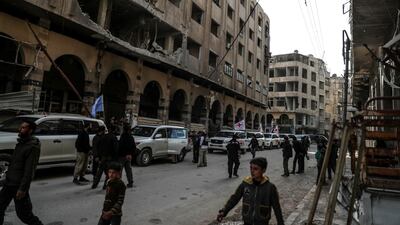
People walk along an aid convoy of trucks as they arrive in Douma, in Eastern Ghouta, Syria, on March 5, 2018. Mohammed Badra / EPA -

A convoy of Syrian Arab Red Crescent (SARC) trucks arrive in Douma, in Eastern Ghouta, Syria, on March 5, 2018. Mohammed Badra / EPA -
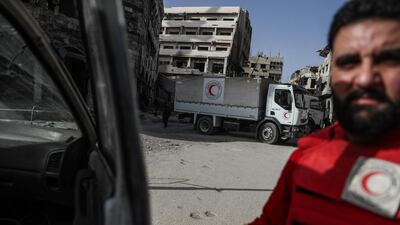
Volunteers with Syrian Arab Red Crescent (SARC) unload aid trucks in Douma, in Eastern Ghouta, Syria, on March 5, 2018. Mohammed Badra / EPA -
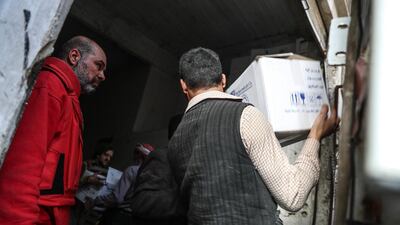
Volunteers with Syrian Arab Red Crescent (SARC) unload aid trucks in Douma, in Eastern Ghouta, Syria, on March 5, 2018. Mohammed Badra / EPA -
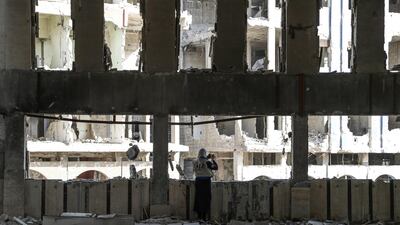
A woman from the World Food Program (WFP) takes pictures after meeting with civilian activists and local council of Douma to discuss the civil situation in Douma, in Eastern Ghouta, on March 5, 2018.Mohammed Badra / EPA -
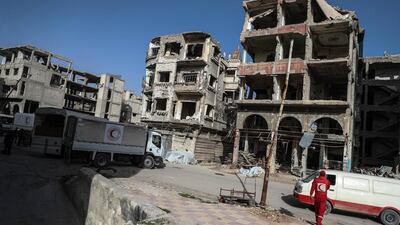
Volunteers with Syrian Arab Red Crescent (SARC) walk to unload aid trucks in Douma, in Eastern Ghouta, Syria, on March 5, 2018.Mohammed Badra / EPA


The UN's refugee agency UNHCR said the convoy was in the town of Douma for nearly nine hours before it cut short its mission.
The UN Security Council will on Wednesday hold urgent talks on the failure of a 30-day ceasefire. France and Britain requested the meeting that will be held behind closed doors at 1500 GMT.
On Tuesday residents of eastern Ghouta were digging deeper underground into their makeshift shelters, amid fears of intensified fighting. Many have largely stayed in basements since the assault began.
“Basements are the only option for people for two reasons: first, it is less dangerous, second, most houses have been fully or partly destroyed,” said one resident of the area who asked to remain anonymous.
Monday's convoy was delivering "health and nutrition supplies, along with food for 27,500 people in need," OCHA said.
According to NGO Save the Children President Bashar Al Assad's regime removed surgical kits and insulin from the delivery. Primary medical equipment is scarce, making it hard for doctors to treat patients.
"Doctors say they have to reuse bandages and needles on multiple patients as there simply aren't enough to go round," Save the Children said.
-

Several destroyed buildings in Douma, in the rebel enclave of Eastern Ghouta on the outskirts of Damascus on March 5, 2018. Amer Almohibany / AFP -
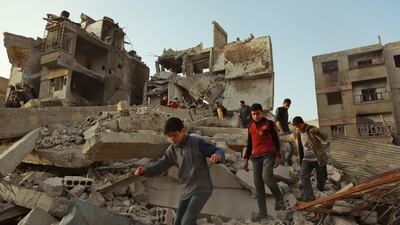
Syrian civilians walk above the rubble of destroyed buildings in the rebel enclave of Eastern Ghouta on March 5, 2018 on the outskirts of Damascus. Hamza Al-Ajweh / AFP -
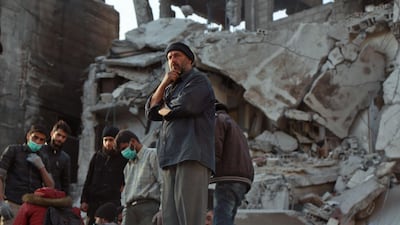
A Syrian civilian watches as civil defence volunteers work on recovering a body from the rubble of a building in the rebel enclave of Eastern Ghouta on March 5, 2018 on the outskirts of Damascus. Hamza Al-Ajweh / AFP -

An UNHCR aid convoy drives through the besieged town of Douma, Eastern Ghouta, Damascus. Bassam Khabieh / Reuters -

A boy stands as an aid convoy of Syrian Arab Red Crescent drives through the besieged town of Douma, Eastern Ghouta, Damascus, Syria on March 5, 2018. Bassam Khabieh / Reuters -
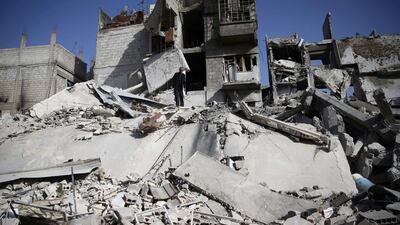
A man stands on the rubble of a damaged building at the besieged town of Douma, Eastern Ghouta, Damascus, Syria on March 5, 2018. Bassam Khabieh / Reuters -
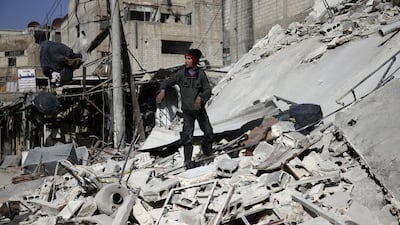
A boy stands on the rubble of a damaged building at the besieged town of Douma, Eastern Ghouta, Damascus, Syria on March 5, 2018. Bassam Khabieh / Reuters -

A man walks on the rubble of damaged buildings at the besieged town of Douma, Eastern Ghouta, Damascus, Syria on March 5, 2018. Bassam Khabieh / Reuters -
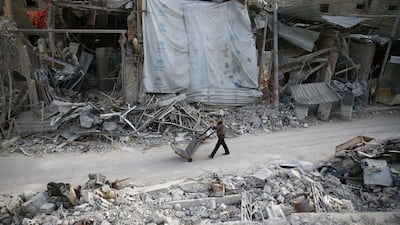
A man pushes a cart past damaged buildings at the besieged town of Douma, Eastern Ghouta, Damascus, Syria on March 5, 2018. Bassam Khabieh / Reuters


"Some 400,000 innocent civilians are trapped with no food, water or medicine. They must be protected," said Sonia Khush, the group's Syria director.
"The items (removed) included trauma kits and other life-saving supplies," said Ms Tom, calling for a solution ahead of a planned Thursday aid delivery.
The United States on Sunday condemned the assault, accusing Moscow of killing "innocent civilians" and ignoring a UN resolution calling for a 30-day cessation of hostilities.
Also on Monday fresh reports of a chlorine gas attack in Ghouta emerged. Just around 11pm local time, activists on Twitter and a media centre in the city of Hamorouria began reporting another chemical attack allegedly carried out by the Assad regime forces.
The Hamorouria media centre reported 30 casualties – 28 of them women and children – who were evacuated “following an attack by regime forces using chlorine gas in the residential part of the city”, a Facebook post read.
Civilians suffered breathing difficulties following a strike by a military aircraft but there was no way to specify the cause of the illnesses.
This was the fourth chlorine gas attack suspected in Eastern Ghouta this year and eighth in Syria during the civil war.
The UN Human Rights Council on Monday ordered investigators to examine the latest violence and condemned "the indiscriminate use of heavy weapons and aerial bombardments against civilians, and the alleged use of chemical weapons in Eastern Ghouta".
_______________
Read more:
White Helmets chief warns Eastern Ghouta worse than Aleppo
In eastern Ghouta rubble, a father looks for his son
Syrian government recaptures 'more than 25%' of Eastern Ghouta
_______________
Regime troops and allied forces have advanced rapidly across farmland in the east of the enclave in recent days, the Syrian Observatory for Human Rights said, leaving them in control of 40 percent of the area.
Armed groups there, one of them made up of fighters from Al-Qaeda's ex-affiliate, have been firing mortar rounds and rockets on adjacent neighbourhoods of Damascus, killing around 20 civilians in two weeks.
Moscow has offered safe passage to non-combatants wishing to leave Eastern Ghouta during daily "humanitarian pauses", but the UN and the Observatory say no Syrian civilians have left the enclave since the first break in fighting took effect last week.
Rebels rejected an amnesty offer by Russia as “forced displacement” on Tuesday as the United Nations said it would attempt to resume aid delivery to besieged suburbs of Damascus later this week.
Damascus and Moscow have accused rebels of preventing civilians from leaving in order to use them as human shields.
Observers have said advances on the ground might spark fresh efforts to negotiate an evacuation to Idlib, a northern province now hosting defeated anti-government forces from across Syria.
In December 2016, tens of thousands of rebels and civilians were evacuated from the last rebel held neighborhoods in Aleppo, on the eastern side of Syria’s largest city. Many of them went to Idlib, including Wissam Zarka, who refers to what happened then as “forced displacement.”
“I had no choice. It was either to be killed, arrested or evacuated,” said Mr Zarka, a 35-year-old teacher who now lives with his family in a town called Sarmada. “All my in-laws who stayed in Aleppo were arrested, in fact. They thought it was okay because they were not against the regime, they were just staying in East Aleppo.”
"Two were arrested right away, one was arrested two weeks ago," Mr Zarka told The National.
Also on Tuesday, the Turkish government announced it would build camps for 170,000 people in parts of northern Syria under its control, including Idlib.
It was unclear who the camps might house, but the fighting has displaced thousands as villages near the border have been heavily damaged by aerial and artillery bombardment.

