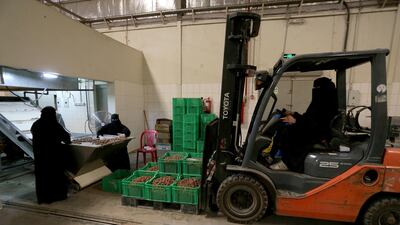
Life has dramatically changed in recent years for the more than 100 Saudi women now working the production lines of the kingdom’s second-largest industrial area.
For many this is their first job and just a few years ago it would have been almost impossible.
But investment and encouragement from the state is leading more women into the workforce as the kingdom seeks to boost private-sector jobs and diversify the labour market.
This year, Mishaal Al Balawi, an official at the Saudi mission to the UN in Geneva, said the kingdom aimed to provide jobs for about 1 million Saudi women in the next decade as part of its Vision 2030 reform plan.
The kingdom has encouraged Saudi women to enter dozens of male-dominated fields.
“The kingdom has banned discrimination against women in jobs and ensured equalisation of women with men in their wages, and enhanced awareness about the importance of women’s participation in the employment market,” Mr Al Balawi said.
Factory worker Salwa Fahad, 23, said: “This is my first job and I am so happy to learn new skills and be trained.
“The hands-on training makes me feel empowered and confident. You can only read so much but here we are given the chance to create something ourselves.”
Others say finding work in the factories of Sudair Industrial City, 130 kilometres north of Riyadh, has offered a vital lifeline to families.
Salma Al Rashid, Women 20 sherpa and chief advocacy officer of Al Nahda Philanthropic Society for Women, said one of the goals of Vision 2030 was to accelerate women’s representation in the labour market and leadership positions.
Rania Nashar is chairwoman of the Empower Alliance, launched at the G20 Osaka Summit in 2019 to promote the advancement of women in the private sector.
“It has been a remarkable year for gender equality and women empowerment," Ms Nashar said.
"Together, we will make the difference in this field and support Empower in ensuring gender equality.”
Asiya Saif, also a factory worker, said: “I am the sole breadwinner in the family. I pay for my child’s school fees, our rent and help my family.
“But the only way this was possible is because the government is helping us secure jobs, even in remote areas.
"They give us transport and childcare services, which help me and my friends go to work every day."
But the encouragement does not just come from the state, says Amu Hamza, a factory worker in the industrial city.

"I am excited to come to work every day where we get to work in a safe and friendly environment, but also have the support of our supervisors and boss who encourage us to learn new skills," she told The National.
There are now female workers who specialise in production management and operating machinery used to take products to warehouses.
They also work in packaging, organising and product quality management.
There are factories completely run by women, including supervisors, officials and employees on production lines, said Qusay Abdul Karim, the spokesman at the Saudi Authority for Industrial Estates and Technology Zones.
Also known as Modon, the authority oversees Sudair Industrial City.
Mr Abdul Karim told The National that Modon was trying to enhance the role of women in the economy.
Modon wants to encourage female investment into the 35 industrial cities that it supervises throughout the kingdom.
“Since its inauguration in 2016, Modon has been supporting the developmental role of women as an active component in the national economy, and enriching its production base by relying on industry,” Mr Abdul Karim said.
He said this included designing worksites to provide needed services to female employees.
“[It means] paying attention to details such as car parking areas, medical and recreational centres, while encouraging investment in everything that facilitates women's work such as transportation and nurseries, among others,” he said.
Under Vision 2030, Saudi Arabia’s Crown Prince Mohammed bin Salman has committed to increasing female participation in the workforce from about 20 per cent today to more than 40 per cent.

"In the past, Saudi women could not travel without a permit, could not attend sports and cultural events, couldn't drive a car, or practise a lot of work and could not solve their issues without a guardian," Prince Mohammed said last week.
"The Saudi woman has suffered from this situation for decades. Today, the Saudi woman enjoys an unprecedented phase of empowerment.
"Today, the Saudi woman is effectively a partner with the Saudi man in the development of our nation without discrimination."
He said tackling unemployment is one of the country's main aims.
"Increasing employment rates is the top priority of the government since work has begun, according to Vision 2030, to reform the labour market and make available more jobs for male and female citizens."
Prince Mohammed said women represented 64 per cent of the total unemployment rate and that "our next goal will be to improve the citizens' income".
On the eve of the G20 Riyadh Summit, Dr Thoraya Obaid, chairwoman of W20 for 2020, said: “It is time to empower women in the kingdom in line with Vision 2030”.
Kholoud Albatarjee, a Saudi sculptor and artist in Jeddah, told The National that the changes to women's roles in society were evident everywhere.
“The vision of [Prince Mohammed] is for everyone to see," Ms Albatarjee said.
"We have women who are top-ranking officials, even a sherpa at the G20, lawyers, ministers and top-ranking officials in the country.
"We have women working on production lines, to flying planes and making executive decisions across the board.
"This is a new era, this is a dream come true for Saudi women."

