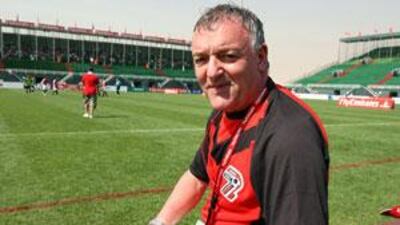
Manchester United legend Lou Macari is using glamping pods as accommodation for homeless people. The National

Former Scotland footballer Lou Macari creates glamping pods for homeless


Nicky Harley
  • English
  • Arabic

Former Scotland international footballer Lou Macari transformed an empty factory into a homeless shelter containing wooden pods.

He came up with the idea after Covid-19 restrictions led to the closure of his centre in the English city of Stoke, which offered dormitory-style accommodation for vulnerable people.

The former Manchester United star set up the Macari Centre four years ago to provide emergency shelter and safe, short-term accommodation for people in need of support.

But last March it had to close owing to the risk of Covid-19 contagion, and 40 residents were moved to hotels.

In an attempt to keep them together, Mr Macari devised the idea of putting wooden glamping pods, fitted with heaters and beds, inside a factory the size of a football field.

“The pods really caught the imagination of the homeless people we bring in to the centre," he said.

"By having their own space, guests can start regaining a degree of independence and responsibility to ensure their room is kept clean, hygienic and well maintained.

"It is also a safe space where guests can take time out by themselves if they feel the need."

Macari, who represented Scotland in the 1978 World Cup and played more than 400 games for Manchester United, said the pods had made a huge difference to the residents.

“They’ve gone from untidy people, to showing a great deal of pride in their pods," he told the BBC.

“Because there’s a number outside, they can now go to the job centre, they can say, 'number 4 Regent Road and the house I live in is number 5'.

“The change it’s made is incredible."

The new factory pods are 300 yards from the original Macari Centre in Stoke.

Macari, who managed football clubs including Celtic, Huddersfield and Stoke City, came up with the idea after noticing there were a lot of homeless people in the city who needed help.

“In 2016, a news bulletin about the number of homeless people in Britain drove me out of the house and on to the streets of Stoke-on-Trent to find out for myself what life was like for someone who was homeless," he said.

"Having seen the evidence, I made up my mind, there and then, that I would do everything in my power to help those that find themselves homeless work towards better lives."

Stoke City chairman Peter Coates, who twice employed Macari as his manager in the 1990s, praised his work.

“What he does there is fantastic and tells you everything about the man," he said.

"He has a very strong social conscience and uses his position to do good in the community, and personally, I am full of admiration for what he is achieving.”


Going grey? A stylist's advice

If you’re going to go grey, a great style, well-cared for hair (in a sleek, classy style, like a bob), and a young spirit and attitude go a long way, says Maria Dowling, founder of the Maria Dowling Salon in Dubai.
It’s easier to go grey from a lighter colour, so you may want to do that first. And this is the time to try a shorter style, she advises. Then a stylist can introduce highlights, start lightening up the roots, and let it fade out. Once it’s entirely grey, a purple shampoo will prevent yellowing.
“Get professional help – there’s no other way to go around it,” she says. “And don’t just let it grow out because that looks really bad. Put effort into it: properly condition, straighten, get regular trims, make sure it’s glossy.”

THE SPECS

Engine: 1.5-litre turbocharged four-cylinder

Transmission: Constant Variable (CVT)

Power: 141bhp 

Torque: 250Nm 

Price: Dh64,500

On sale: Now

Mercer, the investment consulting arm of US services company Marsh & McLennan, expects its wealth division to at least double its assets under management (AUM) in the Middle East as wealth in the region continues to grow despite economic headwinds, a company official said.

Mercer Wealth, which globally has $160 billion in AUM, plans to boost its AUM in the region to $2-$3bn in the next 2-3 years from the present $1bn, said Yasir AbuShaban, a Dubai-based principal with Mercer Wealth.

Within the next two to three years, we are looking at reaching $2 to $3 billion as a conservative estimate and we do see an opportunity to do so,” said Mr AbuShaban.

Mercer does not directly make investments, but allocates clients’ money they have discretion to, to professional asset managers. They also provide advice to clients.

“We have buying power. We can negotiate on their (client’s) behalf with asset managers to provide them lower fees than they otherwise would have to get on their own,” he added.

Mercer Wealth’s clients include sovereign wealth funds, family offices, and insurance companies among others.

From its office in Dubai, Mercer also looks after Africa, India and Turkey, where they also see opportunity for growth.

Wealth creation in Middle East and Africa (MEA) grew 8.5 per cent to $8.1 trillion last year from $7.5tn in 2015, higher than last year’s global average of 6 per cent and the second-highest growth in a region after Asia-Pacific which grew 9.9 per cent, according to consultancy Boston Consulting Group (BCG). In the region, where wealth grew just 1.9 per cent in 2015 compared with 2014, a pickup in oil prices has helped in wealth generation.

BCG is forecasting MEA wealth will rise to $12tn by 2021, growing at an annual average of 8 per cent.

Drivers of wealth generation in the region will be split evenly between new wealth creation and growth of performance of existing assets, according to BCG.

Another general trend in the region is clients’ looking for a comprehensive approach to investing, according to Mr AbuShaban.

“Institutional investors or some of the families are seeing a slowdown in the available capital they have to invest and in that sense they are looking at optimizing the way they manage their portfolios and making sure they are not investing haphazardly and different parts of their investment are working together,” said Mr AbuShaban.

Some clients also have a higher appetite for risk, given the low interest-rate environment that does not provide enough yield for some institutional investors. These clients are keen to invest in illiquid assets, such as private equity and infrastructure.

“What we have seen is a desire for higher returns in what has been a low-return environment specifically in various fixed income or bonds,” he said.

“In this environment, we have seen a de facto increase in the risk that clients are taking in things like illiquid investments, private equity investments, infrastructure and private debt, those kind of investments were higher illiquidity results in incrementally higher returns.”

The Abu Dhabi Investment Authority, one of the largest sovereign wealth funds, said in its 2016 report that has gradually increased its exposure in direct private equity and private credit transactions, mainly in Asian markets and especially in China and India. The authority’s private equity department focused on structured equities owing to “their defensive characteristics.”

Who's who in Yemen conflict

Houthis: Iran-backed rebels who occupy Sanaa and run unrecognised government

Yemeni government: Exiled government in Aden led by eight-member Presidential Leadership Council

Southern Transitional Council: Faction in Yemeni government that seeks autonomy for the south

Habrish 'rebels': Tribal-backed forces feuding with STC over control of oil in government territory

UAE currency: the story behind the money in your pockets