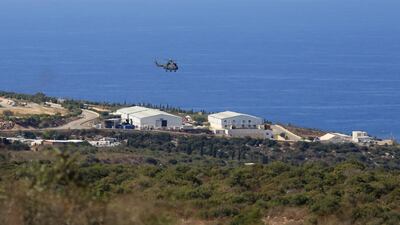
Lebanon and Israel, two countries technically still at war, have been holding indirect talks since 2020 to agree on their shared maritime border, though the US-mediated efforts repeatedly stalled in the past years.
The fact that there is no clear border is an issue that has lingered for decades. It is still used today by Hezbollah to justify its armed confrontation against Israel that it says occupies Lebanese lands despite retreating amid a bloody insurgency in 2000.
Yet the talks are focused not on the land frontier, where over 10,000 UN peacekeepers try to maintain calm, but over the maritime border.
The reason these two long-time adversaries have finally sat down? Potential oil and gas.
What is the maritime border dispute about?
The area of the Eastern Mediterranean off the coast of Israel and Lebanon covers about 860 square kilometres and appears to contain vast reserves of oil and gas.
Known as the Levantine Basin, the area overlaps with the territorial waters of Lebanon, Israel, Syria, and Cyprus. While both Israel and Cyprus already have rigs drilling and extracting from the basin, there are — as yet — no proven reserves in Lebanon, but they are starting to look.
Because Lebanon does not recognise Israel and both sides are technically still at war, rival claims for oil and gas exploration have created a fraught political atmosphere.
In 2010, the US Geological Survey released a report on the energy reserves in the area, which estimated the Levantine Basin might hold oil reserves totalling 1.7 billion barrels of oil, in addition to 122 trillion cubic feet of gas.
This is a huge reserve of energy — Iraq, for example, is thought to have 112 trillion cubic feet of gas.
This is now the contested prize, an asset former Lebanese Energy Minister Gibran Bassil claimed back in 2013 could supply the country with electricity “for the next 99 years” through thermal power.
Such claims are viewed as wild exaggerations by Lebanese oil and gas experts, who caution against believing politicians eager to find quick-fix solutions to Lebanon's long-standing electricity issues.
More recently, Israel’s Energy Ministry claimed that the annual value of gas for Lebanon would be in the region of $6bn, a potentially game-changing sum of money for the country — if it is spent effectively.
The US has been pressing for talks since 2012, and the two sides sat down together for the first time on October 14 2020. They met again on October 29 at a UN base under US mediation in Lebanon’s border town of Naqoura.
Mediators are necessary because it is illegal for Israeli and Lebanese officials to speak directly. The two countries have no diplomatic ties and their borders are closed.
Since then, Mr Hochstein met with Israeli Energy Minister Karine El Harrar to discuss the dispute once again before Lebanon’s parliamentary elections scheduled for May 15.
Mr Hochstein has privileged a shuttle diplomacy approach by travelling to Beirut and Jerusalem, where he meets top officials from both sides.
What are the claims of each side?
In 2010, Lebanon outlined its proposed Exclusive Economic Zone (EEZ), and submitted the proposal to the United Nations, setting the boundary 131km into the Mediterranean, equidistant between neighbouring countries.
The following year, Israel submitted its own proposed EEZ, but placed its suggested border 16km inside the proposed Lebanese zone.
This created an 860 square kilometre patch of disputed ocean.
Since then, the dispute has become a highly contested political issue within Lebanon. In the most recent talks, the Lebanese delegation has increased its territorial claim by an additional 1,430 square kilometres.
The powerful Iran-linked Hezbollah party, which is part of the Lebanese government and also has a large armed group, has long complicated talks by preventing direct negotiations with Israel.
The organisation has acquiesced to mediation since Lebanon’s economy went into free fall last year, leaving the government scrambling for funds amid one of the sharpest economic declines in modern history.
Why now?
So the US has been pushing since 2012 to resolve the issue over the border, but two things have pushed the Lebanese — and Israelis — to agree to meet now.
First off, Lebanon is broke. It has the world's third-highest debt-to-GDP ratio and without an unseen miraculous level of economic growth over years, it has little chance of paying this off alone.
So the potential for tapping into oil and gas is very attractive.
Secondly, after years of talks and planning, Lebanon finally awarded its first oil and gas exploration rights in 2018.
A consortium of France's Total, Italy' Eni and Russia's Novatek bought the rights to search for reserves in two maritime blocs off the Lebanese coast. While 'bloc 4' is off the coast north of Beirut, 'bloc 9' falls partially within the contested maritime zone.
While the consortium has said this should not be an issue to the exploration — they are not searching within the contested zone — it could become a problem if reserves are found.
Israel and Lebanon — and the consortium — want clarity on this matter urgently. This is especially true as Israel’s Karish gasfield lies not far from the disputed zone giving more hope that bloc 9 could yield results.
Israel in June also licensed their own “bloc 72” that lies next to the disputed zone.
Lebanese officials condemned this as an infringement of their country’s rights and there have long been unsubstantiated claims in Beirut that Israel’s far more advanced oil industry will seek to extract any and all reserves in the area before Lebanon can get a look in.
Lebanon relaunched a second offshore oil and gas licensing round for eight remaining blocs on Friday, with the deadline for submission of bids set for June 15, 2022.
So far, no viable reserves have been found in Lebanon.
Could the talks mean normalisation of ties between Lebanon and Israel?
For now, this is unlikely. Speaking on Israeli public TV, Israeli Energy Minister Yuval Steinitz remarked: “This isn’t a negotiation for peace and normalisation.”
Mr Steinitz added that any durable agreement would, however, be “for the benefit of both peoples.”
With strong political pressure in Lebanon against expanding the negotiations to cover other issues, we should not expect further talks to make headway soon.
Other points of contention remain unresolved, including a long-running land border dispute following the Israeli occupation of southern Lebanon in the early 1980s.
For Beirut, there is also the right of return for the tens of thousands of Palestinian refugees displaced by the creation of Israel who still live in Lebanon. Resolving that requires a settlement to the wider Arab-Israeli conflict.
The daughter of Lebanese President Michel Aoun caused controversy in October 2020 when she told local television that personally, she would not be against further talks.
“Are we supposed to stay in a state of war? I don't have doctrinal differences with anyone, I have political differences,” she said.
Going forward, we can expect the US and UN will not be giving up on bringing the two sides together once again.
Protests over Lebanon's economic crisis — in pictures
-
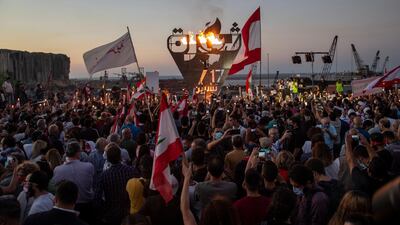
Lebanese anti-government protesters carry placards and hold a torch as they gather in front of a statue, representing the torch of the revolution, to mark the first anniversary of the anti-government protests, near the Beirut port. EPA -
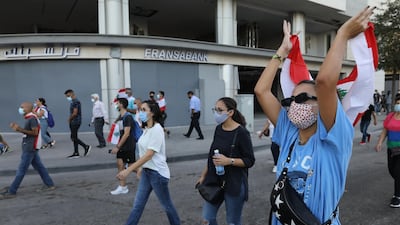
People wave Lebanese flags and chant to mark the first anniversary of anti-government protests in Beirut. Getty Images -
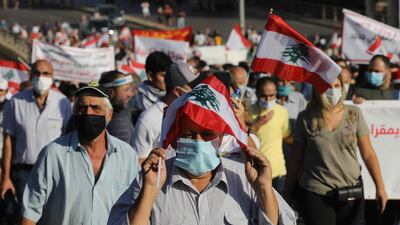
People wave Lebanese flags and chant to mark the first anniversary of anti-government protests. Getty Images -

People walk past a "Hope" graffiti painted on a fenced off entrance of a hotel that was damaged by the August 4 seaport blast on the first anniversary of anti-government protests. Getty Images -

People hold Lebanese flags and lit candles to mark the first anniversary of anti-government protests. Getty Images -
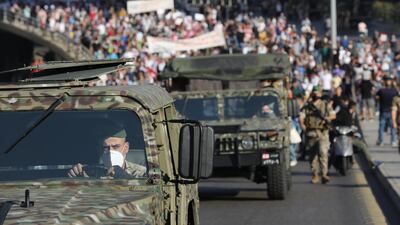
Lebanese army vehicles escort crowds walking over a bridge linking the city on the first anniversary of anti-government protests. Getty Images -
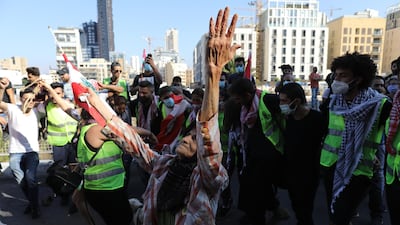
People wave Lebanese flags and chant to mark the first anniversary of anti-government protests. Getty Images -
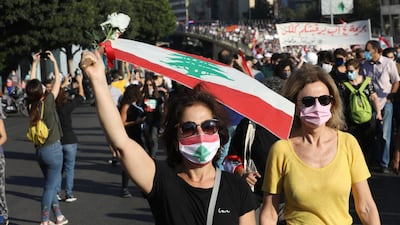
People wave Lebanese flags and chant to mark the first anniversary of anti-government protests. Getty Images -
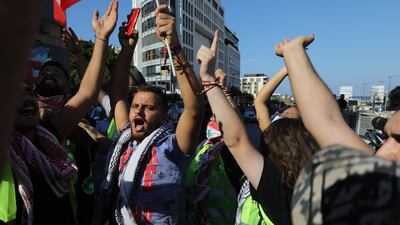
People wave Lebanese flags and chant to mark the first anniversary of anti-government protests. Getty Images -
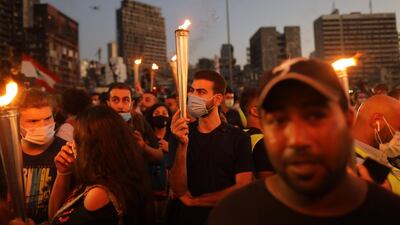
People hold Lebanese flags and lit candles to mark the first anniversary of anti-government protests. Getty Images -
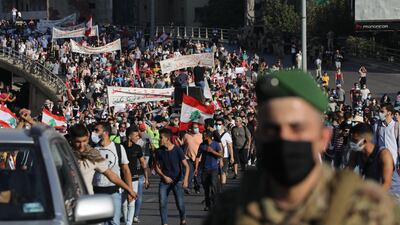
Lebanese army vehicles escort crowds walking over a bridge linking the city on the first anniversary of anti-government protests. Getty Images -
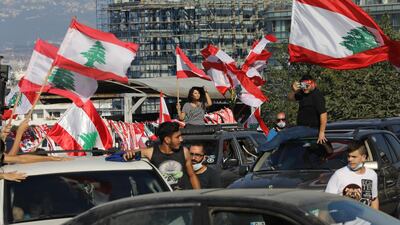
People wave Lebanese flags and chant to mark the first anniversary of anti-government protests. Getty Images -
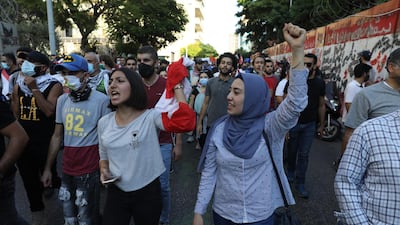
People hold Lebanese flags and chant as they mark the first anniversary of anti-government protests. Getty Images -
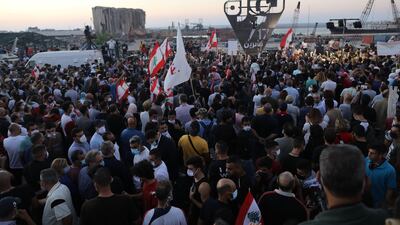
People wave Lebanese flags and chant to mark the first anniversary of anti-government protests with a background of the destroyed silos at Beirut port. Getty Images



