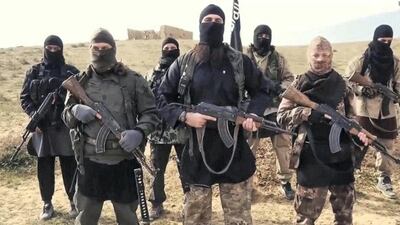
ISIS was ousted last year from its former strongholds in Iraq and Syria

European countries scrambling to adopt new terror laws before ISIS fighters return


Nicky Harley
  • English
  • Arabic

A terrorism expert says a growing number of countries across Europe are rushing to introduce new terror laws as they accept the inevitability of ISIS fighters returning.

Tanya Mehra, a senior research fellow at the International Centre for Counter-Terrorism in The Hague, says the repatriation of Foreign Terrorist Fighters (FTFs) is the “only way forward”.

The Syrian Democratic Forces are holding around 2,000 FTFs in prisons in Syria and a further 23,000 women and children in camps.

European countries are under pressure to find a solution to the issue of ISIS fighters after the withdrawal of US troops a year ago.

Increased military operations by Turkey saw it begin a repatriation programme and announce it was “not a hotel” for ISIS detainees.

More than 70 women and children have been returned to their counties of origin so far.

Speaking in a webinar hosted by the Counter Extremism Project, Ms Mehra said many European politicians are against the repatriation of their citizens, fearing they will commit atrocities.

But she argued doing nothing will lead to more escapes and the unmonitored return of fighters to Europe.

“Countries like Austria, Belgium and the UK have stripped some citizens of their nationalities,” she said.

“In the Netherlands 11 people have been deprived of their nationalities since 2017.

“But there is a shift taking place in Europe, and several countries, Sweden, Germany, France and the Netherlands, have been looking at how their crimes can be prosecuted as international crimes which could provide longer sentences.

“A few FTFs have been prosecuted for pillaging, recruitment of their own children and for war crimes, or for posing next to dead fighters, slavery and human trafficking.

“The tool kit for prosecuting is much larger than just prosecution for terrorism offences and is helped by the increasing use of battlefield evidence.

“There is much more guidance now on how battlefield evidence can be used.

“If FTFs are left there is a chance they will further radicalise or escape and return to European soil years later. We owe it to the victims to bring the perpetrators to justice and we cannot dump the problem on to others.”

Ms Mehra said a major issue facing nations is the repatriation of children of ISIS fighters but she urged states to put trust in their own institutions to safeguard them.

“In the Netherlands 90 per cent of the children of ISIS fighters are aged under 9,” she said.

“We need to stop dehumanising them and treat them as citizens, like what has happened in Bosnia and Kazakhstan. We can look at these nations and see what has worked and what has not and we should have faith in our legal institutions.

“We should invest in more research for rehabilitation programmes to see what does and does not work. Social services and intelligence agencies in many EU countries are ready and have been ready for a long time to repatriate. Management is safer than leaving them all out there, repatriation is the way forward.

“Only then can we help to undermine abandonment and radicalisation and bring terrorists to justice and bring care and assistance to the children that need it.”

Last year, Kazakhstan carried out a number of operations to repatriate more than 600 of its citizens from Syria.


Pharaoh's curse

British aristocrat Lord Carnarvon, who funded the expedition to find the Tutankhamun tomb, died in a Cairo hotel four months after the crypt was opened.
He had been in poor health for many years after a car crash, and a mosquito bite made worse by a shaving cut led to blood poisoning and pneumonia.
Reports at the time said Lord Carnarvon suffered from “pain as the inflammation affected the nasal passages and eyes”.
Decades later, scientists contended he had died of aspergillosis after inhaling spores of the fungus aspergillus in the tomb, which can lie dormant for months. The fact several others who entered were also found dead withiin a short time led to the myth of the curse.

The specs

Engine: 2.0-litre four-cylinder turbo

Power: 178hp at 5,500rpm

Torque: 280Nm at 1,350-4,200rpm

Transmission: seven-speed dual-clutch auto

Price: from Dh209,000 

On sale: now

Switching%20sides
%3Cp%3EMahika%20Gaur%20is%20the%20latest%20Dubai-raised%20athlete%20to%20attain%20top%20honours%20with%20another%20country.%0D%3C%2Fp%3E%0A%3Cp%3E%3Cstrong%3EVelimir%20Stjepanovic%20(Serbia%2C%20swimming)%20%3C%2Fstrong%3E%0D%3Cbr%3EBorn%20in%20Abu%20Dhabi%20and%20raised%20in%20Dubai%2C%20he%20finished%20sixth%20in%20the%20final%20of%20the%202012%20Olympic%20Games%20in%20London%20in%20the%20200m%20butterfly%20final.%20%0D%3C%2Fp%3E%0A%3Cp%3E%3Cstrong%3EJonny%20Macdonald%20(Scotland%2C%20rugby%20union)%20%3C%2Fstrong%3E%0D%3Cbr%3EBrought%20up%20in%20Abu%20Dhabi%20and%20represented%20the%20region%20in%20international%20rugby.%20When%20the%20Arabian%20Gulf%20team%20was%20broken%20up%20into%20its%20constituent%20nations%2C%20he%20opted%20to%20play%20for%20Scotland%20instead%2C%20and%20went%20to%20the%20Hong%20Kong%20Sevens.%20%0D%3C%2Fp%3E%0A%3Cp%3E%3Cstrong%3ESophie%20Shams%20(England%2C%20rugby%20union)%20%3C%2Fstrong%3E%0D%3Cbr%3EThe%20daughter%20of%20an%20English%20mother%20and%20Emirati%20father%2C%20Shams%20excelled%20at%20rugby%20in%20Dubai%2C%20then%20after%20attending%20university%20in%20the%20UK%20played%20for%20England%20at%20sevens.%20%0D%3C%2Fp%3E%0A
ULTRA PROCESSED FOODS

- Carbonated drinks, sweet or savoury packaged snacks, confectionery, mass-produced packaged breads and buns 

- Margarines and spreads; cookies, biscuits, pastries, cakes, and cake mixes, breakfast cereals, cereal and energy bars

- Energy drinks, milk drinks, fruit yoghurts and fruit drinks, cocoa drinks, meat and chicken extracts and instant sauces

- Infant formulas and follow-on milks, health and slimming products such as powdered or fortified meal and dish substitutes

- Many ready-to-heat products including pre-prepared pies and pasta and pizza dishes, poultry and fish nuggets and sticks, sausages, burgers, hot dogs, and other reconstituted meat products, powdered and packaged instant soups, noodles and desserts

Brief scoreline:

Liverpool 2

Keita 5', Firmino 26'

Porto 0

Mercer, the investment consulting arm of US services company Marsh & McLennan, expects its wealth division to at least double its assets under management (AUM) in the Middle East as wealth in the region continues to grow despite economic headwinds, a company official said.

Mercer Wealth, which globally has $160 billion in AUM, plans to boost its AUM in the region to $2-$3bn in the next 2-3 years from the present $1bn, said Yasir AbuShaban, a Dubai-based principal with Mercer Wealth.

Within the next two to three years, we are looking at reaching $2 to $3 billion as a conservative estimate and we do see an opportunity to do so,” said Mr AbuShaban.

Mercer does not directly make investments, but allocates clients’ money they have discretion to, to professional asset managers. They also provide advice to clients.

“We have buying power. We can negotiate on their (client’s) behalf with asset managers to provide them lower fees than they otherwise would have to get on their own,” he added.

Mercer Wealth’s clients include sovereign wealth funds, family offices, and insurance companies among others.

From its office in Dubai, Mercer also looks after Africa, India and Turkey, where they also see opportunity for growth.

Wealth creation in Middle East and Africa (MEA) grew 8.5 per cent to $8.1 trillion last year from $7.5tn in 2015, higher than last year’s global average of 6 per cent and the second-highest growth in a region after Asia-Pacific which grew 9.9 per cent, according to consultancy Boston Consulting Group (BCG). In the region, where wealth grew just 1.9 per cent in 2015 compared with 2014, a pickup in oil prices has helped in wealth generation.

BCG is forecasting MEA wealth will rise to $12tn by 2021, growing at an annual average of 8 per cent.

Drivers of wealth generation in the region will be split evenly between new wealth creation and growth of performance of existing assets, according to BCG.

Another general trend in the region is clients’ looking for a comprehensive approach to investing, according to Mr AbuShaban.

“Institutional investors or some of the families are seeing a slowdown in the available capital they have to invest and in that sense they are looking at optimizing the way they manage their portfolios and making sure they are not investing haphazardly and different parts of their investment are working together,” said Mr AbuShaban.

Some clients also have a higher appetite for risk, given the low interest-rate environment that does not provide enough yield for some institutional investors. These clients are keen to invest in illiquid assets, such as private equity and infrastructure.

“What we have seen is a desire for higher returns in what has been a low-return environment specifically in various fixed income or bonds,” he said.

“In this environment, we have seen a de facto increase in the risk that clients are taking in things like illiquid investments, private equity investments, infrastructure and private debt, those kind of investments were higher illiquidity results in incrementally higher returns.”

The Abu Dhabi Investment Authority, one of the largest sovereign wealth funds, said in its 2016 report that has gradually increased its exposure in direct private equity and private credit transactions, mainly in Asian markets and especially in China and India. The authority’s private equity department focused on structured equities owing to “their defensive characteristics.”

Dust and sand storms compared

Sand storm

  • Particle size: Larger, heavier sand grains
  • Visibility: Often dramatic with thick "walls" of sand
  • Duration: Short-lived, typically localised
  • Travel distance: Limited 
  • Source: Open desert areas with strong winds

Dust storm

  • Particle size: Much finer, lightweight particles
  • Visibility: Hazy skies but less intense
  • Duration: Can linger for days
  • Travel distance: Long-range, up to thousands of kilometres
  • Source: Can be carried from distant regions