
The AstraZeneca-Oxford Covid-19 vaccine should continue to be used, the World Health Organisation said, as the European Union threatened to block exports despite its use being suspended by much of the continent.
The WHO said the benefits of the vaccine outweighed its risks, as it became the second health authority to endorse the shot in as many days. Fears over its safety could derail vaccination programmes by creating public reluctance, experts warned.
Reports of blood clots in recipients of AstraZeneca’s vaccine prompted more than a dozen EU countries to suspend immunisation. Spanish health officials said on Wednesday they were investigating three cases of people who suffered a thrombosis after receiving the drug, one of whom died.
Lebanon's interim health minister said the country was suspending use of the AstraZeneca shot until international health authorities establish its safety.
The European Medicines Agency is due to provide a definitive assessment on Thursday but has previously insisted it is safe to use. Italy and France indicated they would lift suspensions if the vaccine were deemed safe.
A WHO expert group is assessing latest safety data and will communicate the findings once the review is completed.
The WHO said “it is routine for countries to signal potential adverse events following immunisation” in extensive vaccination campaigns. “This does not necessarily mean that the events are linked to vaccination itself, but it is good practice to investigate them.”
The EU's vaccination campaign struggled to get off the ground after delayed deliveries and a row with AstraZeneca even before safety concerns were raised.
Manufacturers contracted to supply member states must declare if they intend to export doses outside the bloc.
European Commission President Ursula von der Leyen accused AstraZeneca of delaying the continent’s vaccination campaign by failing to meet delivery targets.
She said 10 million doses were imported in the past six weeks by the UK, where the AstraZeneca-Oxford vaccine was made and has been administered to significantly more people than the average across EU countries.
"We are in the crisis of the century. If this situation does not change, we will have to reflect on how to make exports to vaccine-producing countries dependent on their level of openness,” Ms von der Leyen said.
"We will reflect on whether exports to countries which have higher vaccination rates than us are still proportionate."
EU countries face fierce criticism for comparatively slow distribution, lagging far behind vaccination programmes in Israel, the UAE, the US and Britain.
Germany should prepare for a “drastically more difficult” third wave of the coronavirus to infect unvaccinated people, a leading virologist said.
Prof Christian Drosten, director of the Institute of Virology at Charite Hospital in Berlin, said the more infectious UK variant was now the dominant strain in Germany, accounting for three in four cases.
He predicted a difficult situation for unvaccinated people over 50.
France is grappling with a steady increase in the number of new cases, leading to a heavy strain on the hospital system, especially in the capital where infection numbers have surged in the city and across the greater Paris region.
On Tuesday, the seven-day average of new cases rose above 25,000 for the first time since November 20.
"It seems to me that the time has come to consider new measures in the greater Paris region," French Prime Minister Jean Castex said.
He said he would receive the AstraZeneca vaccine “very quickly” if the EMA ruled it to be safe.
Italian Health Minister Roberto Speranza said he hoped the EMA could “give the clarifications and reassurances necessary to overcome the difficulties of the last days”.
The head of Italy’s medicines regulator, Nicola Magrini, previously suggested the decision to suspend use of AstraZeneca was a “political one”.
In the UK, Prime Minister Boris Johnson said he would soon be getting the AstraZeneca shot.
On Tuesday, the EMA’s chief said it was “firmly convinced” of the benefits of the AstraZeneca vaccine and there was no indication that it caused blood clots.
Prof Adam Finn of the University of Bristol said the opinions of the EMA had so far “been reassuring”.
In the UK, which has administered 11 million AstraZeneca doses, Health Minister Matt Hancock said there was “no evidence” the vaccine caused blood clots.
Dr Phil Bryan, the vaccine safety lead at the UK’s medicines regulator, said the “benefits of the vaccine in preventing Covid-19, with its associated risk of hospital admission and death, far outweigh the risks of side effects. People should go and get their Covid-19 vaccine when asked to do so".
“It is still the case that it has not been confirmed the reported blood clots were caused by the Covid-19 vaccine from AstraZeneca. Blood clots can occur naturally and are not uncommon,” he said.
Prof Jeremy Brown, a member of the UK’s joint committee on vaccination and immunisation, condemned the widespread suspensions of the drug, describing it as “not sensible” and “not logical”.
“There is the concern that what’s happening in Europe might make people in the UK less confident in the AstraZeneca vaccine, unnecessarily so because it’s perfectly safe,” he told ITV.
-
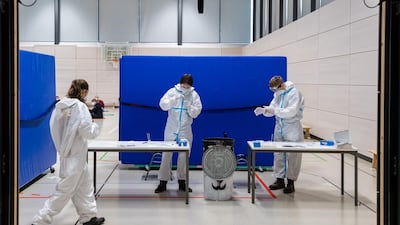
Workers administer rapid antigen tests to high school students at the Ehrenfried Walther von Tschirnhaus Gymnasium high school in Dresden, Germany. Getty Images -

An illustration of a syringe is used to indicate the city's vaccination centre to pedestrians in Osnabrueck, Germany. AP Photo -
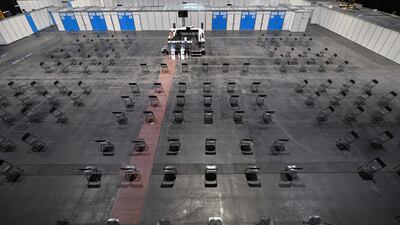
The vaccination centre at the Erfurt exhibition centre in Germany is deserted. After the suspension of AstraZeneca vaccinations, thousands of appointments were cancelled in Thuringia. AP Photo -

A person adds drops of a sample to the test device for a Covid-19 antigen rapid test in Berlin, Germany. AFP -

People walk down a crowded street in the Neukoelln neighbourhood of Berlin, Germany. AP Photo -
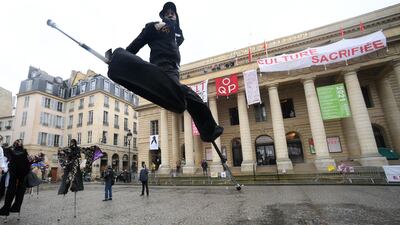
Dancers perform in front of the Theatre de l'Odeon in Paris, France. Workers have occupied the Theatre de l'Odeon since March 4 to protest against the French government's decision to close all theatres. Getty Images -
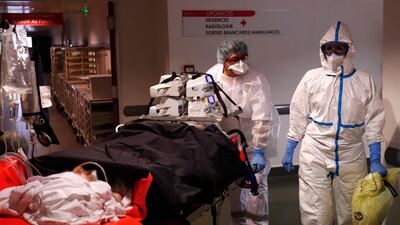
Hospital staff carry a Covid-19 patient at the Clinic du Millenaire, in Montpellier, France. EPA -
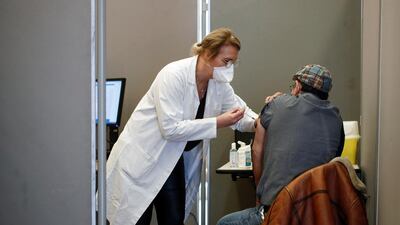
A healthcare worker administers a dose of the Pfizer-BioNTech vaccine at Paris 17th district city hall in Paris, France. Reuters -

Teresa Cabello, 88, waits in a seat before receiving a Pfizer-BioNTech Covid-19 vaccine in Pamplona, northern Spain. AP Photo -
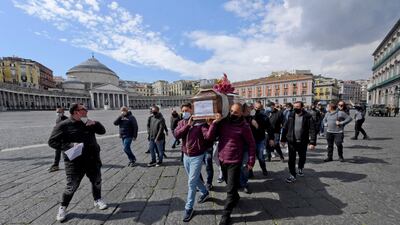
Taxi drivers stage a fake funeral for a taxi in a protest against the reduction of customers caused by restrictive measures aimed at stopping the spread of Covid-19 in the Campania Region in Naples, Italy. EPA -

Employees of the Lazio Region close the entrance of the new vaccination centre in Rome, Italy. AFP -

Customers makes purchases at an IKEA store in Amsterdam, the Netherlands. Due to the lifting of some coronavirus restrictions, stores can receive a maximum of 50 customers per time slot instead of two. AFP


Prof Brown said the move by the EU countries could lead to more deaths.
“It is confusing to understand why so many countries have decided to stop using the vaccine. Many of those countries are going through a third wave, and by stopping using the vaccine they’re actually causing more problems.
“By not using the vaccine, this is going to directly lead to an increased incidence of Covid infection and people will die as a consequence of these decisions,” he said.
Prof Stephen Evans of the London School of Hygiene and Tropical Medicine suggested it was “very likely” that at least some of the clotting disorders seen were a result of Covid-19 rather than the vaccine.
"Hence, even if there were a problem, acknowledged to be very rare with the AstraZeneca vaccine, the overall benefit would be so much greater than any speculative harm," he said.

