UK to adjust inoculation campaign to account for Ramadan


  • English
  • Arabic

The UK will adjust its coronavirus campaign to account for Ramadan, Vaccines Minister Nadhim Zahawi said on Tuesday.

Ministers are looking to future phases of the vaccine campaign after the top four priority groups, representing 15 million people, were offered a vaccine by Monday’s deadline.

Medical officials are considering whether people should be made priorities for vaccines based on their ethnicity and profession during the next stage of the staggered distribution strategy.

The proposal came as officials grow increasingly concerned over “a tsunami of misinformation” leading to public reluctance to take the vaccine.

Authorities have also raised concern over slow take-up of the vaccine among medical staff, while scientists have been forced to dispel claims that the coronavirus drug adversely affects fertility among women.

Mr Zahawi said those who were hesitant or outright refused to take the shot were “heavily skewed” towards minority groups.

He acknowledged that Muslims may be reluctant to receive their first shot because injection of the second dose would take place during Ramadan, which begins on April 12.

The UK allows for a 12-week delay between vaccine shots, so those who receive their first dose in the next few weeks would receive their second while they are fasting.

“Ramadan is something that we’ve got to make sure that the system adjusts to be able to deal with that,” he told Sky News.

“Faith leaders in the Muslim community have come out very clearly … they have come forward and said: “Take your vaccine, it protects you’.”

Mr Zahawi said that the government had plans in place for vaccine distribution during Ramadan, which begins on April 12, but did not say when they would be announced.

“We know that black and ethnic minority communities are disproportionately impacted by this virus, so come forward and take this first dose and we’ll make sure we accommodate any issues around Ramadan, or any other religious festival, to make sure that you can get your second dose safely and in the correct way,” he said.

Muslim authorities in the UK advised the faithful that taking the vaccine during Ramadan does not compromise the principle of fasting. Getty

The National asked the Department of Health for further comment on how it will deal with the issue.

The British Islamic Medical Association said it was acceptable to receive a coronavirus vaccine during Ramadan.

“Taking the Covid-19 vaccines currently licensed in the UK does not invalidate the fast, as per the opinion of Islamic scholars,” it said.

“Individuals should not delay their Covid vaccinations on the account of Ramadan.”

Mr Zahawi said 89 per cent of people took a vaccine in the UK when offered one, while 11 per cent were "vaccine hesitant".

He confirmed that the government had asked the vaccine taskforce - the Joint Committee on Vaccination and Immunisation - to study whether vaccines should be prioritised based on ethnicity and profession during the next phase.

Ministers are aiming to offer a vaccine to everyone aged over 50 and all adults in at-risk groups by May.

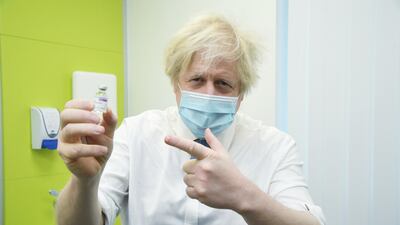
  • Britain's Prime Minister Boris Johnson holds a vial of AstraZeneca vaccine during a visit to a coronavirus vaccination centre in Orpington, South-East of London. Reuters
    Britain's Prime Minister Boris Johnson holds a vial of AstraZeneca vaccine during a visit to a coronavirus vaccination centre in Orpington, South-East of London. Reuters
  • Boris Johnson speaks to people during the visit to the Health and Well-being Centre in Orpington. Reuters
    Boris Johnson speaks to people during the visit to the Health and Well-being Centre in Orpington. Reuters
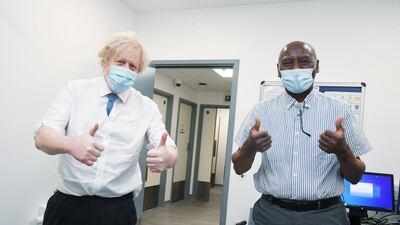
  • Boris Johnson gives thumbs up with Silvester Biyibi during the visit. Reuters
    Boris Johnson gives thumbs up with Silvester Biyibi during the visit. Reuters
  • A person gets off a mobile vaccination centre in Thamesmead, London. Reuters
    A person gets off a mobile vaccination centre in Thamesmead, London. Reuters
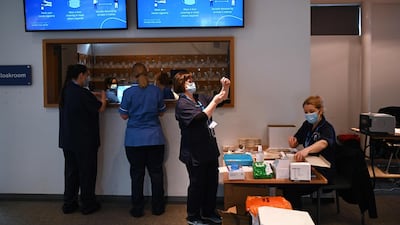
  • Healthcare professionals prepare doses of the vaccine at Chester Racecourse. Boris Johnson called Britain hitting a target of inoculating 15 million of the most vulnerable people with a first coronavirus jab "a significant milestone". AFP
    Healthcare professionals prepare doses of the vaccine at Chester Racecourse. Boris Johnson called Britain hitting a target of inoculating 15 million of the most vulnerable people with a first coronavirus jab "a significant milestone". AFP
  • A vaccinator talks with a patient in a booth at the vaccination centre set up at Chester Racecourse. AFP
    A vaccinator talks with a patient in a booth at the vaccination centre set up at Chester Racecourse. AFP
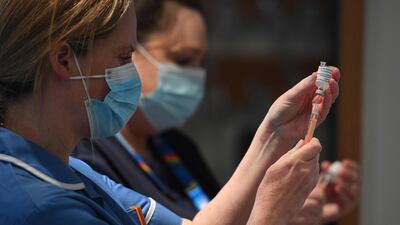
  • A healthcare professional draws up a dose of AstraZeneca vaccine in a syringe at the vaccination centre at Chester Racecourse. AFP
    A healthcare professional draws up a dose of AstraZeneca vaccine in a syringe at the vaccination centre at Chester Racecourse. AFP
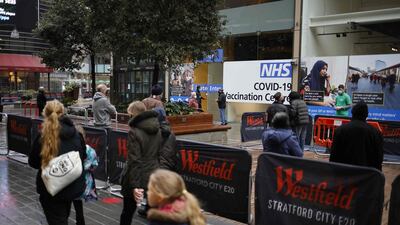
  • People queue to enter the NHS Covid-19 vaccination centre in Westfield Stratford City shopping centre in east London. AFP
    People queue to enter the NHS Covid-19 vaccination centre in Westfield Stratford City shopping centre in east London. AFP

“We think it’s right to ask the question over who should be prioritised next,” Mr Zahawi told the BBC.

However, government sources told The Telegraph that ethnicity was more likely to be targeted in the next phase rather than the type of worker - such as teachers, police officers or supermarket workers - because it could "create too much complication" and slow down vaccine distribution.

People from black and ethnic minority groups are more likely to die from Covid-19, data suggested.

Sir Simon Stevens, head of the NHS, promised that the pace of vaccination would double between now and April.

People aged 65 to 69 are being called to receive the vaccine after everyone in the top four groups was offered a shot.

Ministers have not yet set out how the vaccines will be prioritised among the remaining adults in the top nine categories - about 21 million people.


Ten tax points to be aware of in 2026

1. Domestic VAT refund amendments: request your refund within five years

If a business does not apply for the refund on time, they lose their credit.

2. E-invoicing in the UAE

Businesses should continue preparing for the implementation of e-invoicing in the UAE, with 2026 a preparation and transition period ahead of phased mandatory adoption. 

3. More tax audits

Tax authorities are increasingly using data already available across multiple filings to identify audit risks. 

4. More beneficial VAT and excise tax penalty regime

Tax disputes are expected to become more frequent and more structured, with clearer administrative objection and appeal processes. The UAE has adopted a new penalty regime for VAT and excise disputes, which now mirrors the penalty regime for corporate tax.

5. Greater emphasis on statutory audit

There is a greater need for the accuracy of financial statements. The International Financial Reporting Standards standards need to be strictly adhered to and, as a result, the quality of the audits will need to increase.

6. Further transfer pricing enforcement

Transfer pricing enforcement, which refers to the practice of establishing prices for internal transactions between related entities, is expected to broaden in scope. The UAE will shortly open the possibility to negotiate advance pricing agreements, or essentially rulings for transfer pricing purposes. 

7. Limited time periods for audits

Recent amendments also introduce a default five-year limitation period for tax audits and assessments, subject to specific statutory exceptions. While the standard audit and assessment period is five years, this may be extended to up to 15 years in cases involving fraud or tax evasion. 

8. Pillar 2 implementation 

Many multinational groups will begin to feel the practical effect of the Domestic Minimum Top-Up Tax (DMTT), the UAE's implementation of the OECD’s global minimum tax under Pillar 2. While the rules apply for financial years starting on or after January 1, 2025, it is 2026 that marks the transition to an operational phase.

9. Reduced compliance obligations for imported goods and services

Businesses that apply the reverse-charge mechanism for VAT purposes in the UAE may benefit from reduced compliance obligations. 

10. Substance and CbC reporting focus

Tax authorities are expected to continue strengthening the enforcement of economic substance and Country-by-Country (CbC) reporting frameworks. In the UAE, these regimes are increasingly being used as risk-assessment tools, providing tax authorities with a comprehensive view of multinational groups’ global footprints and enabling them to assess whether profits are aligned with real economic activity. 

Contributed by Thomas Vanhee and Hend Rashwan, Aurifer

Essentials

The flights
Etihad and Emirates fly direct from the UAE to Delhi from about Dh950 return including taxes.
The hotels
Double rooms at Tijara Fort-Palace cost from 6,670 rupees (Dh377), including breakfast.
Doubles at Fort Bishangarh cost from 29,030 rupees (Dh1,641), including breakfast. Doubles at Narendra Bhawan cost from 15,360 rupees (Dh869). Doubles at Chanoud Garh cost from 19,840 rupees (Dh1,122), full board. Doubles at Fort Begu cost from 10,000 rupees (Dh565), including breakfast.
The tours 
Amar Grover travelled with Wild Frontiers. A tailor-made, nine-day itinerary via New Delhi, with one night in Tijara and two nights in each of the remaining properties, including car/driver, costs from £1,445 (Dh6,968) per person.